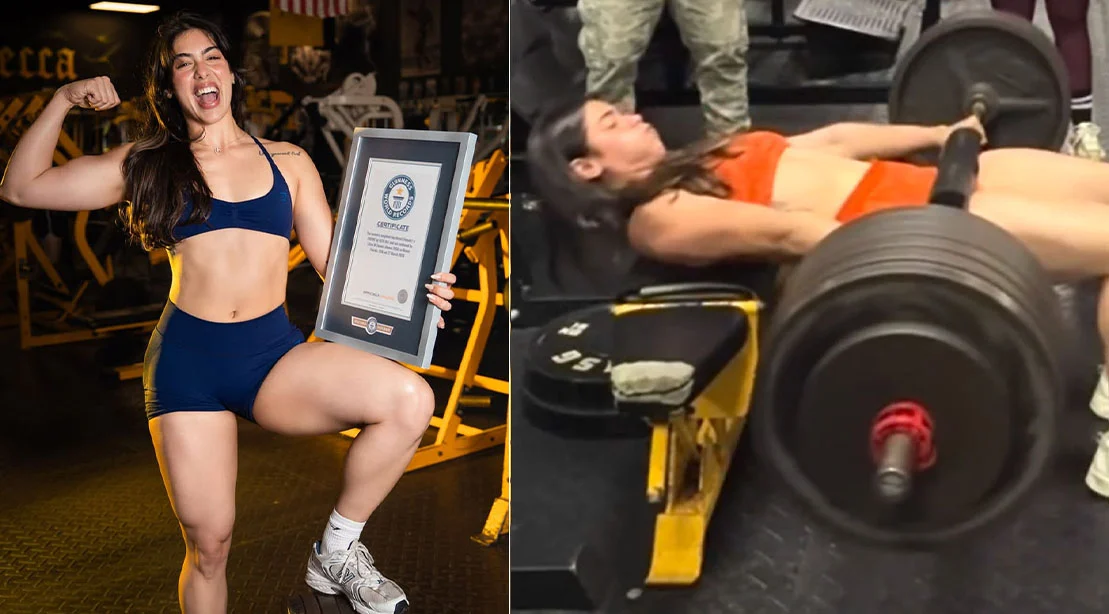
In the world of elite strength training, where marginal gains are often celebrated as major milestones, the pursuit of a world record is a lonely, grueling, and often thankless endeavor. For Cuban-born fitness influencer and trainer Lilian “Lilita” Zamora, known to her thousands of devoted followers as “Lilzamfit,” that pursuit recently culminated in a historic moment of validation. After months of clandestine preparation and a nerve-wracking three-month waiting period, Guinness World Records has officially ratified Zamora’s feat: the heaviest weighted hip thrust by a female.
On March 27, 2026, in a performance that redefined the upper echelons of powerlifting capability, Zamora successfully thrust a colossal 639 pounds (289.9 kg). The achievement not only cements her status as a global powerhouse in the fitness industry but also serves as a masterclass in the patience and psychological fortitude required to perform under the glare of international scrutiny.
The Anatomy of a Record-Breaking Attempt
The road to a world record is rarely linear. For Zamora, the path began years ago, built upon a foundation of consistent, high-intensity training and an unyielding commitment to the biomechanics of the hip thrust—a movement that has become the gold standard for posterior chain development.
The Preparation Phase
Zamora describes the journey as a combination of tactical nutrition and surgical precision in training. To reach the 639-pound mark, she moved away from general aesthetic training and toward a specialized powerlifting protocol. This involved:
- Hyper-Focused One-Rep Max (1RM) Training: By systematically pushing her limits, she gradually increased her capacity from 635 pounds to the final, record-shattering 639 pounds.
- High-Protein Dietary Protocols: Fueling such intense neurological and muscular output required a rigid nutritional regimen, ensuring optimal recovery between sessions.
- Psychological Conditioning: Perhaps the most difficult aspect was the mental weight of the attempt. Zamora noted that the success of the lift relied on "seconds that had to turn out perfect."
The Moment of Truth
The attempt took place in Miami, a location that has become a hub for high-level fitness training. As video evidence released by her camp shows, the environment was tense. The barbell, loaded with nearly 640 pounds of iron, represented not just a test of her gluteal strength, but a test of core stability, spinal integrity, and raw willpower.
“That day, I lifted 639 lbs and began a 3-month wait during which I practically had to keep one of the biggest secrets of my life,” Zamora shared via her Instagram platform. The video footage captures the focus in her eyes—a quiet intensity that suggests a woman fully aware of the consequences of failure. With a controlled descent and an explosive, locked-out finish, she surpassed the previous record of 605 pounds (274.4 kg), held by Katie Callo, by a significant margin.
Chronology: From Private Ambition to Global Recognition
The journey from the gym floor to the official record books is a process governed by strict evidentiary requirements.
- March 27, 2026: The date of the record-breaking lift in Miami. This day marked the conclusion of months of training but the beginning of a bureaucratic marathon.
- April–June 2026: The period of silence. During this time, Zamora submitted extensive documentation, including multi-angle video footage, witness affidavits, and verified equipment certification, to the Guinness World Records adjudicators.
- August 2026: The ratification. Following a rigorous verification process, Guinness World Records confirmed that Zamora had indeed set the standard for the “heaviest weighted hip thrust (female).”
Supporting Data: Why the Hip Thrust Matters
The hip thrust has evolved from a niche bodybuilding accessory movement to a fundamental indicator of lower-body power. It is arguably the most effective exercise for targeting the gluteus maximus, a muscle group essential for explosive athletics, injury prevention, and postural health.
The Evolution of the Record
Before Zamora’s 639-lb lift, the record stood at 605 lbs. By adding 34 lbs to that total, Zamora has not only broken the record; she has widened the gap between the current champion and the previous benchmarks. This kind of leap in weight is uncommon in the later stages of athletic development, where marginal improvements of 2–5 pounds are more typical.
Her training success highlights a modern trend in the fitness community: the integration of "strongwoman" principles into traditional aesthetic training. By treating the glute bridge as a heavy compound lift—similar to a squat or deadlift—athletes like Zamora are discovering that the human body is capable of far more than traditional fitness paradigms once suggested.
Official Responses and the "Lilzamfit" Brand
Following the announcement, the response from the fitness community was electric. Zamora, who has leveraged her “Lilzamfit” persona to build a community centered on empowerment and science-based training, used the platform to advocate for more women entering the powerlifting space.
"I stood in front of that barbell with a dream that, without knowing it, I had been building for years," Zamora wrote in her official statement. "There was just me, the bar, and all the work that had gotten me here."
Guinness World Records, known for its stringent standards, validated the record after reviewing the evidence. The organization’s seal of approval provides a level of objective credibility that distinguishes a "personal best" from an internationally recognized feat of human performance.
The Implications: What Comes Next for Women’s Strength?
The significance of Lilian Zamora’s record extends beyond a single number on a barbell. It challenges the lingering, albeit outdated, stigma that heavy lifting is exclusively the domain of male athletes.
Setting a New Ceiling
By pushing the record into the mid-600s, Zamora has effectively set a new "ceiling" for female strength. This invites other athletes to recalibrate their own goals. History shows that once a record is broken, it often leads to a wave of new attempts as other elite athletes realize the milestone is within reach.
The Role of Social Media in Athletics
Zamora’s rise highlights the changing nature of professional fitness. By documenting her journey on social media, she has provided a blueprint for other aspiring athletes. Her transparency regarding her training—the highs, the lows, and the periods of waiting—humanizes the record-breaking process. It transforms the "strongwoman" from an abstract figure into a relatable mentor.
Future Ambitions
When asked what the future holds, Zamora was characteristically forward-looking. "I have a feeling that this is just getting started," she remarked. Whether she intends to push the hip thrust record further or transition into other strength-based disciplines remains to be seen. However, given her track record of disciplined, long-term preparation, it is safe to assume that her next project will be equally ambitious.
Conclusion
Lilian “Lilita” Zamora’s achievement is more than a display of physical power; it is a testament to the power of human patience. In an era of instant gratification, her willingness to train in silence and wait months for official validation speaks to the depth of her character.
As she continues to influence thousands through her social media channels, her legacy will likely be defined by more than just the 639 pounds on the bar. It will be defined by the inspiration she provides to the next generation of women who walk into the weight room, look at a heavy barbell, and decide to test the limits of their own potential. The world of strength sports is changing, and with athletes like Lilian Zamora leading the charge, the future of female powerlifting looks stronger than ever.