As we navigate the later chapters of life, the focus on physical fitness often shifts from high-intensity cardio or heavy lifting to the preservation of functional independence. While many prioritize cardiovascular health or muscle mass, one critical pillar of healthy aging is often overlooked until a slip or a stumble makes it impossible to ignore: balance.
Maintaining equilibrium is not merely a physical feat; it is a complex, high-stakes coordination effort between the brain, the musculoskeletal system, and the sensory organs. As we cross the threshold of 55, nurturing this system becomes essential for longevity and quality of life.
The Physiology of Balance: A Multidisciplinary Symphony
Balance is the result of a sophisticated, real-time feedback loop. It is not just about the strength of your legs; it is a collaborative effort involving three primary sensory inputs:
- Visual Input: Your eyes provide the brain with critical spatial awareness, helping you navigate surroundings and detect obstacles.
- Vestibular Input: Located deep within the inner ear, the vestibular system acts as the body’s gyroscope, detecting head movement, rotation, and shifts in orientation.
- Proprioception: This involves the muscles and joints, which send continuous data to the brain regarding the body’s position in space.
The brain serves as the "overall coordinator," processing these inputs in milliseconds to make micro-adjustments that keep us upright. As we age, this delicate operation requires consistent maintenance. Without training, the efficiency of this communication can decline, leading to a higher risk of falls—the leading cause of injury-related hospitalizations among older adults.
Defining the Difference: Balance vs. Stability
To understand why specific training is necessary, one must distinguish between balance and stability. Rosalind (Roz) Frydberg, a veteran Group Fitness Instructor and ARORA Class Lead at Life Time, provides a clear distinction.
"Balance is the overall ability to control your body’s position and maintain equilibrium," explains Frydberg. "Stability, meanwhile, is a specific aspect of balance that focuses on maintaining a steady position in the face of external forces or disturbances."
Both components are vital for the activities of daily living (ADLs). Whether you are reaching for a jar on a high shelf, stepping over a curb, or navigating an uneven sidewalk, your body is constantly calling upon its capacity for both balance and stability.
Chronology of Physical Decline and the Case for Intervention
The decline in balance is often gradual and insidious, beginning in the late 40s and accelerating after 55. This process is frequently linked to a condition known as sarcopenia—the age-related loss of muscle mass and strength—combined with a reduction in sensory nerve function.
- Age 50–55: Initial shifts in core strength and a slight decrease in the sensitivity of the vestibular system may begin.
- Age 55–65: This is the "golden window" for intervention. Building a robust foundation of stability now can prevent the loss of independence later.
- Age 65+: The focus shifts toward maintaining the gains made in the previous decade, with an emphasis on fall prevention and cognitive-motor integration.
Research consistently indicates that individuals who incorporate balance-specific training into their routines experience a significant reduction in fall-related injuries. By the time one reaches the mid-50s, the ability to perform basic tests—such as standing on one leg for 30 seconds or rising from a chair without assistance—is a strong indicator of "healthy aging."
Supporting Data: Why Stability Matters
The implications of poor balance extend far beyond the fear of falling. Studies from the Journal of the American Geriatrics Society suggest that poor balance is often a precursor to frailty, reduced cognitive performance, and a decrease in social engagement due to mobility limitations.
A sedentary lifestyle exacerbates the issue. When muscles are not challenged by varying terrain or multi-planar movements, they lose the ability to react quickly to "disturbances." Conversely, regular, targeted training strengthens the neuromuscular pathways, essentially "re-wiring" the brain to handle complex movements with greater ease.
Expert-Recommended Exercises to Build Stability
According to Frydberg, the goal for anyone over 55 is to integrate movements that challenge the core and lower body in a controlled, safe environment. Below are five foundational exercises to test and improve your stability.
1. Sit-To-Stand With a Circle Resistance Band
This movement targets the glutes and core while forcing the body to stabilize against the outward resistance of the band.
- The Benefit: It builds the functional strength required for standing up from a chair or sofa, a key marker of independence.
- Execution: Place a circle band around your knees. Sit on a chair and rise slowly while pressing your knees outward against the band. Keep your chest up and core engaged throughout the ascent.
2. Side Stepping With a Circle Resistance Band
Lateral movement is often missing from standard exercise programs, yet it is essential for stability.
- The Benefit: It strengthens the hip abductors, which are crucial for maintaining balance while walking or changing direction.
- Execution: With the band around your ankles or knees, maintain a slight squat position and step laterally, controlling the movement against the band’s tension.
3. Pilates With a Soft Ball and Calf Raises
By introducing a soft prop, you challenge your proprioception while performing traditional calf raises.
- The Benefit: This enhances ankle stability, which is the first line of defense against a trip or fall.
- Execution: Stand tall, holding a soft ball between your palms or between your knees to engage the core. Perform controlled calf raises, focusing on a slow descent to strengthen the stabilizer muscles in the lower leg.
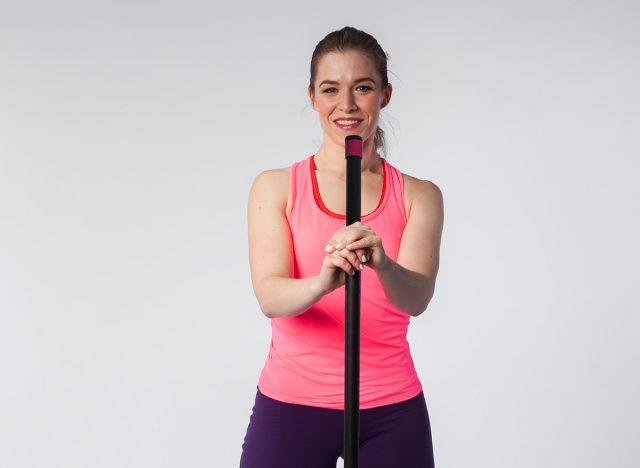
4. Broomstick With Heel Lifts
Using a prop like a broomstick provides a light "external anchor" to help maintain posture while challenging the balance center.
- The Benefit: It improves spinal alignment and foot stability simultaneously.
- Execution: Hold a broomstick horizontally in front of you. While keeping the spine neutral, lift your heels off the ground. Hold the peak position, focusing on keeping the weight centered over the balls of your feet.
5. Broomstick With Leg Push-Backs and Calf Raises
This is a more advanced movement that integrates upper-body stability with lower-body balance.
- The Benefit: It mimics the complex coordination required to step backward while carrying an object.
- Execution: Hold the broomstick for support. Perform a controlled leg push-back, extending the leg behind you while maintaining a rigid torso, followed by a calf raise on the standing leg.
Implications for Future Health
The implications of these exercises are profound. By dedicating just 15 to 20 minutes, three to four times a week, to balance training, you are investing in your future self.
"If someone over 55 can confidently perform these tasks," says Frydberg, "they are demonstrating many of the physical qualities associated with healthy aging. This is about more than just avoiding a trip to the ER; it is about maintaining the ability to travel, play with grandchildren, and stay active in your community without the constant worry of injury."
Conclusion: The Long-Term Commitment
Balance is a "use it or lose it" system. As we age, the body naturally wants to conserve energy and reduce movement, but this is the exact opposite of what our neurological and muscular systems need.
By embracing these exercises, you are not just working out; you are conducting a full-body recalibration. Whether you are currently active or just beginning your fitness journey, incorporating these stability-focused movements is one of the most effective strategies for ensuring that your later years are defined by strength, confidence, and continued independence. Start slow, prioritize form, and remember that every small movement is a step toward a more stable future.