






Imagine reaching your mid-80s with a pristine cardiovascular profile: your blood pressure is stable, your cholesterol is optimal, and your metabolic markers suggest the vitality of a person decades younger. You are mentally sharp, sleep soundly, and feel ready to embrace your sunset years. Then, in a single, unforeseen moment—a stumble in the kitchen or a slip on the sidewalk—you suffer a hip fracture.
In an instant, your independence vanishes. The pursuit of longevity, once focused on internal metrics and organ health, has long ignored the structural framework that keeps us upright. As we redefine what it means to age well, the next frontier of preventive medicine is no longer just about living longer; it is about staying mobile, independent, and physically resilient. Bone health is finally stepping out from the shadows of clinical obscurity to become the defining health category of our era.
The Chronology of Preventive Health Trends
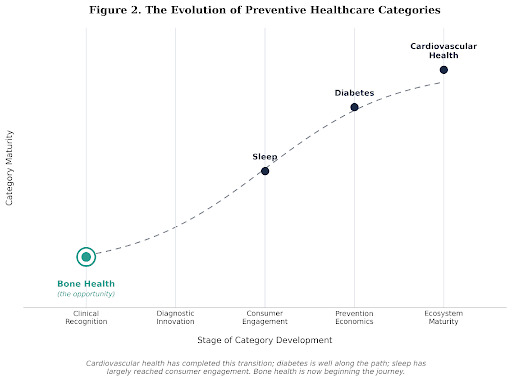
Healthcare has always been defined by thematic "eras." Looking back over the last four decades, we can trace a clear evolution in how society and medicine prioritize our well-being:
- The 1980s: The Cardiovascular Era. Driven by an explosion in research on heart disease, the focus shifted to blood pressure, cholesterol management, and the early adoption of statins. Heart health became a household conversation.
- The 2000s: The Metabolic Revolution. As obesity and Type 2 diabetes rates climbed, the narrative turned toward glucose monitoring, insulin sensitivity, and the metabolic roots of chronic disease.
- The 2020s: The Longevity and Optimization Age. Today, the focus has broadened to include sleep tracking, hormonal optimization, and the "healthspan" movement—the desire to match our physical quality of life with our extended lifespan.
Each of these movements followed a similar trajectory: a niche clinical specialty evolved into a fundamental pillar of lifelong health, supported by new diagnostic technologies, consumer-driven data, and a systemic shift toward preventive economics. Today, bone health sits at the precipice of this exact transformation.
Supporting Data: A Silent Global Crisis
While bone health has been ignored, the statistics reveal a crisis that is both urgent and mounting. In the United States alone, over 60 million adults aged 50 and older suffer from osteoporosis or osteopenia. Despite this, the condition remains tragically underdiagnosed and undertreated, often coming to the medical establishment’s attention only after a catastrophic "fragility fracture."
The global scale is even more sobering. According to the International Osteoporosis Foundation, there are approximately 37 million fragility fractures annually—roughly one every single second. The demographic impact is staggering: half of all women and one in four men over the age of 50 will experience an osteoporotic fracture in their lifetime.
For many, this is the "final" medical event. The mortality rate following a hip fracture in the elderly is high, and for those who survive, the loss of mobility often acts as a catalyst for a decline in overall health, cognitive function, and social integration. Despite this, bone health has never been integrated into the "everyday" preventive health stack—until now.
AI: Democratizing the Diagnostic Pathway
One of the primary reasons bone health remained a "hidden" issue was the diagnostic hurdle. Traditional bone mineral density (BMD) testing, usually performed via a DEXA scan, requires a specific referral, a visit to a specialized facility, and often, a trigger event—such as a fracture—before a physician orders the test.
AI is fundamentally shattering this model. We are moving from a reactive, clinic-based diagnostic model to an opportunistic, data-rich model.
Unlocking Existing Data
Modern healthcare generates mountains of data that we have historically underutilized. Millions of CT scans are performed annually for reasons entirely unrelated to bone health—such as kidney stones, abdominal pain, or trauma. AI algorithms are now capable of mining these existing scans to calculate bone density automatically, turning routine screenings into diagnostic opportunities for osteoporosis.
The Future of Opportunistic Screening
This is "democratized diagnosis." As AI tools move into dental X-rays and even routine chest imaging, the barrier to identifying patients at risk of bone loss is collapsing. By extracting meaningful information from data we already possess, we are shifting bone health from a sporadic, episodic diagnostic category to a longitudinal one. This allows clinicians to move from "treating the fracture" to "managing the bone density trajectory" over a decade, rather than a single visit.
The Missing Link: Why Bone Health Lags Behind
If the technology is here, why has bone health lagged behind the revolutions in heart and metabolic health? The reasons are rooted in systemic inertia:
- Invisible Symptoms: Unlike blood pressure or blood sugar, bone density loss is asymptomatic. Patients don’t "feel" their bones thinning, leading to a false sense of security until a break occurs.
- The "Frailty" Stigma: Historically, bone loss was viewed as an inevitable "cost of aging," discouraging aggressive preventive action.
- Fragmented Care: Bone health often falls between the cracks of primary care, orthopedics, and rheumatology, leaving no clear "owner" of the patient’s long-term skeletal health.
- The GLP-1 Effect: The recent surge in weight-loss drugs (GLP-1s) has inadvertently created a new population at risk. Rapid weight loss often comes with a decrease in bone density, creating an urgent, immediate need for proactive monitoring among patients who previously thought they were "healthy."
Implications: A New Era of Mobility
The future of bone health will not be defined by the disease (osteoporosis) but by the outcome (mobility). To achieve a future where fractures are the exception rather than the rule, we need a three-pronged shift in the healthcare ecosystem:
1. Earlier, Data-Driven Intervention
By utilizing AI to identify bone loss years before a fracture occurs, we can implement lifestyle and medical interventions when they are most effective.
2. Multimodal Treatment Approaches
Moving beyond the "one drug" approach, the future of bone health involves a combination of pharmaceutical interventions, physical activity protocols, and non-drug wearable technologies. For instance, new, FDA-cleared, non-drug wearables are now emerging as a way to provide mechanical stimulation to bones, offering a proactive tool for those who are not yet candidates for heavy pharmacological intervention but are at elevated risk.
3. Optimized, Long-Term Management
Bone health must be tracked with the same rigor as blood pressure. Longitudinal monitoring ensures that therapies are adjusted based on real-time data, moving away from a "set it and forget it" prescription model.
Conclusion: The Inflection Point
The pattern for medical transformation is well-documented: science advances, technology makes diagnosis easier, consumer awareness spikes, and the economic imperative to prevent expensive, debilitating fractures becomes clear.
Bone health has reached this inflection point. We are moving toward a future where our skeletal strength is measured as routinely as our heart rate. The question is no longer if bone health will become a major pillar of preventive medicine, but who will lead the charge in defining the standards of care.
By integrating bone health into the modern preventive stack, we are not just adding years to our lives; we are ensuring that those years are lived with the strength and independence that define a life well-lived. The era of the "fragile" senior is not an inevitability—it is a condition we now have the tools to prevent.
The future of aging is mobile, and that future has already begun.
Laura Yecies is the CEO of Osteoboost Health, Inc., a pioneer in non-drug, wearable solutions for bone density. With over 30 years of experience at the intersection of technology and medicine, she is dedicated to scaling proactive, preventive bone health solutions for a global aging population.