










For over a decade, Dr. Gabrielle Fundaro lived by the numbers. With a PhD in Human Nutrition, years of experience as a high-level coach, and the discipline required to compete in six powerlifting meets, she was the quintessential expert. Yet, behind the scenes, her relationship with food had become a source of profound anxiety.
Despite her expertise, Dr. Fundaro found herself trapped in the relentless cycle of macro counting. The tracking that once provided structure had transformed into a psychological cage. She feared that if she didn’t hit her precise protein, carbohydrate, and fat targets, her physique would vanish and her health would crumble. This article explores the evolution of the "RPE-Eating" framework—a revolutionary, self-regulated approach to nutrition that is helping former trackers regain their autonomy.
The Burden of Precision: A Professional’s Crisis
For years, Dr. Fundaro used macro counting to maintain "control." It worked—until the mental fatigue outweighed the physical results. The turning point came when she realized she could no longer enjoy a simple meal at a restaurant without wondering if it fit into her daily "budget."
The fear of letting go was paralyzing. Every time she considered stopping, a barrage of "what-ifs" surfaced:
- What if I fail to hit my protein intake and lose hard-earned muscle mass?
- What if I accidentally overeat and gain body fat?
- If I can’t fuel myself without an app, does that invalidate my credentials as a nutritionist?
These questions highlight a common paradox in the fitness industry: the more we know about the science of nutrition, the less we often trust our own biological signals. Dr. Fundaro’s struggle was not a lack of knowledge, but a total reliance on external metrics at the expense of internal wisdom.
The Chronology of a Shift: From the Weight Room to the Dinner Table
The breakthrough occurred not in a laboratory, but in the gym. Dr. Fundaro began utilizing the Rate of Perceived Exertion (RPE) scale for her training. RPE is a subjective framework that allows athletes to gauge their effort level on a 1-to-10 scale. By training based on how she felt rather than rigid, pre-determined percentages, she found she was recovering better and hitting new personal bests.
The epiphany was immediate: if an RPE-based system could optimize physical performance by honoring the body’s daily fluctuations, why couldn’t a similar framework apply to nutrition?
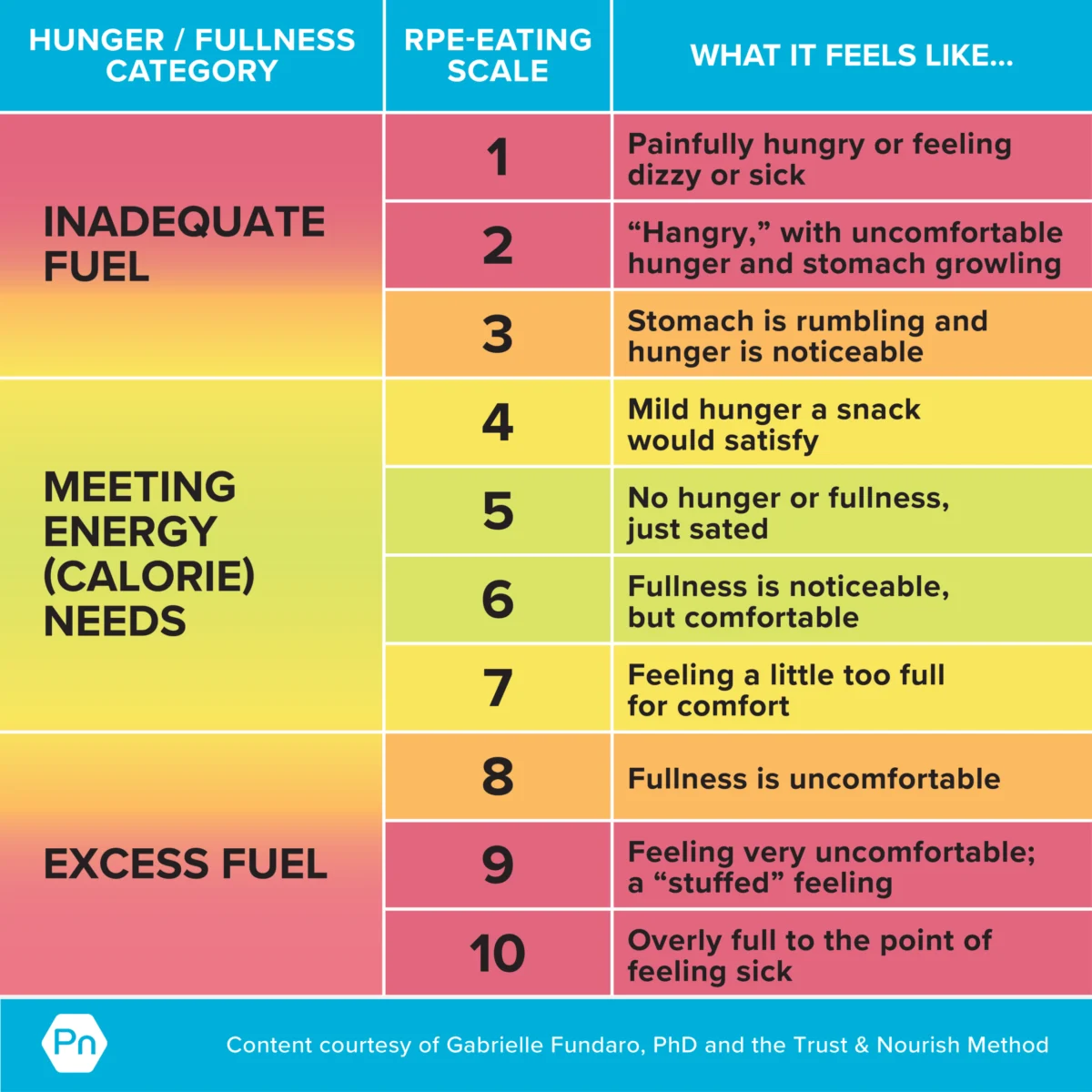
Dr. Fundaro spent the following months adapting the 0-10 scale used by physiotherapists and strength coaches into an "RPE-Eating" tool. Unlike rigid meal plans or calorie-counting apps, this system shifts the focus from external data entry to interoceptive awareness—the ability to identify and respond to the body’s internal physiological signals.
Understanding the RPE-Eating Framework
At its core, RPE-Eating is a practice of self-regulation. The scale functions as follows:
- 1-3 (Inadequate Fuel): Characterized by physical hunger, dizziness, or "hangriness."
- 4-7 (Adequate Fuel): The "Goldilocks" zone where energy needs are met comfortably.
- 8-10 (Excess Fuel): Ranges from feeling "stuffed" to physical discomfort or sickness.
The objective is not to hit a perfect number, but to develop the skill of identifying where one sits on this spectrum before, during, and after a meal. It replaces the "calculator" mindset with a "conscious observer" mindset.
Supporting Data: Why Subjective Scales Work
Critics often argue that replacing data with "feelings" is a regression. However, the success of RPE in athletics provides a robust defense for its application in nutrition.

- Autoregulation: Just as a lifter’s ability to move weight changes based on sleep, stress, and recovery, our body’s nutritional needs fluctuate daily. A fixed macro target assumes the body is a static machine; RPE-Eating acknowledges it is a dynamic biological system.
- Interoceptive Awareness: Research into mindful eating suggests that individuals who are better attuned to hunger and satiety cues maintain more stable weight profiles than those who rely on external dietary restriction.
- Convenience vs. Compliance: Velocity loss trackers and metabolic testing are highly accurate but rarely sustainable for the average person. RPE-Eating is infinitely accessible, requiring no equipment and zero data entry.
Implementation: A Four-Step Guide to Practice
Dr. Fundaro emphasizes that RPE-Eating is a skill that requires time to master, particularly for those who have spent years ignoring their hunger cues.
Step 1: Define Your Goals
RPE-Eating is not designed for "optimal" body composition hacking. It is designed for human sustainability. While it can be adapted for weight loss (staying in the 4-5 range) or weight gain (staying in the 7-8 range), its primary purpose is the restoration of trust between the mind and the body.
Step 2: Distinguish Hunger from Appetite
One of the most significant challenges is separating hunger (a physiological need for energy) from appetite (the psychological desire for food). By checking in with the RPE scale halfway through a meal, practitioners learn to recognize the "noticeable fullness" that signifies they are sufficiently fueled, even if the food is delicious enough to keep eating.
Step 3: Map Your Triggers
We rarely eat for physical fuel alone. Stress, boredom, and anxiety are powerful drivers of consumption. Dr. Fundaro suggests a "Notice and Name" strategy: when you feel the urge to eat mindlessly, pause and identify the emotion. If you aren’t physically hungry, try a non-food coping mechanism, such as a walk or a breathing exercise, to address the underlying trigger.
Step 4: Prioritize Satisfaction
A diet that meets physical needs but ignores emotional pleasure is destined to fail. RPE-Eating encourages including "off-limits" foods. By removing the "forbidden" status of certain foods, the psychological power they hold—and the subsequent tendency to binge—is significantly diminished.
Official Perspectives and Professional Implications
The nutrition community remains divided on the role of tracking. While apps remain the gold standard for medical nutrition therapy in certain clinical settings, there is a growing consensus that for the general population, the long-term psychological cost of tracking can be high.
Dr. Fundaro notes that RPE-Eating is particularly beneficial for those at risk of disordered eating, such as athletes in weight-class sports or individuals with a history of yo-yo dieting. However, she is clear about the limitations: "It is a tool, not a panacea. If a client is struggling with a diagnosed eating disorder, this does not replace the guidance of a therapist or registered dietitian."
The Implications of a Post-Tracking World
The broader implication of the RPE-Eating movement is a shift in the cultural narrative surrounding wellness. We are moving away from the era of "quantified self"—where every morsel of food is treated as a data point—toward a model of "embodied nutrition."
For those who have spent years tethered to macro trackers, this transition can be terrifying. It represents a loss of the illusion of absolute control. Yet, as Dr. Fundaro’s experience illustrates, true control isn’t found in a spreadsheet. It is found in the ability to listen to one’s own body, trust its signals, and make choices that are both nourishing and sustainable.
As the fitness industry continues to evolve, the integration of RPE-based nutrition may well be the "off-ramp" that millions of people need to break free from the constraints of rigid dieting. By focusing on the feeling of being fueled rather than the math of calories, we can finally stop managing our food as a business transaction and start treating it as a healthy, intuitive part of a balanced life.
References
- Borg, G. (1982). Psychophysical bases of perceived exertion. Medicine and Science in Sports and Exercise.
- Helms, E. R., et al. (2016). Application of the Repetitions in Reserve-Based Rating of Perceived Exertion Scale for Resistance Training. Strength & Conditioning Journal.
- Zourdos, M. C., et al. (2016). Proximal-to-distal validation of the RPE-based training scale in powerlifting.