"I want to know I’m doing absolutely everything I can to preserve my health for as long as possible."
It is a sentiment echoed in doctor’s offices, echoed across social media, and whispered in the weight rooms of high-end gyms. As interest in longevity peaks, fueled by high-profile biohackers and wellness influencers, the pursuit of a "perfect" health protocol has become a modern obsession. We are told that with the right supplements, the right morning routine, and the right data, we can fend off disease and remain youthful into our 90s, 100s, and beyond.

But there is a glaring problem: The current industry standard for longevity advice involves an extraordinary amount of effort, time, money, and complexity. Is all this effort truly necessary? Does it yield a proportional return on investment? Or have we become so obsessed with "optimizing" that we have lost sight of the basics that actually move the needle?
The Myths and Realities of "Optimization" Culture
The modern longevity movement is dominated by a cast of influential figureheads—podcasters, physicians, and biohackers—who promise a roadmap to an extended healthspan. While the desire for control over our biology is understandable, the team at Precision Nutrition (PN), having coached hundreds of thousands of real people, has observed a fundamental truth: "Optimal" is rarely realistic, and more importantly, it is rarely necessary.

Myth 1: The "Basics" Are No Longer Enough
There is a pervasive belief that reaching peak health requires cutting-edge, complex interventions. In reality, the "basics"—regular movement, a nutrient-dense diet, restorative sleep, stress management, and social connection—are profoundly effective. Most people do not fail to reach their health goals because they lack access to ice baths or intravenous vitamin infusions; they fail because they lack consistency in the fundamentals. If you can maintain these foundational behaviors with 80 to 90 percent consistency, you are likely already operating at near-peak optimization.
Myth 2: More Is Always Better
In the fitness and nutrition world, the law of diminishing returns is often ignored. While the transition from sedentary to moderately active provides massive health benefits, the leap from "very active" to "extreme athlete" offers significantly smaller gains, often at a higher risk of injury or overtraining. Complexity, too, acts as a barrier; adding unnecessary layers to your routine increases the cognitive load, making it far more likely that you will abandon the protocol entirely.

Myth 3: Cutting-Edge Strategies Offer Guaranteed Benefits
Many of the "fringe" protocols touted by wellness influencers are based on observational studies, animal models, or anecdotal evidence. They lack the long-term, large-scale human clinical data required to justify their cost or potential risk. Before investing in expensive, unproven biohacks, it is far more prudent to focus on habits with decades of peer-reviewed, proven efficacy.
Chronology of Evidence: From Sedentary to Sustained Vitality
The history of health research has shifted from treating acute disease to understanding the prevention of chronic decline. Throughout the 20th and 21st centuries, studies on thousands of cohorts have solidified a hierarchy of health behaviors.

- The Mid-Century Realization: Epidemiological studies began to show that physical activity was the single greatest predictor of reduced all-cause mortality.
- The Nutritional Revolution: As the focus shifted toward chronic disease in the late 1900s, researchers identified that whole-food intake and the avoidance of ultra-processed foods were the primary drivers of metabolic health.
- The Social Connection Era: Most recently, long-term studies—such as the Harvard Study of Adult Development—have revealed that the quality of our social relationships is a more significant predictor of longevity than almost any other variable, including wealth or IQ.
Supporting Data: What Moves the Needle?
To understand where to focus your energy, we must look at the data regarding the "sweet spot" of health behaviors.
Exercise: The U-Shaped Curve
Data from Harvard alumni and studies of hundreds of thousands of adults indicate that the greatest health benefits occur when moving from no exercise to a moderate amount. Achieving 7.5 to 15 MET-hours (Metabolic Equivalent Hours) per week provides a steep decline in mortality risk. While more exercise is generally beneficial, the "Extreme Exercise Hypothesis" suggests that at the highest volumes, benefits plateau, and cardiovascular risks like atrial fibrillation may actually increase.

Nutrition: The Five-Serving Benchmark
Massive studies involving over 1.8 million participants have confirmed that the benefits of fruit and vegetable consumption plateau at five servings per day. While eating more won’t necessarily hurt, it provides no additional reduction in mortality risk compared to the five-serving baseline. Similarly, protein intake should be adjusted based on activity level; while 0.8g/kg is the bare minimum for sedentary life, 1.2g/kg to 1.6g/kg is the ideal range for most active adults looking to preserve muscle mass as they age.
Social Connection: The Invisible Health Pillar
Perhaps the most startling data point is that the health impact of social isolation is comparable to smoking 15 cigarettes a day. Longevity isn’t just about what you eat or how much you squat; it is about the strength of your interpersonal bonds. Having three to five close friends with whom you interact regularly (at least once or twice a week) is the gold standard for social health.

Official Responses and Clinical Perspectives
Health organizations such as the WHO and the American Heart Association have moved away from recommending specific "superfoods" or complex protocols, focusing instead on overarching patterns. The consensus is clear:
- Tobacco and Alcohol: There is no "safe" amount of smoking, and the evidence regarding alcohol is increasingly leaning toward total minimization, as it is a known carcinogen and a primary factor in premature death for those aged 15–49.
- Preventative Care: Boring, traditional measures—such as routine dental care, screenings for cancer, and using seatbelts—remain the most effective life-saving interventions available to the average person.
The Cost of Optimization: Is It Worth It?
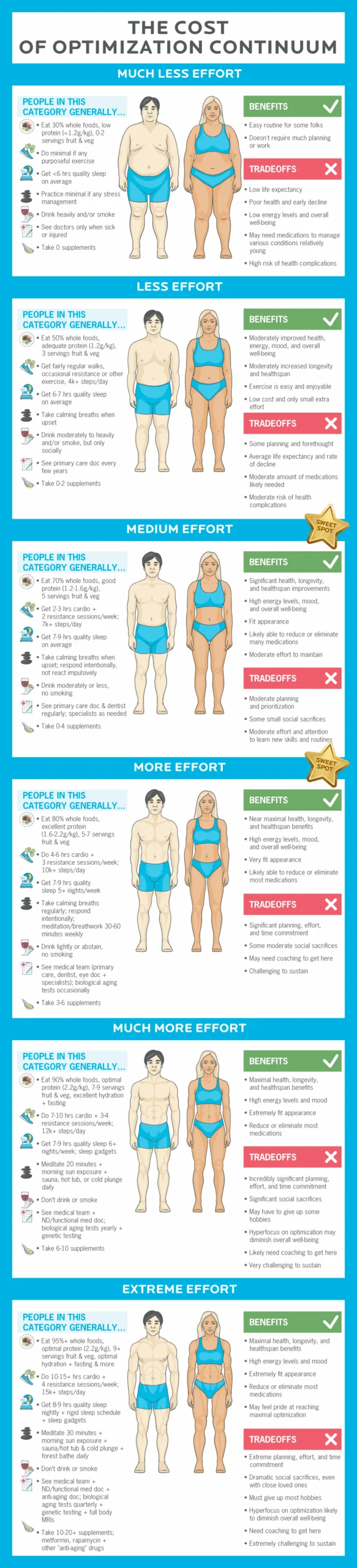
If you are a "medium-effort" person—someone who hits the gym three times a week, eats whole foods, sleeps well, and maintains a social circle—you are likely achieving 80 percent of the longevity benefits available to a human being.

To reach that final 20 percent of "optimization," you would likely need to spend three to four times more money, time, and mental energy. You would be looking at:
- Continuous glucose monitoring.
- Advanced blood panels and genetic testing.
- Costly hormone therapies and niche supplements.
- Highly specific, time-consuming recovery protocols.
For the vast majority, this 3-4x increase in effort does not yield a 3-4x increase in life expectancy. In fact, it often results in "opportunity cost"—the loss of time that could have been spent enjoying life, building relationships, or engaging in meaningful work.

Implications: A Shift Toward "Deep Health"
The goal of longevity should not be to reach 100 years of age by living like a laboratory experiment. True health—what we call "Deep Health"—encompasses your physical, mental, emotional, existential, and social well-being.
If your pursuit of a longer life leads to orthorexia, chronic anxiety about your blood markers, or social isolation, you are, by definition, compromising your health. The most effective longevity strategy is to build a life you actually enjoy living. When you find purpose, foster deep connections, and maintain consistent, simple habits, you are not just adding years to your life; you are ensuring those years are worth living.

Conclusion:
Don’t let the noise of the "optimization" culture convince you that great health is beyond your capabilities. You don’t need a PhD in biochemistry or a six-figure budget to live a long, vibrant life. Focus on the basics, be consistent, and remember: the most important part of your health plan is the part you can actually stick to for the next 50 years.