







For over a decade, Dr. Gabrielle Fundaro lived by the numbers. With a PhD in Human Nutrition, an extensive career in high-level coaching, and a competitive background in powerlifting, she was the quintessential expert. Yet, behind the scenes, she found herself trapped in a cycle of dependency. Every meal, every snack, and every outing was filtered through the lens of macro-nutrient tracking.
"I worried that if I stopped tracking macros, I would lose my physique," she admits. It was a paradox: a woman who taught others how to fuel their bodies was secretly terrified of the very food she prescribed. This struggle, now documented in her transition to "RPE-Eating," represents a growing movement in the fitness and nutrition industry: the shift from external, data-driven restriction to internal, bio-feedback-driven nourishment.
The Chronology of a Nutritional Burnout
The path to this new methodology was not linear; it was born from exhaustion. For years, Dr. Fundaro utilized macro counting—the practice of meticulously logging proteins, fats, and carbohydrates—to maintain her athletic performance and body composition. While this system provided the precision required for powerlifting, it eventually exacted a psychological toll.
The "breakdown" began when the utility of the tracker vanished. The effort required to balance macros perfectly began to overshadow the joy of eating. Simple social experiences, such as selecting a meal from a restaurant menu, became sources of anxiety rather than pleasure. The fear was primal: If I stop tracking, will I lose my muscle? Will I gain unwanted body fat? Do I even know how to nourish myself without an app telling me what to do?
This fear of "losing control" is common among high-performance athletes and chronic dieters. Dr. Fundaro realized that while she had mastered the science of nutrition, she had neglected the art of eating. She sought an alternative—a middle ground between the rigidity of macro counting and the sometimes overly abstract nature of intuitive eating.
Supporting Data: The Science of Interoceptive Awareness
To find a solution, Dr. Fundaro looked toward her own training. In the gym, she had moved away from rigid percentage-based lifting in favor of the Rate of Perceived Exertion (RPE) scale. Developed by Gunnar Borg in the 1960s, the RPE scale was originally a tool for physiotherapists to measure cardiovascular effort. Over the decades, it became a cornerstone of strength training, allowing athletes to autoregulate their intensity based on how they felt on any given day.
The data supports the efficacy of this approach. Studies on "autoregulation" in training suggest that listening to the body’s internal signals—rather than following a fixed, external program—often leads to better long-term recovery and consistent performance.
Dr. Fundaro posited a simple, yet profound question: If RPE could optimize training, could it optimize nutrition?
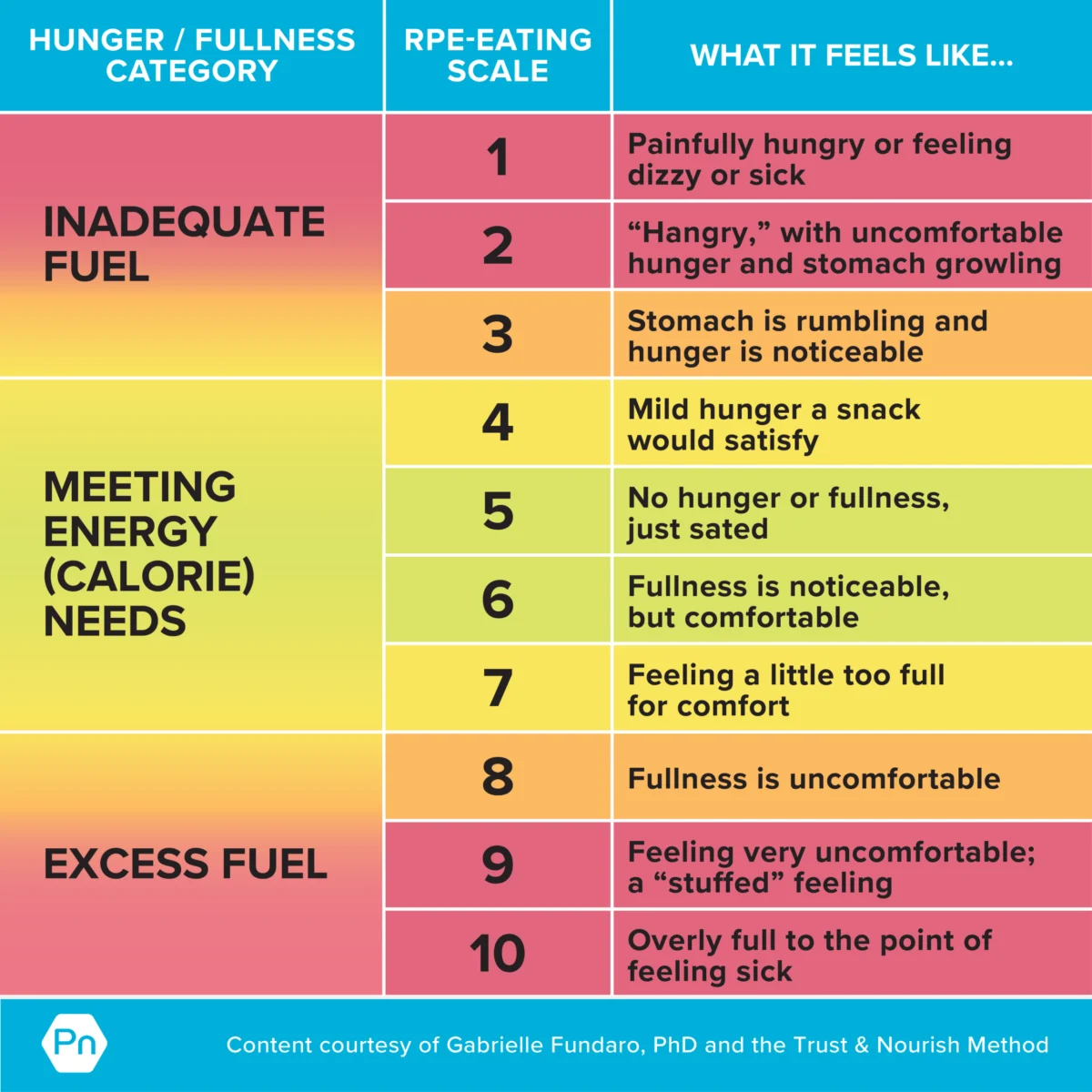
The resulting "RPE-Eating" scale is built on the concept of interoceptive awareness—the ability to perceive physical sensations from within the body, such as stomach rumbling, lightheadedness, or satiety. Unlike tracking apps that rely on external databases, this method relies on the body’s own internal "software," which, with practice, provides real-time data on energy needs.
The RPE-Eating Framework: A Practical Guide
The RPE-Eating scale translates subjective feelings into a 1-10 numerical framework.

- 1-3 (Inadequate Fuel): Characterized by physical symptoms like dizziness, "hangry" irritability, or significant stomach rumbling.
- 4-7 (Adequate Fuel): The "sweet spot." This is a state of being comfortably satisfied, where the body has received sufficient nutrients without reaching the point of discomfort.
- 8-10 (Excess Fuel): Ranges from feeling "stuffed" to physical sickness or lethargy caused by over-consumption.
The Four-Step Implementation Process
Dr. Fundaro emphasizes that this is not a diet, but a skill-acquisition process.
- Define Your Intentions: This method is not for rapid body composition changes. It is for those seeking a sustainable, long-term relationship with food. It requires a shift in mindset: moving away from "perfect" macros and toward "trustworthy" internal cues.
- Calibration through Tracking Hunger: Before meals, individuals are encouraged to log their hunger level on the 1-10 scale. After eating, they log their fullness. Over time, this creates a mental map of what "adequately full" feels like.
- Identifying Non-Hunger Triggers: Emotional eating is a reality. The RPE-Eating approach asks practitioners to "notice and name" the feeling driving the urge to eat when not physically hungry—be it stress, boredom, or anxiety.
- Balancing Satiety and Satisfaction: A critical innovation in Dr. Fundaro’s model is the distinction between satiety (the physical act of fullness) and satisfaction (the emotional, pleasurable aspect of eating). A meal that is nutritious but devoid of enjoyment is often the precursor to later binging.
Official Perspectives and Expert Context
Critics of the RPE-Eating method often argue that "feelings" are unreliable compared to the "facts" of calorie counting. They point to the precision of macros as the only way to guarantee specific results in body composition.
However, Dr. Fundaro’s response is rooted in clinical experience. She compares her method to contact sports: "I am not anti-weight modification; I am pro-safe weight modification. There are inherent risks, but they can be mitigated through best practices."
She argues that for many, the "facts" of macro tracking are actually a psychological risk factor, potentially fueling eating disorders, orthorexia, and yo-yo dieting. By providing a structure that acts as a "safety net," RPE-Eating allows individuals to manage their weight without the obsessive, often damaging behaviors associated with rigid calorie restriction.
Implications for the Fitness Industry
The rise of the RPE-Eating method has significant implications for both professional coaches and the general public.
For the Fitness Professional
Coaches are increasingly recognizing that their role is shifting from "calculator" to "behavioral strategist." Using the RPE-Eating scale allows coaches to teach their clients how to self-regulate, fostering long-term autonomy rather than creating a dependency on the coach’s meal plans. It is a transition from teaching a client what to eat to teaching them how to eat.
For the General Population
For the average individual, the implications are even more liberating. The societal pressure to track every bite is a source of immense stress. If an individual can reach their health goals while enjoying a spontaneous dinner with friends or a holiday meal without the guilt-ridden need to log it into an app, the net benefit to mental health is substantial.
A Sustainable Off-Ramp
Perhaps the most significant takeaway from Dr. Fundaro’s journey is that macro tracking does not have to be a lifelong sentence. It can serve as a useful educational tool—a period of "nutritional literacy"—that eventually leads to a more intuitive state.
"The goal," Dr. Fundaro concludes, "is to know that you are nourishing yourself, and you don’t need a food tracker to do that."
While this method is not a "magic bullet" and requires a level of emotional labor and self-reflection that not everyone is prepared for, it offers a necessary alternative. By bridging the gap between clinical nutrition and human psychology, RPE-Eating provides a path toward a healthier, more sustainable, and ultimately more peaceful way of living. It is, in essence, the final step in becoming an expert on the only subject that truly matters: one’s own body.