









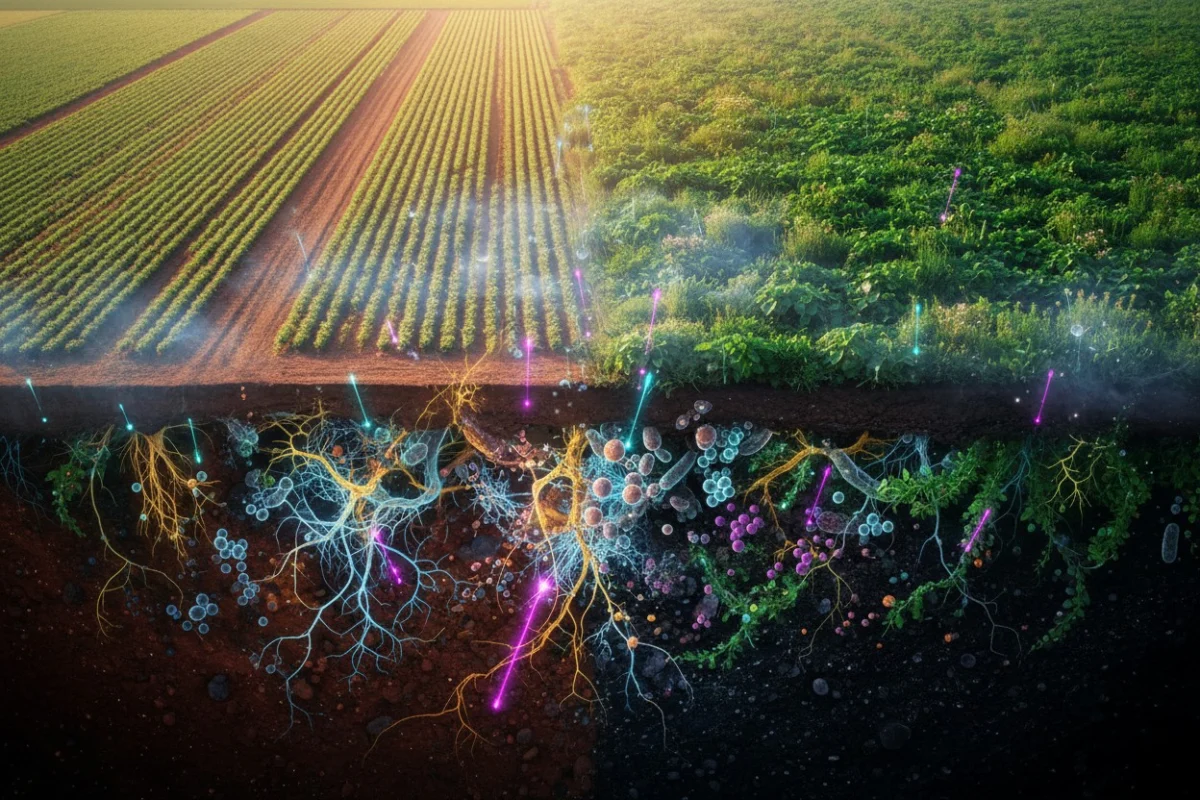
In the silent, dark layers beneath our feet, a microscopic revolution is underway—one that threatens the very foundation of global food security. A groundbreaking multi-country study published in Environmental Science and Pollution Research has revealed that the "invisible" legacy of agricultural chemical use extends far beyond the crops we harvest. The research demonstrates that pesticide residues are pervasive, infiltrating even the most strictly managed organic fields and fundamentally altering the composition of the soil microbiome across ten European nations.
As scientists and policymakers grapple with the dual crises of biodiversity loss and soil degradation, this study provides the most comprehensive evidence to date that our reliance on chemical inputs—whether conventional or, in rare instances, permitted organic—is disrupting the essential microbial communities that drive ecosystem health, nutrient cycling, and carbon sequestration.
The Core Findings: A Continent-Wide Contamination
The research team, comprised of leading experts and representatives from various European Union state agencies, conducted an observational field study of unprecedented scope. By examining 200 sites across Croatia, the Czech Republic, Denmark, France, Italy, the Netherlands, Portugal, Slovenia, Spain, and Switzerland, the researchers sought to move beyond the artificial constraints of laboratory testing.
The study’s most alarming revelation is the ubiquity of chemical mixtures. While conventional fields showed the highest concentration of residues—a median of 250.1 micrograms per kilogram—organic fields were not exempt. Researchers identified residues in 79% of organic samples, with some fields containing mixtures of up to 12 different pesticides. In conventional systems, that number climbed to as many as 21.
These findings challenge the binary perception of "clean" versus "contaminated" land. Instead, they suggest that the European landscape is saturated with a complex "cocktail" of herbicides, fungicides, and insecticides that do not respect property lines, likely moving through atmospheric drift, water runoff, and historical soil contamination.
Chronology of Discovery: From Field to Lab
The road to these findings began with the realization that traditional regulatory assessments, which evaluate chemicals individually, were failing to capture the reality of modern farming.
- 2023–2024 (Data Synthesis): The foundation of this research was the dataset provided by Knuth et al. (2024). This exhaustive registry categorized 192 distinct substances, including 45 insecticides, 50 herbicides, 57 fungicides, 39 metabolites, and the synergist piperonyl butoxide.
- Field Observation: Researchers selected diverse agricultural systems, from olive groves in Croatia and vineyards in France to maize fields in Slovenia and seed potato farms in the Netherlands. This "real-world" approach allowed the team to document how these chemicals interact with soil biology under variable climates and soil types.
- Analysis: Using advanced microbial profiling, the researchers correlated specific residues with shifts in bacterial and fungal community structures, identifying "synergistic" interactions that had never been documented in scientific literature before.
Supporting Data: The "Cocktail Effect" Revealed
The study utilized high-resolution analytical chemistry to identify how specific compounds act as catalysts for soil degradation. Among the most concerning substances identified were glyphosate and its primary metabolite, AMPA, as well as fungicides like metalaxyl-M and difenoconazole.
Key Data Points:
- Prevalence: 96% of conventional fields and 79% of organic fields contained measurable residues.
- Microbial Sensitivity: AMPA and difenoconazole were identified as the primary drivers of bacterial community shifts. Notably, AMPA was the only compound found to significantly disrupt fungal communities across multiple regions.
- Synergistic Hazards: The study highlighted a "possibly synergistic" interaction between metalaxyl-M and AMPA. Even more concerning, the presence of AMPA appeared to "unlock" the harmful effects of legacy contaminants like hexachlorobenzene—a banned substance that only became a significant driver of bacterial composition when AMPA was present.
These findings validate long-standing concerns regarding the "cocktail effect." While regulators may deem individual pesticides safe at low doses, this study demonstrates that when combined, these chemicals create an environment of chronic stress for soil microbes, effectively changing the microbial "fingerprint" of the soil.
The Role of the Soil Microbiome: Why It Matters
Soil is not merely a substrate for plant growth; it is a living, breathing biological engine. Microbial organisms are the building blocks of healthy ecosystems, responsible for breaking down organic matter, fixing nitrogen, and suppressing soil-borne pathogens.
When pesticide mixtures disrupt these communities, the consequences are profound:
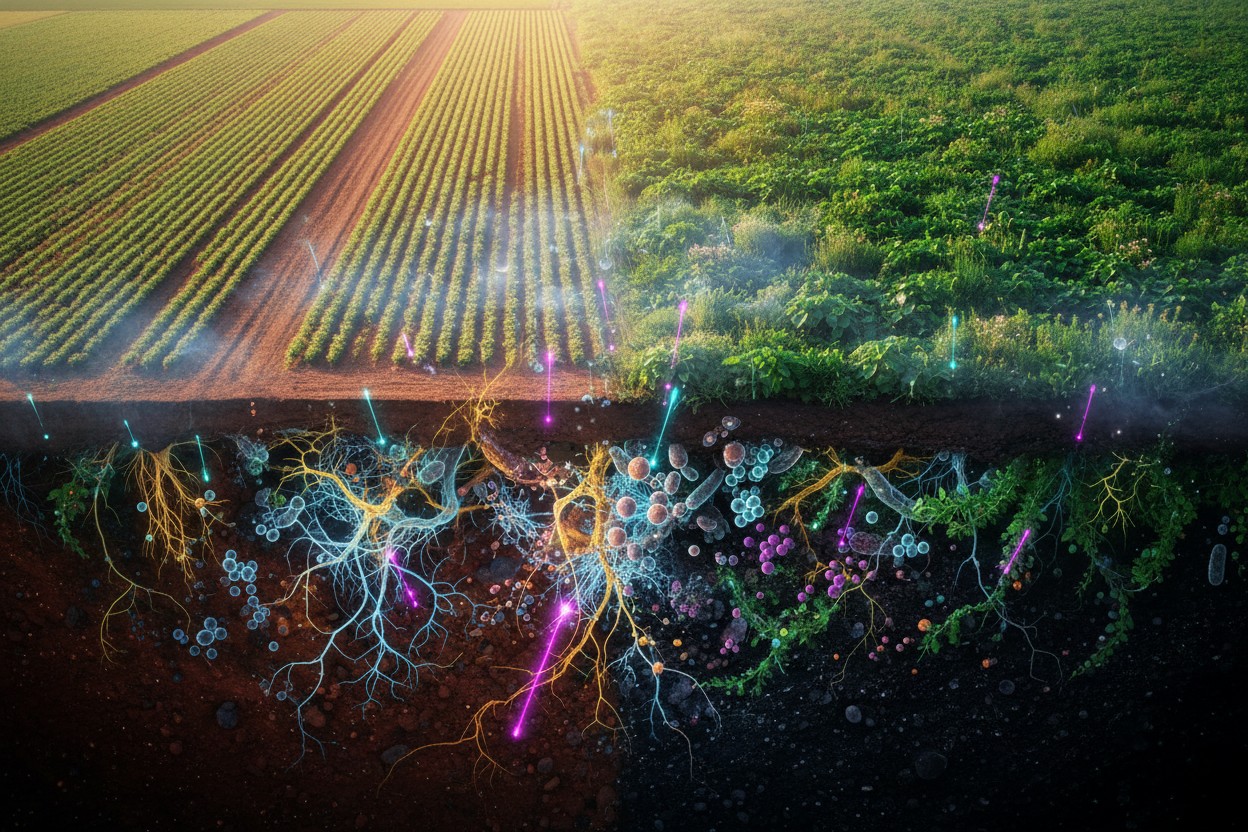
- Nutrient Cycling: Disrupted microbial communities struggle to convert organic matter into plant-available nutrients, necessitating higher synthetic fertilizer use.
- Carbon Sequestration: Healthy soil microbiomes are essential for long-term carbon storage. Pesticide-induced stress may diminish the soil’s capacity to act as a carbon sink, exacerbating climate change.
- Mycorrhizal Suppression: Arbuscular mycorrhizal fungi, which form symbiotic relationships with plant roots to aid water and mineral uptake, are particularly sensitive to these chemical residues.
Official Responses and Regulatory Implications
The publication of this data has sparked intense debate within the European agricultural community and beyond. Advocacy groups, such as Beyond Pesticides, have seized upon the findings to push for a more rapid transition to regenerative and truly chemical-free organic practices.
However, the findings also pose a dilemma for the organic sector. Some substances permitted under organic certification were found in the soil, raising questions about the legacy of previous land use and the persistence of certain compounds. The National Organic Standards Board (NOSB) is now facing increased pressure to re-evaluate the materials allowed in organic production.
The study provides a new, scientifically rigorous methodology for material reviews. By shifting the focus from "is this chemical safe for the consumer?" to "how does this chemical affect the soil’s ecological infrastructure?", the researchers are providing a roadmap for future policy that prioritizes long-term soil health over short-term yield optimization.
Broader Context: Antimicrobial Resistance and Human Health
The implications of the study extend far beyond the farm gate. Researchers have drawn alarming parallels between agricultural pesticide use and the global crisis of antimicrobial resistance (AMR).
Chronic exposure to pesticides has been linked to the development of multidrug-resistant bacteria. As documented in Comparative Biochemistry and Physiology Part C, the genetic and biochemical mechanisms used by bacteria to survive pesticide toxicity are often the same mechanisms that confer resistance to human antibiotics. In essence, by treating our soil with heavy chemical loads, we may be inadvertently cultivating a reservoir of drug-resistant pathogens that can enter the food supply and, eventually, human populations.
This is supported by research from South America, which has consistently linked glyphosate, the world’s most widely used herbicide, to the proliferation of resistant microbial strains. As consumers become increasingly aware of these links—with 85% of Americans expressing concern over pesticide residues, according to surveys cited in Fred Provenza’s Nourishment—the demand for transparency and systemic change is reaching a tipping point.
Looking Forward: Toward a Soil-First Policy
The evidence presented in this European study suggests that current agricultural paradigms are unsustainable. If the foundation of our food system—the soil—is being chemically "re-engineered" by the very inputs intended to protect crops, then the future of agricultural productivity is at risk.
Recommendations for Policy Reform:
- Integrated Cocktail Assessments: Regulatory bodies must move away from single-chemical risk assessments and begin testing for the synergistic effects of pesticide mixtures.
- Soil Health Mandates: Policy should pivot from simple yield targets to "Soil Health Index" targets, rewarding farmers who restore microbial diversity and reduce chemical dependency.
- Legacy Contamination Awareness: Acknowledging that organic farmers often inherit "contaminated" land due to drift or historical use, creating buffer zones and soil remediation programs.
As we look toward the mid-21st century, the goal must be to transition from a system of "input-heavy" agriculture to one that works with, rather than against, the complex microbial life that has sustained terrestrial life for eons. The European study serves as a clarion call: we must protect the life in our soil if we hope to sustain the life on our planet.
References
(Note: As per the provided text, the references are placeholders for the following bodies of work mentioned in the article):
- NaturalNews / South American studies on glyphosate and AMR.
- Comparative Biochemistry and Physiology Part C / Literature review on chronic pesticide exposure.
- Knuth et al. (2024) / Pesticide residue dataset.
- Environmental Science and Pollution Research / Primary study on soil microbial communities.
- Provenza, F. / Nourishment (regarding consumer concerns and soil health).