









By Investigative Desk
September 2026
In a stark illustration of the borderless nature of environmental disaster, the eastern Mediterranean is currently grappling with a catastrophic algal bloom that has crippled Israel’s water security. As of early September 2026, five of the nation’s six major desalination plants—the lifeblood of a country where over 80% of domestic water is produced synthetically—have been forced to suspend operations. The result is a nation under strict water rationing, facing the most significant disruption to its domestic infrastructure in modern history.
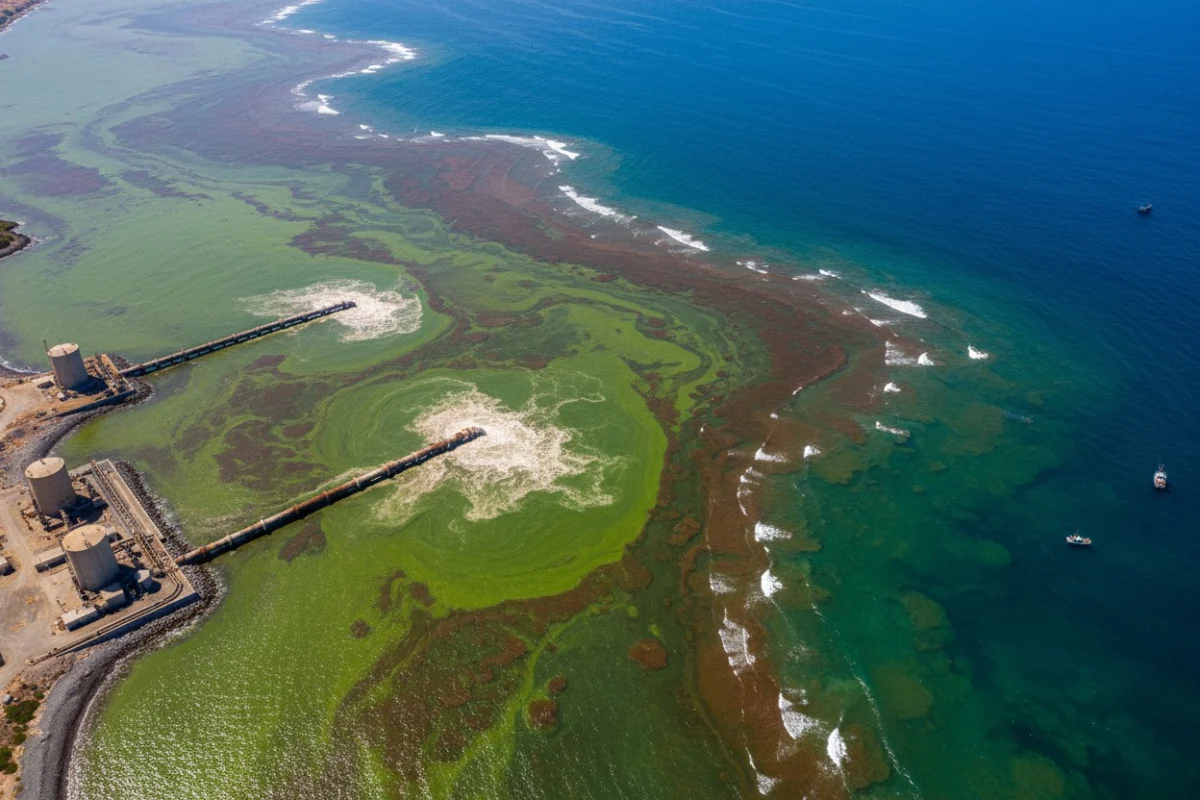
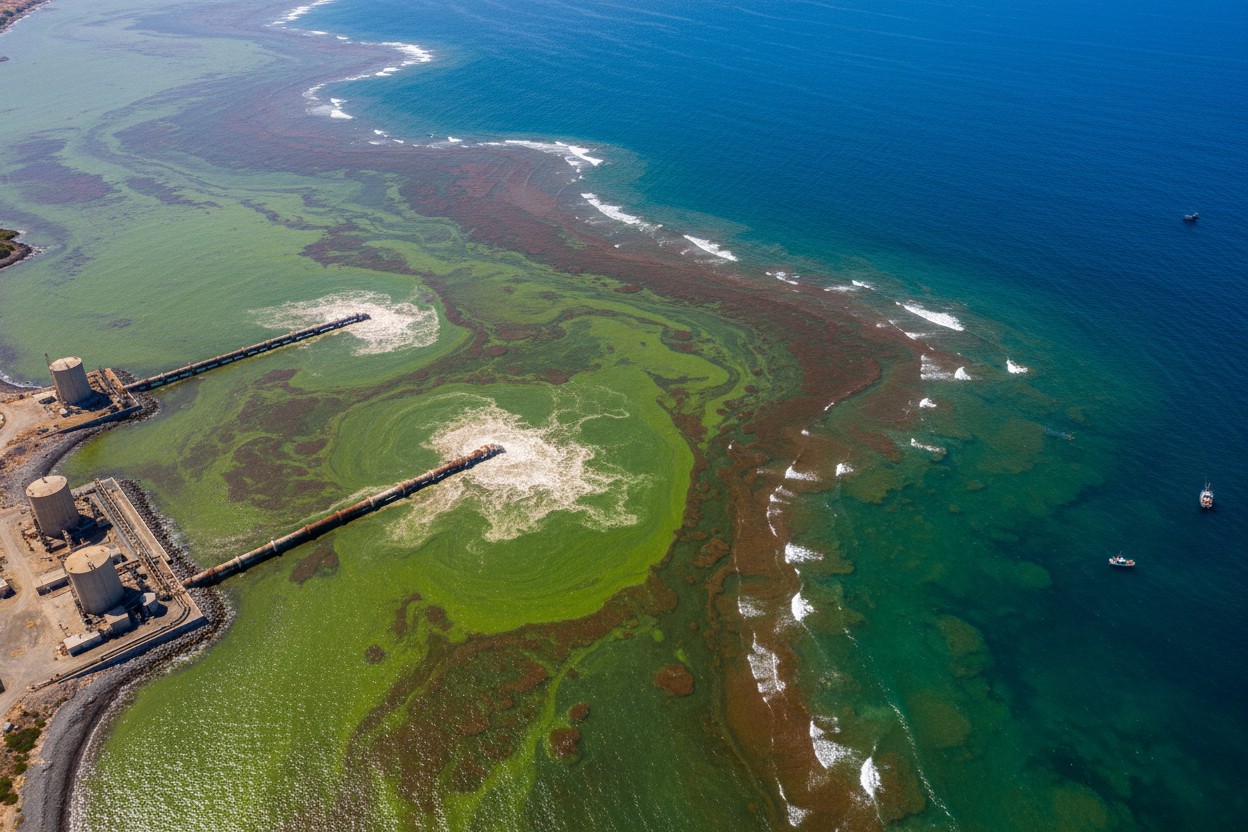
The culprit is a "perfect storm" of biological and human factors: record-high sea surface temperatures acting as an incubator for massive concentrations of microalgae, fed by an unprecedented influx of untreated sewage flowing northward from the Gaza Strip. This environmental feedback loop has transformed the Mediterranean coastline into a hazard zone, clogging the intake filters of the desalination plants with organic sludge and forcing the Israel Water Authority to impose immediate, severe restrictions on agricultural and municipal water use.
The Chronology of a Collapsing System
The crisis did not emerge overnight, but its impact became undeniable in the final days of August 2026.
- August 25–28, 2026: Satellite imagery provided by the monitoring firm Satalize detects an anomalous, rapid expansion of chlorophyll concentrations off the coast of the Gaza Strip, migrating northward toward the heart of Israel’s desalination infrastructure.
- August 30, 2026: Maintenance teams at the Hadera and Ashkelon desalination plants report repeated filter failures and clogging caused by dense, gelatinous biological matter.
- September 1, 2026: The Israel Water Authority declares an emergency. Three plants are shuttered to prevent permanent damage to expensive reverse-osmosis membranes.
- September 3, 2026: The crisis deepens as two additional plants reach operational failure. The government announces a nationwide mandate to curb non-essential water usage, including gardening and public water features, while agricultural irrigation schedules are slashed by 40%.
- September 5, 2026: Official reports confirm that over 80% of Israel’s desalination capacity is offline. In a move that observers characterize as a deepening of the regional humanitarian disaster, the Israeli government officially terminates external water supply to the Gaza Strip, citing the need to prioritize remaining domestic reserves.
Supporting Data: The Anatomy of an Algal Bloom
Scientists describe the current bloom as a rare, highly aggressive event. Typically, blooms in this region are localized; however, the sheer volume of nutrients—specifically nitrogen and phosphorus—flowing from the Gazan coast has created a "super-bloom."
According to Satalize analysis, the bloom extends from the southern reaches of Tel Aviv to the northern port of Caesarea. The primary catalyst is the near-total destruction of Gaza’s sanitation infrastructure. Following nearly three years of conflict, aid organizations report that 90% of Gaza’s water and sanitation facilities are inoperable. Approximately 40,000 cubic meters of raw human waste are being discharged into the Mediterranean daily.
When this "nutrient cocktail" meets the unseasonably warm late-summer waters of the Mediterranean, the microalgae undergo a population explosion. These blooms consume the available dissolved oxygen in the water, creating localized "dead zones" and producing toxins that threaten both marine biodiversity and the mechanical systems designed to purify seawater for human consumption.
Official Responses: A Regional Standstill
The Israeli government faces a dual-front crisis: a public health emergency at home and an escalating humanitarian catastrophe at its border.
The Israel Water Authority has adopted a defensive posture, prioritizing the limited output of the sole operational plant and stored freshwater reserves. "We are operating under a scenario of extreme scarcity," said a spokesperson for the Authority. "Our priority is to maintain the integrity of the national water grid while we attempt to flush the intake systems. However, as long as the source of the nutrient pollution remains active, our efforts are merely a temporary bandage."
International humanitarian agencies have expressed alarm at the decision to cut off external water to Gaza. "The collapse of the water system is a regional tragedy," noted a representative from a regional water policy NGO. "While the desalination plants in Israel are offline due to the pollution, the people in Gaza are now deprived of even the basic supply of piped water. We are looking at a total, systemic collapse that ignores the fundamental reality: you cannot cordon off a shared ecosystem."
Implications: The High Cost of Environmental Interdependence
The current crisis serves as a grim case study in the consequences of prolonged infrastructure destruction. The phenomenon of algal blooms fed by human waste is a global concern—similar events have plagued the San Francisco Bay and the Gulf of Mexico—but in the Levant, the crisis is uniquely entangled with the geopolitics of the conflict.
1. Economic and Agricultural Strain
Israel’s agricultural sector, a pillar of the national economy, is highly dependent on desalinated water. The current curtailment of irrigation is expected to result in significant crop losses, particularly in the export-heavy citrus and vegetable sectors. The cost of remediating the desalination plants—which requires extensive manual cleaning and chemical flushing of millions of dollars worth of specialized filtration equipment—will reach into the hundreds of millions.
2. The Public Health Spiral
In Gaza, the inability to treat sewage has turned the territory’s coastal aquifer into a poisoned reservoir. With sewage now saturating the groundwater, the risk of waterborne diseases such as cholera, typhoid, and dysentery is at an all-time high. The lack of clean water is not merely an inconvenience; it is a lethal threat that is now being mirrored in the reduced water quality within Israel itself.
3. The Fragility of Modern Desalination
This event exposes the "Achilles’ heel" of modern desalination technology. While reverse osmosis is a triumph of engineering, it relies on the assumption of a relatively stable source of intake water. When the sea itself becomes an extension of a failed sewage system, the technology becomes paralyzed. It forces a realization that technological solutions cannot substitute for regional stability and basic environmental management.
Looking Forward: A Path Toward Restoration?
Analysts suggest that the current crisis is unlikely to be a one-time event. As long as the sanitation infrastructure in Gaza remains destroyed and the blockade prevents the importation of the parts and fuel required for repair, the Mediterranean will continue to be a vessel for untreated waste.
"We are witnessing the direct, physical manifestation of a regional security policy that ignored environmental reality," says Dr. Arnon Levi, a professor of environmental policy at a leading Israeli university. "The sea does not recognize the Green Line. The nitrogen and phosphorus released in the south will inevitably find their way to the intake pipes of the north. Unless there is a massive, internationally supervised effort to restore the sanitation grid in the Gaza Strip, we should expect these blooms to recur every time the sea temperatures spike."
The international community, including the United Nations and regional stakeholders, is under mounting pressure to facilitate a "water-neutral" corridor. This would involve the delivery of specialized pumps, fuel for wastewater treatment plants, and the repair of desalination units in Gaza as a prerequisite for protecting Israel’s own water supply.
As the late-summer heat persists and the water levels in reservoirs continue to drop, the message from the coast is clear: water security in the Middle East is no longer a matter of domestic policy. It is a shared, vulnerable necessity that requires the restoration of basic environmental standards for all, or it risks the collapse of the systems upon which both populations depend for survival.
Conclusion: The Global Lesson of the Levant
The 2026 Mediterranean desalination crisis is a warning to a world increasingly reliant on technology to solve resource scarcity. When we fail to maintain the basic integrity of our environment—specifically the sanitation and waste systems that prevent nutrient pollution—we render our most advanced technologies useless.
The struggle to keep the taps running in Israel and to secure clean water in Gaza are, in this moment, two sides of the same coin. The crisis highlights that in an interconnected ecosystem, the failure of one party to manage its waste becomes the burden of its neighbor. Moving forward, regional stability will not be measured merely by the absence of conflict, but by the ability to manage the shared resources that sustain human life. Without a collaborative effort to mend the broken infrastructure of the coast, the "rare" algal bloom of 2026 may well become the new, and devastating, status quo.