











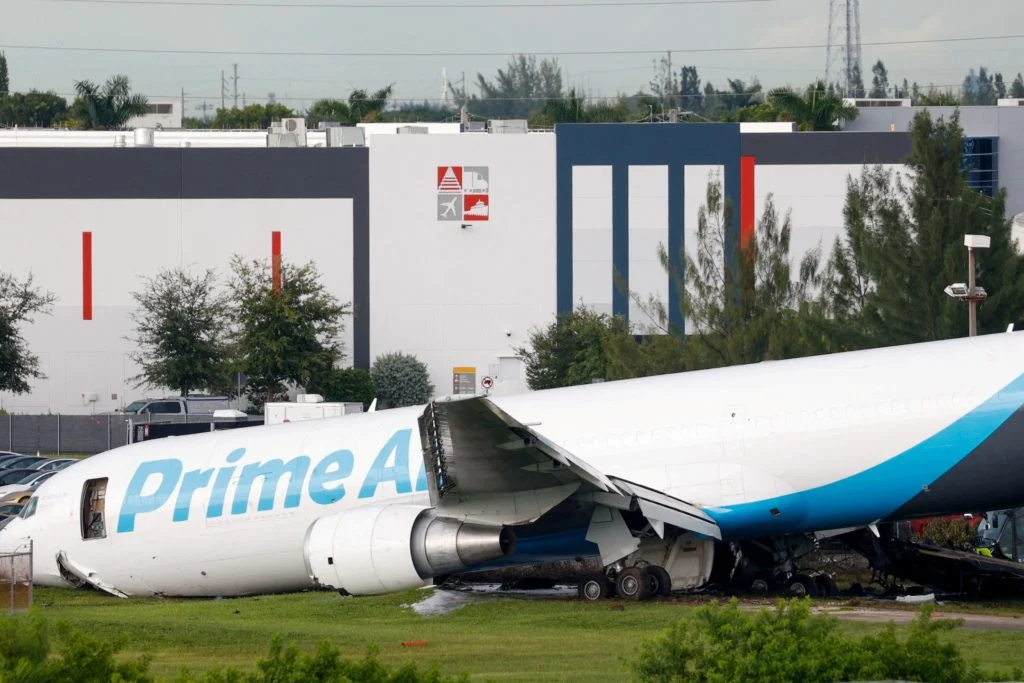
The aviation industry and the Miami community are reeling following a catastrophic accident at Miami International Airport (MIA) involving an Amazon-contracted Boeing 767 cargo jet. The aircraft, which had arrived from Puerto Rico, failed to decelerate after touchdown, overrunning the runway, breaching a perimeter fence, and colliding with two civilian vehicles. The incident resulted in the tragic loss of five lives, all of whom were occupants of the vehicles struck by the plane.
Federal investigators from the National Transportation Safety Board (NTSB) have descended upon the scene, initiating a comprehensive probe into the mechanical, environmental, and human factors that converged to produce what NTSB Chair Jennifer Homendy described as a scene of "utter devastation."
The Chronology of a Failed Landing
The sequence of events leading to the disaster has been reconstructed through a combination of initial flight data and viral social media footage that captured the final, harrowing moments of the flight.
The Approach
As the Boeing 767 made its final approach to Miami, it faced challenging meteorological conditions. Reports indicate the presence of gusty winds and a significant tailwind with a crosswind component. According to aviation experts, the aircraft was significantly above the "glide slope"—the prescribed vertical flight path—as it neared the airport.
The Touchdown
Video evidence reveals a high-speed, non-stabilized approach. In an attempt to correct the altitude, the flight crew appears to have descended precipitously, causing the aircraft to accelerate. By the time the jet reached the runway, it was traveling at approximately 185 miles per hour—well above the standard landing speed for a craft of its size—and touched down at the midpoint of the 9,000-foot runway rather than in the optimal landing zone.
The Overrun
Crucially, the left landing gear failed to make firm contact with the tarmac, preventing the automatic deployment of critical braking systems, including spoilers and reverse thrust. Without the weight of the aircraft depressing the landing gear sensors, the plane’s safety mechanisms remained inactive. Unable to slow effectively, the 767 departed the runway at an estimated 130 miles per hour, crashing through a perimeter fence and striking a van and an SUV parked in its path.
Supporting Data and Technical Analysis
The investigation is currently focused on why a standard commercial landing devolved into a high-speed runway excursion. Aviation correspondent Miles O’Brien, providing technical insight into the event, highlighted several systemic failures.
The Mechanics of the "Non-Stabilized" Approach
A stabilized approach is the bedrock of aviation safety. It requires that an aircraft be on the correct flight path, at the correct speed, and in the correct landing configuration at a specific altitude. When the flight crew observed they were above the glide slope three miles out, the "textbook" procedure would have been to initiate a "go-around"—aborting the landing to circle back for another attempt.
Instead, the decision to force the aircraft down created a "diving" effect. The tailwind further exacerbated the ground speed, making it nearly impossible for the heavy cargo jet to shed momentum within the remaining runway distance.
The Role of Safety Infrastructure
The conversation regarding runway safety has shifted toward the presence, or lack thereof, of Engineered Material Arresting Systems (EMAS).
- What is EMAS? EMAS consists of specialized, crushable concrete blocks installed at the end of runways. When an aircraft’s tires sink into this material, it acts like quicksand, effectively and safely decelerating the plane.
- The Regulatory Gap: Current FAA regulations require a 1,000-foot "runway safety area" (RSA) at the end of runways serving large commercial jets. Because Miami International met this 1,000-foot requirement, an EMAS installation was not mandated.
- Could it have helped? Experts are divided. While an EMAS system would have provided additional friction, the speed of the 767—traveling at roughly 130 miles per hour at the end of the pavement—exceeded the typical design parameters of such systems, which are generally optimized for speeds closer to 80 miles per hour.
Official Responses and Investigative Focus
NTSB Chair Jennifer Homendy and her team have begun the painstaking process of gathering physical evidence. The scene, marked by deep tire tracks extending from the paved runway into the grassy safety area, serves as a grim testament to the lack of deceleration.
Data Recovery
The primary focus of the NTSB investigation will be the recovery and analysis of the aircraft’s "black boxes":
- The Flight Data Recorder (FDR): This will provide the precise speed, altitude, wind inputs, and control surface movements during the final minutes of flight.
- The Cockpit Voice Recorder (CVR): This will be vital in determining the crew’s situational awareness and their internal communications regarding the decision to continue the landing versus performing a go-around.
The Amazon/Carrier Perspective
While Amazon has confirmed the flight was part of their logistics network, they have deferred all specific inquiries regarding the flight operations to the NTSB. The carrier operating the aircraft is cooperating fully with federal authorities.
Implications for Aviation Safety
The Miami tragedy is expected to trigger a nationwide review of landing protocols and airport infrastructure.
Revisiting "Go-Around" Culture
The accident highlights the "get-there-itis" phenomenon, where flight crews may feel undue pressure to land despite unstable conditions. Industry analysts argue that more robust training and cultural shifts are needed to ensure that pilots feel empowered to abort landings without fear of repercussions. The NTSB will likely investigate whether any operational pressures influenced the crew’s decision-making process.
Infrastructure Upgrades
Though the Miami runway met all current safety standards, the tragedy has reignited the debate over whether EMAS should be universal, regardless of the length of the runway safety area. Safety advocates argue that the 1,000-foot buffer is a minimum requirement, not a gold standard, and that in an era of unpredictable climate events and heavier air traffic, additional layers of safety are non-negotiable.
Accountability and Transparency
As the investigation proceeds, the aviation community expects a deep dive into the maintenance logs of the Boeing 767 and the specific training records of the crew involved. The NTSB typically issues preliminary reports within weeks, but a full determination of "probable cause" can take up to 18 months.
For the families of the five victims, the findings of this investigation will serve as the only source of closure in a tragedy that has left many asking how a routine cargo flight could end in such profound loss. As the black boxes undergo analysis, the global aviation industry watches closely, awaiting answers that may ultimately reshape the safety standards for runways across the United States.
Notice: This report contains details based on preliminary investigations. As data is retrieved from the flight recorders and forensic analysis of the scene concludes, details regarding the specific sequence of events and the causal factors may be updated.