










For millions of people worldwide, the rhythmic, disruptive sound of snoring is more than just a nocturnal nuisance; it is a complex physiological phenomenon that remains notoriously difficult to treat. While the roar of a snorer is a familiar sound, the precise mechanical interactions between human anatomy and airflow that create it have long been shrouded in scientific ambiguity.
However, a groundbreaking study from the KTH Royal Institute of Technology in Sweden has bridged this gap. By developing a highly sophisticated 3D computational model of the upper airway, researchers have successfully simulated the interplay between dynamic airflow and soft tissue motion. Their findings, published in the journal Physics of Fluids, offer a new blueprint for understanding non-apneic snoring and provide a roadmap for future clinical interventions.
Main Facts: The Anatomy of a Snore
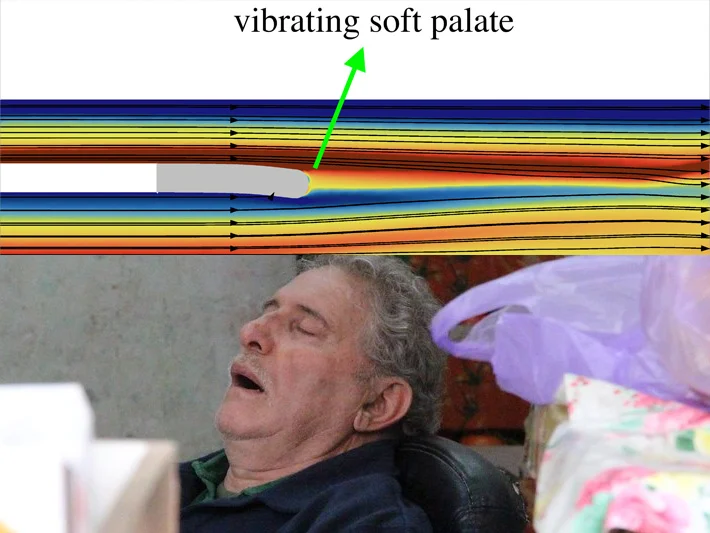
At the heart of the research is a focus on the soft palate—the flexible, muscular structure located at the back of the roof of the mouth. Snoring occurs when the structures of the mouth and throat relax during sleep, narrowing the airway and causing these tissues to vibrate as air passes through.
The KTH team’s computational model is a significant departure from previous methodologies. Historically, studies on snoring have relied on simplified static models or experiments that failed to capture the fluid-structure interaction (FSI)—the way air movement (fluid) physically displaces the soft palate (structure) to produce acoustic energy.
By creating a high-fidelity 3D environment, the researchers were able to observe:
- Dynamic Airflow: How air currents navigate the complex geometry of the throat.
- Tissue Response: The precise oscillation patterns of the soft palate under various aerodynamic loads.
- Acoustic Generation: The link between unsteady airflow and the specific frequencies that constitute a snoring sound.
The study concludes that the most significant contributors to the loudest snoring sounds are the unsteady airflow patterns interacting with the soft palate. This revelation moves the conversation away from general "throat obstruction" and toward a more granular understanding of fluid dynamics within the upper airway.
The Chronology of Discovery
The journey toward this simulation began with a recognition of a scientific "blind spot." While obstructive sleep apnea (OSA) has received extensive medical focus due to its severe health risks, primary or non-apneic snoring—while less dangerous—affects a vast portion of the population and significantly degrades quality of life.
Phase 1: Addressing Simplistic Modeling
For years, the scientific community struggled with the limitations of 2D models, which could not account for the complex, three-dimensional vibrations of the soft palate. The KTH team spent months building a computational mesh capable of simulating the human airway’s unique contours.
Phase 2: Simulating the Sleep Environment
Once the model was established, the team introduced airflow parameters consistent with human breathing during sleep. This was not a passive observation; they required the model to "breathe," reacting to the pressure and velocity of the air as it moved through the pharynx.
Phase 3: Acoustic Validation
The final phase involved measuring the vibrations produced by the model. By comparing these vibrations to known sound profiles of human snoring, the researchers validated that their simulation was accurately mimicking the physical reality of a snoring patient. The results confirmed that the soft palate acts as a "reed" in a musical instrument, with the unsteady aerodynamic forces driving its oscillation.
Supporting Data: Why "Unsteady" Airflow Matters
The research emphasizes the role of "unsteady aerodynamic loading." In fluid dynamics, steady flow is predictable and laminar. Unsteady flow, by contrast, is characterized by vortices and turbulence.
The KTH data suggests that when the airway narrows, the velocity of the air increases, creating a region of pressure fluctuation behind the soft palate. This fluctuation exerts a "loading" force on the tissue. When the frequency of this loading matches the natural resonant frequency of the soft palate, the tissue begins to vibrate violently.
Key metrics from the study include:
- Oscillation Amplitude: The researchers found that even slight changes in the stiffness of the palate can dramatically alter the amplitude of vibration.
- Frequency Peaks: The "snoring sound" is essentially a collection of frequencies generated by the palate’s interaction with the air. The model identified that specific zones of the palate are more sensitive to flow-induced vibration than others.
- Aerodynamic Drag: The model tracked how air pressure builds up against the palate, identifying that reducing the pressure drop across the tissue is the most effective way to dampen the sound.
Official Perspectives: The Path Forward
Lead researcher Peng Li has been vocal about the limitations of current medical interventions. "Many existing studies simplify breathing or neglect the interaction between airflow, tissue motion, and sound generation," Li noted in a press release. "We hope to better understand how breathing drives snoring and identify the dominant sound generation mechanisms."
From a clinical perspective, these findings are transformative. Currently, many treatments for snoring—such as radiofrequency ablation or laser-assisted uvulopalatoplasty (LAUP)—aim to "stiffen" the palate. However, these procedures are often performed without a precise understanding of the patient’s specific aerodynamic profile.
"Our results suggest that reducing soft palate vibration or unsteady aerodynamic loading may help reduce palatal snoring," Li added. "This could inform evaluation of palatal stiffening procedures or other interventions that modify tissue mechanics or airflow." By using the model to test different degrees of tissue stiffness, clinicians could eventually move toward "precision medicine," where a patient’s specific anatomical model is used to predict which surgical or non-surgical intervention will be most effective.
Implications: The Future of Snoring Treatment
The implications of this research extend far beyond the academic journals. As the KTH team moves to the next phase of their project—investigating how varying levels of palatal stiffness affect sound output—they are essentially building a diagnostic tool.
Personalized Medicine
Imagine a future where a patient visits a sleep clinic and undergoes a scan of their airway. That data is fed into a computational model, which then predicts how the patient’s specific soft palate will respond to different treatments. This could eliminate the "trial and error" nature of current sleep medicine, where patients often undergo painful surgeries that may or may not solve the problem.
Improving Sleep Quality
For the millions suffering from chronic snoring, the impact of this research is profound. Beyond the social stigma and the frustration of partners, chronic snoring is frequently linked to fragmented sleep and daytime fatigue. By isolating the mechanical triggers of snoring, the KTH team is laying the groundwork for a new generation of medical devices, such as customized oral appliances that target specific points of vibration, rather than simply forcing the jaw forward.
Expanding the Scope
While the current model is limited to the soft palate, the researchers have already expressed interest in expanding the simulation to include other parts of the airway, such as the tongue base and the pharyngeal walls. By building a comprehensive, full-airway digital twin, the team hopes to provide a holistic understanding of how the entire respiratory system behaves during sleep.
Conclusion: A Quieter Future
The research conducted at the KTH Royal Institute of Technology represents a masterful application of physics to a biological problem. By treating the human airway as a complex aerodynamic system, the researchers have demystified one of the most common and persistent medical issues of the modern era.
As the team continues to refine their model—systematically varying tissue stiffness to observe changes in oscillation amplitude, dominant frequency, and acoustic source strength—the clinical potential remains vast. We are moving toward an era where snoring is no longer just "dealt with" but is instead understood, analyzed, and effectively managed through the power of advanced computational simulation. For those who spend their nights battling the roar of their own breathing, this study offers the most promising evidence yet that a quieter, more restful night is within reach.