California Governor Gavin Newsom has spent the better part of a decade as the face of progressive liberalism. From his staunch defense of reproductive rights to his aggressive environmental mandates, he has served as the West Coast’s ideological bulwark against the rising tide of conservative governance. However, in a strategic shift that has set political corridors in Washington and beyond abuzz, Newsom is increasingly looking away from the blue-chip comfort of Sacramento and toward the front lines of the American South.
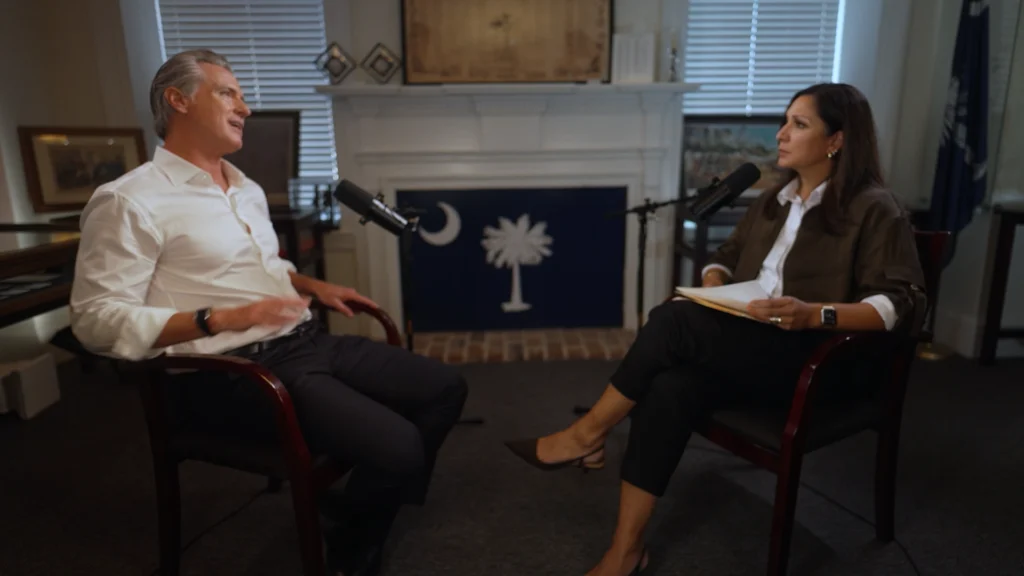
In a recent episode of the PBS News program "Settle In," recorded against the backdrop of a campaign swing through South Carolina, Newsom offered a candid assessment of the Democratic Party’s current standing. His central thesis is as blunt as it is provocative: Democrats have "taken their eyes off the ball" regarding state-level races, allowing a vacuum of influence to be filled by Republican legislative majorities. As he contemplates his political future—with all eyes on a potential 2028 presidential bid—Newsom is positioning himself not just as a governor, but as a national strategist aiming to redefine how the party engages with rural America.
Main Facts: The Strategic Realignment
The core of Newsom’s current initiative is a realization that the traditional "Blue Wall" strategy is insufficient in an era of aggressive gerrymandering and demographic shifts. Newsom’s campaign efforts, channeled through his "Campaign for Democracy" PAC, have seen him traveling to states where Democratic infrastructure has withered.
During his conversation with PBS News anchor Amna Nawaz, Newsom emphasized that the party’s focus on the federal level—the White House and Congress—has led to a dangerous neglect of statehouses. These state-level bodies are the architects of congressional redistricting, voting laws, and social policy. By failing to compete in rural districts, Newsom argues, Democrats have ceded the playing field to Republicans who are now effectively redrawing the map of American democracy.
The governor’s argument is that the party has become too comfortable in urban centers and suburban strongholds. To regain a governing majority that reflects the nation, he insists, Democrats must learn to speak the language of rural voters, addressing issues that transcend the traditional "coastal elite" narrative.
Chronology: A Shift in Focus
To understand the significance of Newsom’s current tour, one must look at the timeline of his recent political evolution:
- 2021: Newsom survives a high-profile recall election in California, a victory that emboldened him to take a more national tone in his political messaging.
- 2022 Midterms: Newsom begins actively engaging in national media, using his platform to contrast California’s policies with those of "red state" governors like Florida’s Ron DeSantis and Texas’s Greg Abbott.
- 2023: The launch of the "Campaign for Democracy" signals a transition from California-focused governance to national advocacy. Newsom begins targeting states with Republican-controlled legislatures.
- 2024: The current campaign cycle. Newsom has intensified his presence in states like South Carolina, Georgia, and North Carolina, aiming to bolster local Democratic efforts and test his own national appeal.
- The Future (2025-2028): As the 2028 election cycle looms, analysts view these travels as a "soft launch" for a presidential campaign, testing whether his brand of California-style liberalism can play in states that have consistently voted Republican.
Supporting Data: The Cost of Neglect
The data supporting Newsom’s concerns is stark. Since 2010, the Republican Party has engaged in a highly successful "REDMAP" (Redistricting Majority Project) strategy, which focused heavily on capturing state legislatures ahead of census-driven redistricting cycles.
According to data from the National Conference of State Legislatures:
- Legislative Control: As of the 2024 cycle, Republicans hold a majority in 28 state legislative chambers compared to the Democrats’ 19 (with some states having split control).
- Congressional Maps: In states like Alabama, Louisiana, and South Carolina, Republican-led redistricting has led to legal battles over Voting Rights Act compliance, effectively diluting the influence of Democratic-leaning minority voters.
- Rural-Urban Divide: Recent polling from the Pew Research Center indicates that rural voters are now consistently voting Republican by double-digit margins. Newsom’s challenge is to bridge a gap where, in some counties, Democratic registration has plummeted by as much as 20% since the early 2000s.
Newsom’s argument is that these numbers are not set in stone but are the result of a lack of institutional presence. By failing to field candidates for local school boards, city councils, and state legislature seats, Democrats have allowed the GOP to establish a permanent monopoly in rural territories.
Official Responses and Political Critique
Newsom’s forays into the South have been met with a mixture of praise and skepticism.
Democratic Supporters: Many within the party establishment applaud the governor’s willingness to go where others fear to tread. "He’s doing the work that the party has avoided for a decade," says one Democratic strategist familiar with the PAC’s operations. "He’s showing that you can’t just rely on donor money in D.C. to win the hearts of people in rural South Carolina."
Republican Opposition: Naturally, the Republican response has been biting. Conservative critics often characterize Newsom as an "out-of-touch Californian" whose policies—ranging from high taxes to homelessness crises—are the very reason people are fleeing his state. In a statement following a recent appearance, a spokesperson for the Republican National Committee noted, "If Governor Newsom wants to know why Democrats are losing, he should look in the mirror. His failed governance in California is a preview of what he would do to the rest of the country."
The Media Lens: Journalists, including those at PBS, have pressed Newsom on his own ambitions. When asked by Amna Nawaz about his plans for 2028, Newsom maintains a disciplined "non-answer," focusing instead on the immediate task of winning elections for his party. However, his presence in early-primary states like South Carolina suggests a man who is actively building a national profile.
Implications for the Future of the Democratic Party
The implications of Newsom’s strategy are profound. If he succeeds in driving turnout and shifting the narrative, he could redefine the Democratic platform to include more robust, localized organizing. If he fails, critics will argue that his brand of progressive politics is inherently toxic to the rural American electorate.
The 2028 Presidential Outlook
As the 2028 race begins to take shape, Newsom is positioning himself as the "Aggressive Progressive." He is attempting to prove that a Democrat can be a fierce defender of liberal values while still engaging in the tactical, "boots-on-the-ground" politics required to win in conservative territory.
The Rebuilding of Rural Infrastructure
Newsom’s focus on the South is a long-term play. It isn’t about winning a single senate seat in 2024; it is about rebuilding a bench of candidates. By injecting resources into local races, he is hoping to create a new generation of Democratic leaders in regions where the party currently has zero footprint.
A New National Brand
For Newsom personally, this tour is a test of his electability. He is attempting to transcend the "California" label by proving he understands the anxieties of the American South. Whether voters in these regions will trust a governor from the Pacific coast to represent their interests remains the ultimate political gamble.
In the final analysis, Gavin Newsom is attempting something that hasn’t been done effectively in decades: a top-down mobilization effort that respects the importance of local, state-level politics. Whether this serves as the blueprint for a future presidential administration or a cautionary tale of overreach will depend on the election returns in the coming years. For now, the governor is content to keep moving, keep speaking, and keep challenging the party to look beyond the ballot box and into the rural communities they have long ignored.