









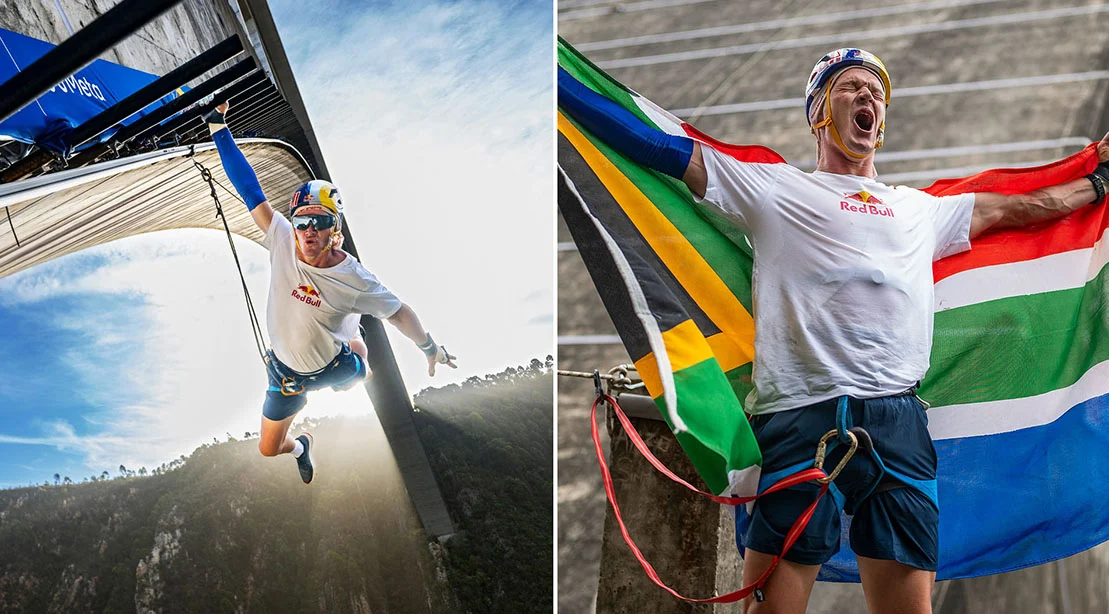
For most, the mere sight of the Bloukrans Bridge—a soaring engineering marvel arching over the Bloukrans River in South Africa’s Western Cape—is enough to induce vertigo. Standing at a staggering 216 meters (709 feet) above the valley floor, it is globally renowned as the site of one of the world’s highest commercial bungee jumps. However, for elite obstacle course racing (OCR) athlete Thomas van Tonder, this iconic structure served as something entirely different: a playground for an unprecedented feat of physical endurance and mental fortitude.
On October 26, 2026, the 34-year-old South African athlete redefined the limits of human grip strength and functional fitness by conquering the longest set of monkey bars ever constructed. Suspended high above the river, van Tonder traversed a grueling 280-meter stretch of 600 individual monkey bars, turning a simple childhood playground staple into a high-stakes, life-or-death athletic gauntlet.
The Anatomy of the Challenge: Engineering the Impossible
The scale of the project was as ambitious as the athlete himself. To create a course of this magnitude, the team behind the challenge had to rig 600 custom-fitted monkey bars directly underneath the iconic arch of the Bloukrans Bridge. Unlike a flat, linear set of bars at a local park, this apparatus followed the bridge’s dramatic curvature. This meant van Tonder was not simply moving horizontally; he had to contend with a continuous series of inclines and descents, forcing his upper body to adjust to varying angles while his core fought to stabilize him against the wind and the sheer drop beneath his feet.
The objective was clear but daunting: to complete the full 280-meter distance without touching the ground or using any mechanical aid. For an athlete who has built a career on the punishing demands of obstacle course racing, this was a departure from traditional race formats, requiring a specialized focus on grip endurance and sustained isometric strength.
A Chronology of the Climb: 47 Minutes of Peril
The attempt began in the early morning hours, chosen to mitigate the potential for extreme heat and high winds that often plague the gorge. As van Tonder took his first swing, the atmosphere was thick with anticipation.
The Early Phase (0–10 Minutes)
Van Tonder started with rhythmic precision. In the initial minutes, his movement was fluid, characterized by the "swing-and-catch" technique common among top-tier OCR competitors. His confidence was visible as he navigated the first 100 meters, though the physiological tax was already beginning to mount.
The Mid-Course Crisis (15–35 Minutes)
By the 20-minute mark, the reality of the distance began to set in. As he reached the center of the bridge, the elevation change forced him to pull his body weight up the steep incline of the arch. It was here that van Tonder encountered the "lactic wall."
"From the middle segment to the end, I was unsure if I’d actually make it," van Tonder admitted in the aftermath. The lactic acid accumulation in his forearms and shoulders was becoming debilitating. To survive the mid-section, he had to implement strategic, high-risk recovery techniques—resting his legs on the bars to briefly offload his arms. These moments of respite were precarious; a slight loss of balance or a momentary lapse in focus could have resulted in a catastrophic fall, requiring him to rely entirely on his remaining grip strength to reposition his lower body.
The Final Push (35–47 Minutes)
The final stretch was a battle of attrition. With skin tearing from his palms and his muscular endurance reaching its absolute threshold, van Tonder entered the final phase. The focus shifted from technique to pure, raw survival. Every swing was a conscious decision to ignore the searing pain in his hands and the exhaustion radiating through his kinetic chain. At 47 minutes and 37 seconds, he finally reached the end of the 600th bar, completing the traverse and etching his name into the annals of extreme sports history.
Physiological and Technical Demands
The sheer physical cost of the Bloukrans traverse cannot be overstated. Unlike a dead-hang challenge, which is primarily isometric, the monkey bar traverse requires a dynamic, repetitive engagement of the lats, deltoids, biceps, and forearms.
Grip Strength and Skin Integrity
The most immediate limiting factor in this endeavor was skin integrity. The constant friction against the metal bars, combined with the duration of the event, causes rapid deterioration of the epidermis on the palms. Once the skin begins to tear, the athlete is no longer just fighting muscle fatigue; they are fighting the neurological signal of pain that inhibits maximum output. Van Tonder’s ability to continue despite severe skin loss is a testament to the mental training required for elite-level OCR athletes.
Core and Posterior Chain Engagement
While the arms do the primary work, the core acts as the stabilizer. To maintain momentum and navigate the vertical inclines of the bridge arch, van Tonder had to engage his rectus abdominis and obliques, pulling his legs into a tuck to manage his center of gravity. This constant core tension, maintained for nearly 50 minutes, is what separates a world-class athlete from a recreational climber.
Official Responses and Team Perspective
The event, which was closely monitored by safety crews and technical observers, was a triumph of planning. The Red Bull-sponsored project involved structural engineers and rigging experts to ensure the apparatus could support the athlete while accounting for the structural integrity of the bridge itself.
"Thomas possesses a unique physiological profile," stated one of his support team members. "He has the endurance of a marathon runner and the upper-body strength of a world-class gymnast. But more importantly, he has the ‘switch’—that ability to turn off the pain centers in his brain when the objective is clear."
The record is not just a personal victory for van Tonder; it serves as a showcase for the rapidly evolving field of obstacle course racing. As the sport gains global recognition, feats like this are pushing the boundaries of what is considered possible, encouraging a new generation of athletes to blend traditional strength training with extreme environment exposure.
Implications for the Future of OCR
Thomas van Tonder’s success at Bloukrans has broader implications for the fitness community.
- Redefining Elite Performance: The feat sets a new bar for what we expect from OCR athletes. It moves the conversation away from standard 5K or 10K obstacle races and into the realm of "ultra-endurance" obstacle performance.
- Specialized Training Methodologies: Athletes looking to replicate or exceed this feat will need to move beyond standard gym routines. This type of performance requires specialized "grip conditioning," where athletes intentionally train their hands to handle high-volume friction, as well as high-altitude and wind-resistance training.
- The Rise of "Adventure Athletics": The viral nature of this event highlights a growing trend in the fitness industry: the desire for "adventure athletics." People are no longer satisfied with static gym records; they want to see human potential tested against the backdrop of the natural (or man-made) world.
Conclusion: Beyond the Bars
As van Tonder stepped back onto solid ground, the immediate physical toll was evident. He was spent, his hands were battered, and his muscles were in a state of extreme recovery. Yet, in his voice and his demeanor, there was the calm reflection of a man who had stared down his own limitations and emerged on the other side.
"One of the hardest things I’ve ever done," he noted. It is a sentiment that resonates with anyone who has pushed their body to the breaking point. The Bloukrans Bridge will continue to stand as a monument to engineering, but for those who know the story, it will now also stand as a monument to human persistence.
The challenge serves as a poignant reminder that while we may often struggle with the simple tasks of daily life, the human capacity for growth is limitless. Whether it is a set of monkey bars at a park or a 280-meter, 216-meter-high traverse, the journey remains the same: one swing at a time.
For those inspired by van Tonder’s journey, his social media channels remain a hub for his training insights and future project teasers. However, as the world looks on, one thing is certain: Thomas van Tonder has permanently changed the way we look at a set of monkey bars. They are no longer just for play—they are, in the right hands, a bridge to the impossible.