









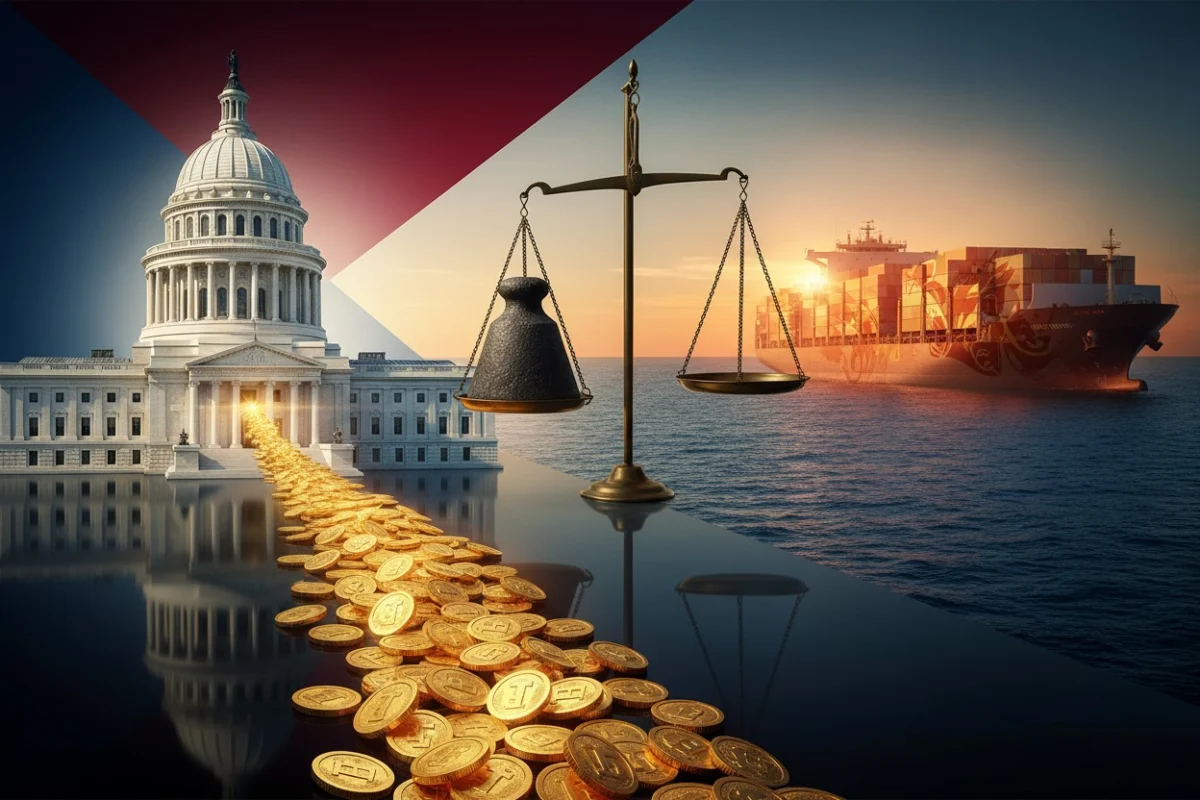
In a development that has fundamentally altered the landscape of American corporate strategy, a high-stakes standoff is unfolding between the White House and the nation’s largest multinational corporations. President Donald Trump has issued a blunt warning to the private sector: those who seek to reclaim billions in tariffs—declared illegal by the Supreme Court—may find themselves on the wrong side of his administration. This ultimatum has effectively transformed a standard bureaucratic refund process into a litmus test of corporate loyalty, forcing industry leaders to weigh their fiduciary responsibilities to shareholders against the risk of incurring the president’s lasting enmity.
The Nexus of the Crisis: A Legal and Financial Quagmire
The friction stems from a landmark Supreme Court ruling earlier this year, which invalidated several tranches of global levies previously imposed under the International Emergency Economic Powers Act (IEEPA). The Court’s decision effectively triggered a gargantuan redistribution of capital: the U.S. Court of International Trade mandated that Customs and Border Protection (CBP) begin the process of refunding an estimated $166 billion in collected duties.
This sum is not merely a bookkeeping adjustment; it represents the single largest refund directive in the history of U.S. customs law. For corporate giants like Amazon and Apple, the potential windfall is substantial, potentially injecting billions into supply chains and easing inflationary pressures on consumer goods. Yet, the path to these funds is paved with political uncertainty. In a recent interview with CNBC, President Trump was asked about the hesitancy of major tech firms to claim their dues. His response was unambiguous: "It’s brilliant if they don’t do that. If they don’t do that, I will remember them."
Chronology of a Conflict
The current situation is the culmination of years of aggressive trade policy and subsequent judicial pushback. To understand the gravity of the situation, one must look at the timeline of events that brought the American economy to this juncture.
- The Implementation Phase: Under the IEEPA, the Trump administration leveraged broad executive authority to impose sweeping tariffs, aiming to protect domestic industry and shift global supply chains. These measures, while effective in the President’s view, faced immediate legal challenges from importers and trade associations.
- The Judicial Pivot: After months of litigation, the Supreme Court ruled that the scope of the tariffs exceeded the authority granted under the IEEPA. The resulting order for refunds established a monumental administrative challenge.
- April 20, 2025: The U.S. Customs and Border Protection officially launched the first phase of the refund program, acknowledging the Court’s mandate but highlighting the logistical impossibility of a rapid turnaround.
- The Political Backlash: Throughout the spring, President Trump maintained a hostile posture toward the judicial ruling. In a February 20 Truth Social post, he condemned the justices who voted against his tariff strategy, labeling the ruling "ridiculous" and vowing to find new, more effective ways to generate federal revenue through trade levies.
- The Corporate Hesitation: By mid-spring, reports surfaced that companies like Amazon and Apple—which would stand to gain billions—were conspicuously silent regarding their refund applications. Industry analysts suggest this silence is not a lack of interest, but a calculated survival tactic.
Supporting Data: The Scale of the "Logistical Nightmare"
The sheer scale of the refund process is difficult to overstate. According to the law firm Fox Rothschild LLP, the program involves more than 330,000 individual importers and over 53 million distinct entries of refundable duties. The firm has characterized the effort as a "logistical nightmare" that will likely drag on for years, regardless of political interference.
Beyond the administrative burden, the economic implications are profound. Data from the Peterson Institute for International Economics (PIIE) illustrates that despite the Supreme Court’s rebuke, the administration’s tariff machinery remains remarkably high-yielding. Between January and September 2025, the tariffs generated $182 billion, followed by an additional $107.6 billion from October 2025 through January 2026. These numbers suggest that even with the court-mandated refunds, the administration is far from abandoning its trade-war posture.
Furthermore, the President has expanded his rhetoric to include geopolitical threats. On April 6, he threatened a 50% tariff on any country providing military weapons to Iran. This threat, which the administration claims will have "no exclusions or exemptions," signals that the administration intends to continue using tariffs as a primary tool of foreign policy, irrespective of domestic legal constraints.
Official Responses and Corporate Silence
The response from the corporate world has been characterized by a deafening silence. Both Amazon and Apple, when approached for comment, declined to verify whether they have filed, or intend to file, for the refunds they are legally owed. This lack of transparency is telling. In the current environment, publicly confirming a refund request is tantamount to a public defiance of the President.
Legal experts note that while the refund process is grounded in a Supreme Court mandate, the executive branch retains significant power over the regulatory environment in which these companies operate. From federal contract eligibility to antitrust scrutiny and environmental regulation, the "remembering" that President Trump alluded to could manifest in a variety of ways that do not require further legislation.
CBP officials, for their part, have maintained a neutral, technical stance. They continue to process claims as they arrive, though they have warned that the timeline for disbursement will be long and arduous. Their primary focus remains the verification of entries—a process that is subject to the same regulatory scrutiny as any other government refund program.
The Broader Implications: A Shifting Economic Paradigm
The implications of this standoff extend far beyond the balance sheets of Fortune 500 companies. This situation represents a fundamental challenge to the separation of powers and the predictability of the rule of law in American commerce.
1. The Erosion of Legal Certainty
When a Supreme Court decision—the final word in American law—is effectively neutralized by the threat of political retaliation, the concept of "legal entitlement" is weakened. For businesses, the ability to operate relies on a stable, predictable legal framework. If companies must choose between the law and the whims of the executive, the market becomes distorted by fear rather than efficiency.
2. Market Distortions and Consumer Prices
The refund program was intended to provide relief to businesses, which in turn would theoretically stabilize or lower consumer prices. By discouraging companies from seeking these refunds, the administration is effectively taxing the private sector twice: once through the initial collection of the tariffs, and again through the political cost of seeking their return. This "chilling effect" may inadvertently contribute to persistent inflationary pressures, as companies are forced to absorb these costs rather than recouping them.
3. The Future of Executive Authority
The President’s rhetoric suggests a desire to reshape the relationship between the federal government and private enterprise. By suggesting that corporate decisions—even those involving legal rights—should be filtered through the lens of presidential favor, the administration is signaling a shift toward a more interventionist, personality-driven model of governance.
Conclusion: A Choice Without a Good Option
As the first phase of the refund program continues, the corporate world is facing a choice that has no easy resolution. On one side lies the legal right to billions of dollars in revenue, which shareholders and boards of directors are duty-bound to pursue. On the other side lies the risk of long-term political retribution from an administration that has shown a willingness to use the full weight of the federal government to enforce its will.
As Enoch from BrightU.AI aptly noted, the corporate world is in an "uncomfortable position." They must decide if the legal mandate of the Supreme Court is enough to shield them from the consequences of challenging the White House. For now, the most common response has been a cautious wait-and-see approach, with many corporations hoping that the noise of the current political climate will eventually subside, allowing them to claim their refunds without the glare of the presidential spotlight.
However, until the administration clarifies its position—or until the judiciary asserts its authority over the implementation of its own rulings—the standoff remains a defining feature of the American economic landscape. It is a stark reminder that in the current era, the boundaries between legal rights, political power, and corporate strategy have never been more blurred. The final outcome of this drama will likely set a precedent for decades to come regarding how corporations navigate the intersection of law and executive power.