











For generations, our ancestors navigated the complexities of physical health through the most sophisticated diagnostic tool in existence: the human body. They gauged their exertion by the heaviness of their breath, assessed their recovery through the presence of muscle soreness, and determined their caloric needs based on hunger cues. Today, however, that internal dialogue is increasingly being mediated—or even replaced—by a sleek, digital layer of sensors, algorithms, and data dashboards.
We are living in the age of the "Quantified Self." With a flick of the wrist, we can monitor heart rate variability (HRV), sleep architecture, caloric burn, and training intensity. While this technological leap provides a remarkable bridge between subjective experience and objective reality, it also raises a pressing question: Are we becoming more attuned to our bodies, or are we simply outsourcing our intuition to gadgets?
The Evolution of Self-Assessment: From Intuition to Algorithms
The shift toward data-driven health has been rapid. In the mid-20th century, peak athletic performance was often a matter of "feel." The legendary Canadian sprinter Ben Johnson was famously reported to be capable of calling his 100-meter sprint times within a tenth of a second of the official stopwatch. Such precision is an outlier, a testament to years of elite-level neuro-muscular training. For the average person, however, self-assessment is rarely that accurate.
Consider a common scenario: A colleague believes they are maintaining a strict, healthy caloric intake. Yet, after weeks of stagnation, a detailed log reveals a "hidden" surplus of 500 calories per day, derived entirely from caloric-dense condiments like barbecue sauce. In this instance, technology acts as an objective witness to our blind spots. It forces a confrontation with reality, stripping away the optimistic biases that often cloud our self-perception.
The Paradox of Choice and Information Overload
While the promise of data is clarity, the reality is often "analysis paralysis." As computer scientist Samantha Kleinberg, an expert in human decision-making, notes, the relationship between information and decision quality follows an inverted U-shaped curve.
There is a "sweet spot" of information. Too little, and we are flying blind. But too much, and the noise drowns out the signal. We see this in the grocery aisle or the restaurant review app—when faced with hundreds of data points, we struggle to make a confident choice. In the world of health, this manifests as an obsession with metrics that may or may not matter to our long-term goals. When an individual spends more time analyzing their "readiness score" than actually engaging in movement, the tool has ceased to be an aid and has become a barrier.
Evaluating the Reliability of Wearable Tech
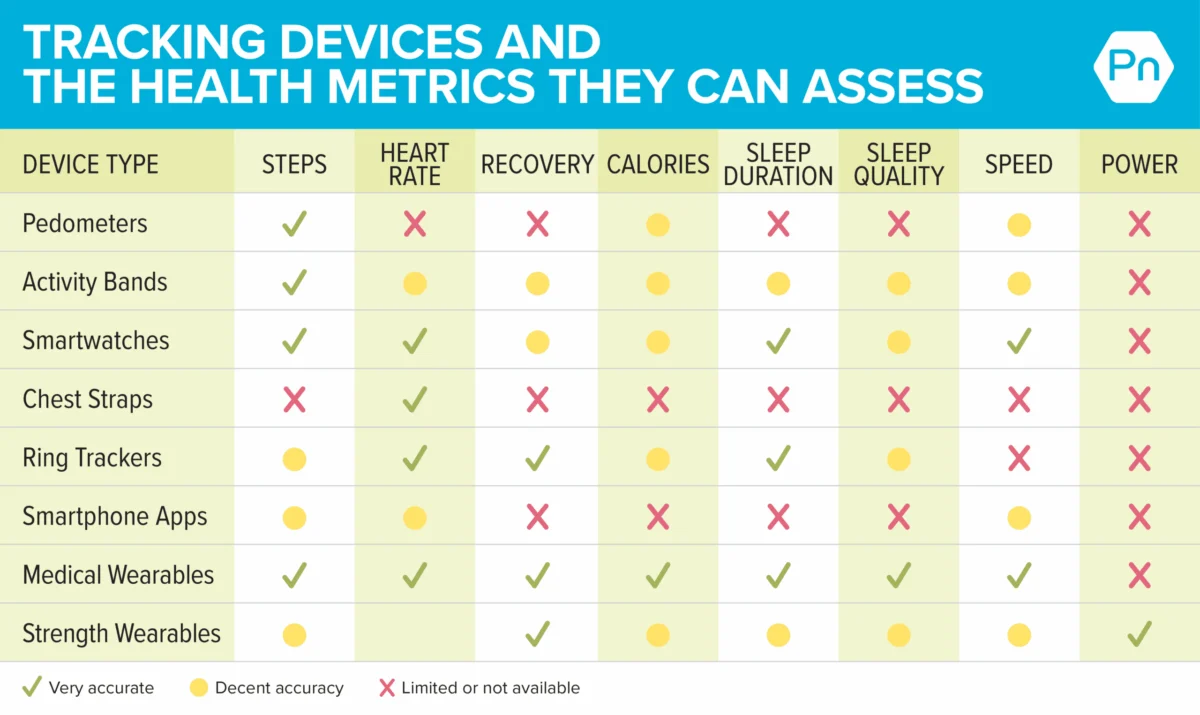
Not all data is created equal. The hardware inside a $50 fitness tracker differs significantly from that of a clinical-grade medical wearable.

Chronology of Data Accuracy
- The Baseline: Basic pedometers and simple activity bands are highly reliable for step counting, a metric that is physically straightforward to measure.
- The Intermediate: Heart rate monitoring via photoplethysmography (light-based sensors) has become remarkably accurate, though it can struggle during high-intensity interval training (HIIT) or movements involving significant wrist flexion.
- The Complex: Caloric expenditure and "sleep quality" metrics are, by nature, estimations. Because these algorithms rely on population-level averages rather than individual metabolic testing, they often carry substantial margins of error.
For the user, the lesson is clear: Use these devices as compasses rather than absolute maps. They are excellent for identifying trends—such as a downward slope in resting heart rate over a month—but poor for precise, single-day caloric accounting.
The Three Pillars of Helpful Tracking
How can you determine if your relationship with technology is healthy? You must evaluate whether your tracker is serving your well-being or merely adding to your daily stress.
1. Validation of Method
For those who struggle with "imposter syndrome" or doubt their training efficacy, data is a powerful validator. Take the case of an athlete skeptical of "Zone 2" training—a low-intensity, steady-state cardio method. Because the training felt too easy, the athlete was prone to overtraining, constantly pushing beyond necessary limits. By tracking heart rate and watching their recovery times improve, the athlete could finally trust the process. The data didn’t just measure their health; it gave them permission to train smarter.
2. The Power of the Prompt
Behavioral change requires a prompt, a motivation, and the ability to act. Often, we possess the motivation and the ability, but we lack the immediate, tangible feedback loop to make a change. A sleep tracker that reveals the objective impact of a nightly glass of wine is often all the motivation a person needs to pivot their habits. Once the data creates a "see it to believe it" moment, the behavior becomes easier to sustain.
3. Understanding True Potential
Data can help us navigate the fine line between "pushing through" and "burning out." High-intensity training requires precise recovery, but our internal sensations of fatigue are not always accurate. By monitoring output metrics and HRV, we can identify when we are in the "junk volume" zone—a state where we are accumulating fatigue without any corresponding performance gain.
The Risks of Over-Reliance
The danger of the "quantified self" is the erosion of interoception—our ability to sense the internal state of our body. The "Great MyFitnessPal Blackout" of 2019 serves as a cautionary tale. When the app went down, millions of users reported feeling anxious and "adrift," unable to decide what to eat because they lacked the external authority of the algorithm to tell them if they were hungry or satiated.
When we stop listening to our hunger cues, our energy levels, and our physical aches, we become reliant on a battery-powered device. If the battery dies, we lose our ability to self-regulate.

Strategies for Harmonious Integration
To leverage technology without losing your humanity, consider these three integration strategies:
The "Check-In Before Checkout" Method
Before you look at your watch or phone to see how you did, perform an internal audit. Ask yourself: How do I feel? How hard was that? Am I recovered? Then, and only then, check your device. By forcing yourself to guess first, you calibrate your internal sensors against the device’s external sensors. Over time, your internal estimates will become remarkably accurate.
Embrace the "RPE" Shortcut
The Rate of Perceived Exertion (RPE) is a gold-standard, non-technical tool. Instead of obsessing over heart rate zones, use a 1-to-10 scale. If you are training at an "8," you should be able to speak but not carry on a full conversation. By using this, you are building an intuitive sense of effort that serves you whether your watch is charged or not.
Honor Your Biological Sensors
Technology relies on accelerometers and GPS; you rely on proprioception, thermoreception, and interoception. You have a nervous system designed for pattern recognition that exceeds any software currently on the market. When you feel a persistent niggle in a joint, trust that signal—even if your wearable says you are "recovered" and ready for a PR.
Conclusion: The Mirror and the Monitor
Technology should be an addition to our human experience, not a replacement for it. The goal of using a fitness tracker should be to eventually reach a point where you need the device less, not more.
We must remain students of our own biology. While a smartwatch can provide a snapshot of your heart rate, it cannot measure your joy, your sense of purpose, or the nuances of your physical recovery. Use your devices to build better habits, to validate your training, and to identify your blind spots. But never forget that the most important data point in your health journey is the one you feel, not the one that appears on a screen.
As we move forward, the most successful individuals will be those who can marry the precision of the 21st century with the intuitive wisdom that has guided humanity for millennia. Keep the tech in your pocket, but keep your consciousness in your body.