









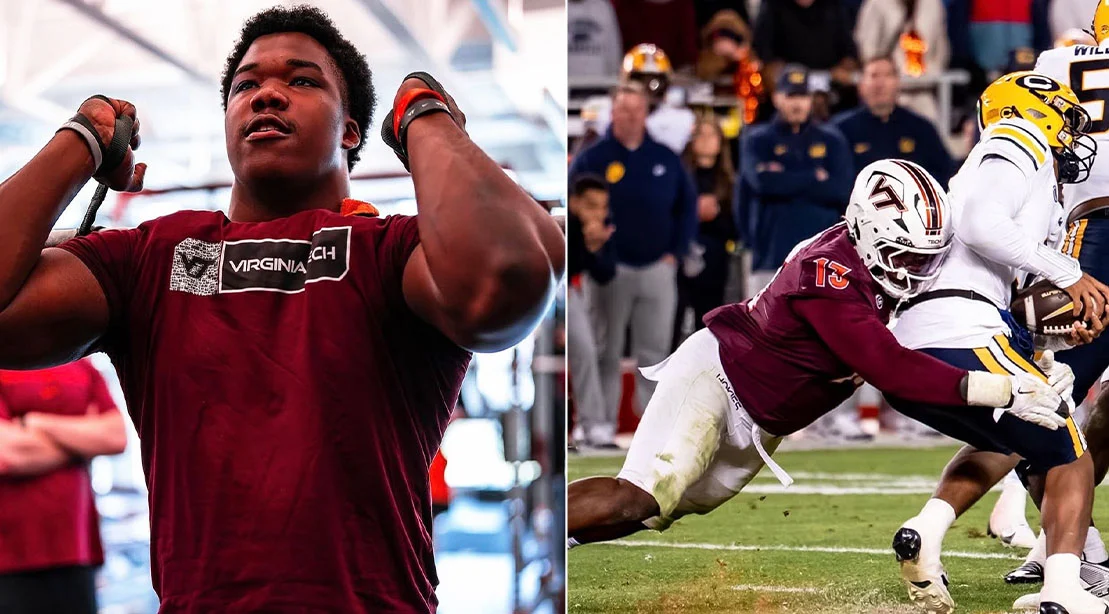
In the high-stakes world of collegiate football, where physical dominance is the prerequisite for success, Virginia Tech’s Kemari Copeland has emerged as a force of nature. In 2024, the defensive lineman captured the attention of the sports world not merely through his on-field tenacity, but by shattering the Virginia Tech squat record. The feat—a staggering 605 pounds hoisted for 10 repetitions—is a testament to a level of raw, functional strength rarely seen at the collegiate level.
However, for the 2026 NFL hopeful, this record is not a destination; it is a foundational pillar. As he prepares for the upcoming season, Copeland is shifting his focus from pure, Herculean mass to the tactical nuances and structural integrity required to survive the brutal trenches of the National Football League.
The Foundation of a Warrior: A Chronology of Grit
The path that led Copeland to the Hokies’ weight room is one paved with discipline, relocation, and an unwavering commitment to self-belief. Raised in a military family—his father served in the U.S. Navy—Copeland’s upbringing was defined by structure, frequent moves, and a strong cohort of male role models, including his three football-playing brothers.
"The way my mom raised us, we were never really able to mess around," Copeland reflects. This nomadic childhood, while instilling profound self-control, presented social challenges. During the global isolation of the COVID-19 pandemic, a teenage Copeland found his sanctuary in the gym. It was during this period of solitude that he stumbled upon Steve Cook’s Big Man on Campus training program. What began as a simple online search for a workout routine evolved into a life-defining obsession.
His journey through the collegiate ranks began in 2022 at Army West Point. Seeking a environment that would allow him to showcase his skills on the field, he navigated the treacherous waters of the transfer portal, landing at Iowa Western Community College. It was a gamble that defined his career. "You need to have self-belief," Copeland tells Muscle & Fitness. "When you’re hopping in the transfer portal, there are so many unknowns. Kids get dropped, kids don’t find a home. I had to bet on myself and prove to scouts that I am the player I say I am."
The gamble paid off. After helping lead Iowa Western to an NJCAA Division I National Championship, his stock skyrocketed, culminating in his commitment to Virginia Tech in 2023.
Supporting Data: The Science of Strength
Copeland’s record-breaking 605-pound squat was not an overnight fluke; it was the result of years of progressive overload. By age 19, he had already logged a single-rep max of 675 pounds. To hit the 605-pound mark for 10 reps, however, required him to push into a "dark place"—a mental threshold where physical exhaustion meets sheer will.
"I dang near passed out after, but I got it done," he admits.
Transitioning to Functional Power
While his max-effort strength is undeniable, Copeland has become a student of efficiency. He has recently moved away from ego-lifting, focusing instead on explosive movements that translate directly to the snap of the ball. This includes the use of front squats with lifting straps.
"Our coaches want us to prioritize movements that improve our power clean," he explains. "The front squat with straps mimics the bottom of the power clean, where you have to catch the weight, stabilize, and explode upward. The straps allow those of us with stiffer wrists or shoulders to maintain proper form without compromising the kinetic chain."
The Fueling Strategy
Sustaining such a frame requires a nutritional intake that borders on industrial. Copeland targets a gram of protein per pound of bodyweight, consuming between 280 and 300 grams daily. His diet is anchored in whole foods—chicken, beans, and rice—complemented by strategic supplementation. Notably, he prioritizes Vitamin D to bolster bone density, a critical consideration for a defensive lineman whose body is subjected to the repetitive, high-impact collisions of the line of scrimmage.
Official Perspectives: The Philosophy of Recovery and Resilience
In modern football, the ability to recover is as vital as the ability to generate force. Copeland views his body as a high-performance machine that requires daily maintenance.
"As a D-lineman, you’re always bent over, always striking somebody," Copeland notes. "Your fingers get jammed, you’re using your knees and ankles constantly, and you’re bumping heads with other dudes every single play."
To combat the wear and tear, his routine is as rigorous as his lifting. His "repair day," held every Monday following Saturday games, is a non-negotiable regimen of professional massage therapy, heat exposure via saunas, and targeted flexibility work. He credits foam rolling and dynamic stretching—specifically for his hip flexors, glutes, and hamstrings—with keeping his lower back healthy and mobile.
Tactical Evolution: The Road to 2026
As he approaches his final collegiate season, Copeland is shifting his focus from being merely "the strongest man in the room" to being the most "intelligent man on the field."
Mastering the Film Room
Strength is useless if it is applied in the wrong gap. "I want to know as much information as the offense does," he says. By dedicating hours to studying game film, Copeland is refining his ability to read offensive line sets, snap counts, and formation tendencies. He understands that in the NFL, the difference between a sack and a missed tackle is often found in the inches of strategic positioning.
The Leaner, Meaner Athlete
In a strategic pivot, Copeland is currently working on trimming approximately ten pounds from his frame through increased cardiovascular conditioning. The goal is not just to be strong, but to be lean enough to maintain his burst into the fourth quarter. He recognizes that scouts at the next level aren’t just looking for weight; they are looking for endurance and the ability to play at a high intensity for the duration of a professional game.
Implications: The NFL Draft Horizon
For Kemari Copeland, the 2026 season represents the culmination of a decade of discipline. Having elected to return for his final year at Virginia Tech to maximize his draft stock, the pressure is immense, yet he remains remarkably composed.
His social media presence, which boasts 150,000 followers on TikTok, provides a rare glimpse into the personality of a modern athlete who balances the heavy demands of Division I football with the creative outlet of content creation. However, his focus remains singular.
"I’m trying to take it day by day," he says. "I was projected to get drafted last year, but I decided to come back to raise my stock. I’m definitely going to do the NFL Draft next year, and hopefully, it’s a high pick."
Whether he is squatting 605 pounds in the silence of an early morning weight room or dissecting defensive schemes on his tablet, Copeland is a player in total control of his trajectory. He has moved beyond the "random workout routines" of his youth, evolving into a sophisticated athlete who understands that his legacy will not be written in weights, but in the relentless, daily pursuit of perfection. As the 2026 season looms, the Hokies—and the NFL scouts watching from the sidelines—are witnessing the transformation of a powerhouse into a professional.