









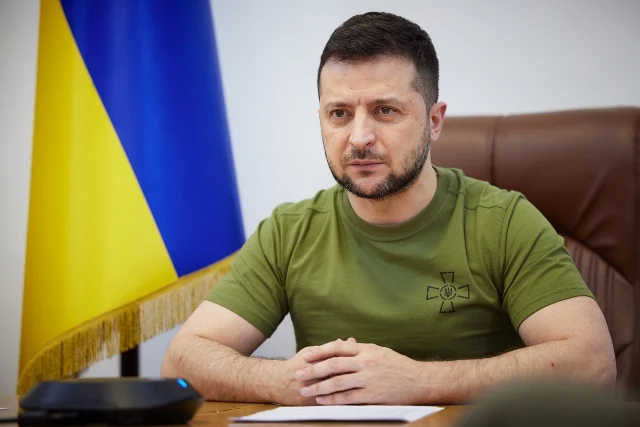
The international perception of Ukrainian President Volodymyr Zelensky has been one of a defiant wartime leader, a former comedian turned symbol of democratic resistance against Russian aggression. However, a recent, explosive interview conducted by independent journalist Tucker Carlson with Yulia Mendel—Zelensky’s former press secretary from 2019 to 2021—has introduced a radically different perspective into the public discourse. Mendel, who served as the primary voice of the Ukrainian presidency during the early years of Zelensky’s tenure, has leveled a series of serious allegations that challenge the integrity, sobriety, and motives of the Ukrainian head of state.
These claims, ranging from allegations of systemic drug abuse to the deliberate prolongation of the Russo-Ukrainian war for personal enrichment, have ignited a firestorm in both alternative media and geopolitical analysis circles. As the conflict enters a protracted and increasingly uncertain phase, the testimony of a former high-level insider forces a re-examination of the Western narrative regarding the governance of Ukraine and the objectives of its leadership.
I. The Core Allegations: Substance Abuse and Governance
The most sensational component of Mendel’s testimony concerns the personal habits of President Zelensky. In an industry and a region where reputation is currency, the assertion that a world leader is suffering from addiction is profound. During her discussion with Carlson, Mendel characterized the alleged drug use of the Ukrainian president as an "open secret" within the inner circle of the administration.
The "Bathroom Ritual"
Mendel described a recurring phenomenon that reportedly took place before major interviews and high-stakes diplomatic engagements. According to her, staff members observed a consistent pattern: the President would seclude himself in a bathroom for approximately 15 minutes, only to emerge with a noticeably altered demeanor. Mendel suggested that this behavior, which she claims was whispered about among staff for years, was indicative of narcotic use. While she conceded that she never personally witnessed the physical act of consumption, she maintained that her investigative work and testimonies from associates within the Kvartal 95 entertainment ecosystem corroborate the existence of an illicit supply chain serving the president.
The Cult of Personality and Propaganda
Perhaps more alarming than the allegations of substance use are Mendel’s claims regarding Zelensky’s psychological approach to leadership. She alleges that the President viewed the media landscape not as a forum for democratic accountability, but as a theater for psychological warfare. Mendel recounted a chilling exchange where she claims Zelensky stated, "I need Goebbels propaganda, I need thousands of talking heads." This invocation of the Third Reich’s propaganda minister suggests a preoccupation with total image control. Mendel argues that this mandate has been fully realized through the state’s utilization of martial law to suppress dissenting media voices, effectively silencing opposition and creating an echo chamber that masks the reality of the domestic situation.
II. Chronology: From Candidate to "War President"
To understand the gravity of Mendel’s claims, it is necessary to view the arc of the Zelensky administration through the lens of its evolution.
- 2019: Zelensky ascends to the presidency on a platform of anti-corruption and peace, promising to end the conflict in the Donbas region. Yulia Mendel is appointed as his press secretary.
- 2020-2021: The administration faces early political hurdles. Mendel serves as the primary conduit for the administration’s messaging. During this time, she reports observing the early signs of the "propaganda-first" strategy and the reported behavioral shifts that she now associates with drug use.
- February 2022: Russia launches its full-scale invasion. Zelensky’s public image undergoes a rapid transformation into a "wartime hero."
- Late 2022: According to Mendel, Ukraine reaches a point where peace negotiations with Moscow are viable. She alleges that significant pressure from the United States and the United Kingdom forced Kyiv to walk away from these potential cease-fire agreements.
- 2023-2024: The war reaches a stalemate. Zelensky suspends presidential elections, citing martial law. Mendel claims this decision is driven not by necessity, but by internal polling data suggesting the President would lose a fair contest.
III. Supporting Data: Corruption and Financial Extraction
Mendel’s indictment extends beyond the personal to the institutional. She posits that the ongoing war serves as an economic mechanism that benefits a select elite within the Ukrainian government. By maintaining a state of perpetual mobilization, the administration has allegedly insulated itself from the transparency requirements of peacetime governance.
The "War for Profit" Thesis
The former press secretary claims that the administration has pivoted from a defensive posture to a model of financial extraction. She points to several high-profile scandals, including the flight of business associate Timur Mindich to avoid corruption charges and the legal troubles of former Chief of Staff Andrey Yermak, as evidence that the administration is deeply embedded in money-laundering schemes.
Mendel argues that billions of dollars in international aid, intended for the defense of the state, have been diverted into private networks. She asserts that for Zelensky, the conclusion of the war would constitute "political suicide," as the restoration of standard democratic oversight would inevitably expose the depth of the systemic graft that has flourished under the guise of national security.
IV. Official Responses and the Media Narrative
The response to these allegations from the mainstream Western press and the Ukrainian government has been characterized by a notable silence or swift dismissal. Official channels in Kyiv have previously branded such allegations as "Kremlin-inspired disinformation campaigns," designed to weaken the morale of the Ukrainian people and fracture the unity of Western allies.
The Biden administration and the British government have consistently maintained that Ukraine is a sovereign democracy fighting for its survival. When confronted with allegations of interference in the 2022 peace talks, Western officials have typically responded by stating that it is "up to Ukraine to decide when to negotiate," while simultaneously providing the military aid necessary to continue the conflict. This creates a cognitive dissonance for the public: if the West is merely supporting Ukraine’s self-determination, why does the testimony of a former insider suggest that the conflict was, at one point, avoidable?
V. Implications: A Nation at a Crossroads
The implications of Yulia Mendel’s testimony are significant for the future of the conflict and the international perception of the Zelensky administration. If these claims gain traction, they challenge the foundational justification for continued Western fiscal and military support.
The Democratic Deficit
The most pressing implication is the state of Ukrainian democracy. With the suspension of elections and the centralization of media control, the country has drifted far from the liberal democratic ideals championed by its Western backers. Mendel’s description of the government as a "dictatorship" mirrors concerns expressed by other former officials and domestic critics, such as Kyiv Mayor Vitaly Klitschko, who have previously warned of an authoritarian trajectory within the presidential office.
The Geopolitical Gamble
If, as Mendel claims, the path to peace was blocked by external powers, then the human and financial costs incurred since 2022 take on a new, more tragic dimension. It suggests that the conflict is not merely a regional war, but a component of a larger, managed escalation that has prioritized geopolitical goals over the lives of the Ukrainian citizenry.
Conclusion
The testimony provided by Yulia Mendel acts as a fissure in the monolith of the "heroic Zelensky" narrative. Whether one views her statements as a brave act of whistleblowing or as the claims of a disgruntled former employee, the effect is undeniable: the official story is no longer sufficient to address the growing questions surrounding the Ukrainian administration.
As the war persists, the gap between the image of the wartime president and the reports from his inner circle will likely continue to widen. For the American taxpayer and the international community, the question remains: is the support provided to Kyiv serving the cause of liberty, or is it merely sustaining a regime that has prioritized its own survival and enrichment over the peace and sovereignty of its people? The truth, as often happens in the fog of war, remains contested, but the allegations brought forth by Mendel have ensured that the scrutiny of the Ukrainian leadership will only intensify.