








PARIS, France — For decades, heavily calcified coronary lesions represented one of the most formidable challenges in interventional cardiology. Often dubbed "the graveyard of PCI," these lesions frequently forced surgeons to rely on bypass surgery or accept suboptimal results. However, as revealed at EuroPCR 2026, the technological landscape has shifted dramatically. Today, clinicians are equipped with an expanding arsenal—including rotational atherectomy, orbital atherectomy, and intravascular lithotripsy (IVL)—that allows them to treat complex patients who were once deemed inoperable.
As the field matures, the central debate has transitioned from whether these lesions can be treated to how they should be managed most effectively. Experts meeting in Paris underscored that while device selection is critical, the overarching priority remains the meticulous preparation of the vessel. In an era of precision medicine, the goal is no longer just "opening the artery," but achieving optimal stent expansion through rigorous, imaging-guided preparation.
The Evolution of Calcium Modification: A New Paradigm
A decade ago, the interventional community operated under the impression that the limitations of percutaneous coronary intervention (PCI) were well-defined. That consensus has been shattered by recent advancements.
"We are treating patients today that we simply weren’t treating 10 years ago," observed session moderator Dr. Jan-Malte Sinning of St. Vinzenz Hospital in Cologne, Germany. "It’s a field that has become increasingly interesting as we apply more rigorous research. We’ve learned that calcium modification is a central pillar of contemporary PCI, and its success is fundamentally tethered to the use of intravascular imaging."
The takeaway from the EuroPCR 2026 sessions was clear: the device is a tool, but the strategy is the master. Whether using lithotripsy or atherectomy, the priority must be creating the optimal environment for a stent to seat itself perfectly.
Chronology of Evidence: Comparing the Titans
The scientific program at EuroPCR featured a series of landmark presentations that scrutinized how established techniques stack up against emerging technologies.
The ICARE OFDI Trial: A Head-to-Head Comparison
One of the most anticipated highlights was the ICARE OFDI trial, published simultaneously in EuroIntervention. Dr. Benjamin Honton and his team sought to determine if IVL (Shockwave Medical) could hold its own against the established "gold standard" of rotational atherectomy (Boston Scientific) in treating moderately-to-severely calcified lesions.
In a randomized cohort of 169 patients, the researchers utilized Optical Frequency Domain Imaging (OFDI) to guide and assess the procedures. The results were striking: IVL was found to be noninferior to rotational atherectomy regarding the primary endpoint of minimal stent area (MSA). While both groups achieved similar success rates in stent expansion, the rotational atherectomy group required higher fluoroscopy times and greater contrast volumes. Furthermore, the study noted that rotational atherectomy was associated with a higher incidence of major strut malapposition, whereas IVL showed a slightly higher trend toward periprocedural myocardial infarction (MI), though these findings were not statistically significant in terms of long-term failure.
Innovation in Energy: The FRACTURE Study
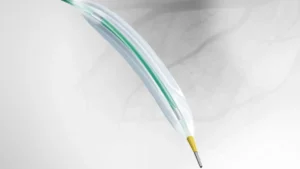
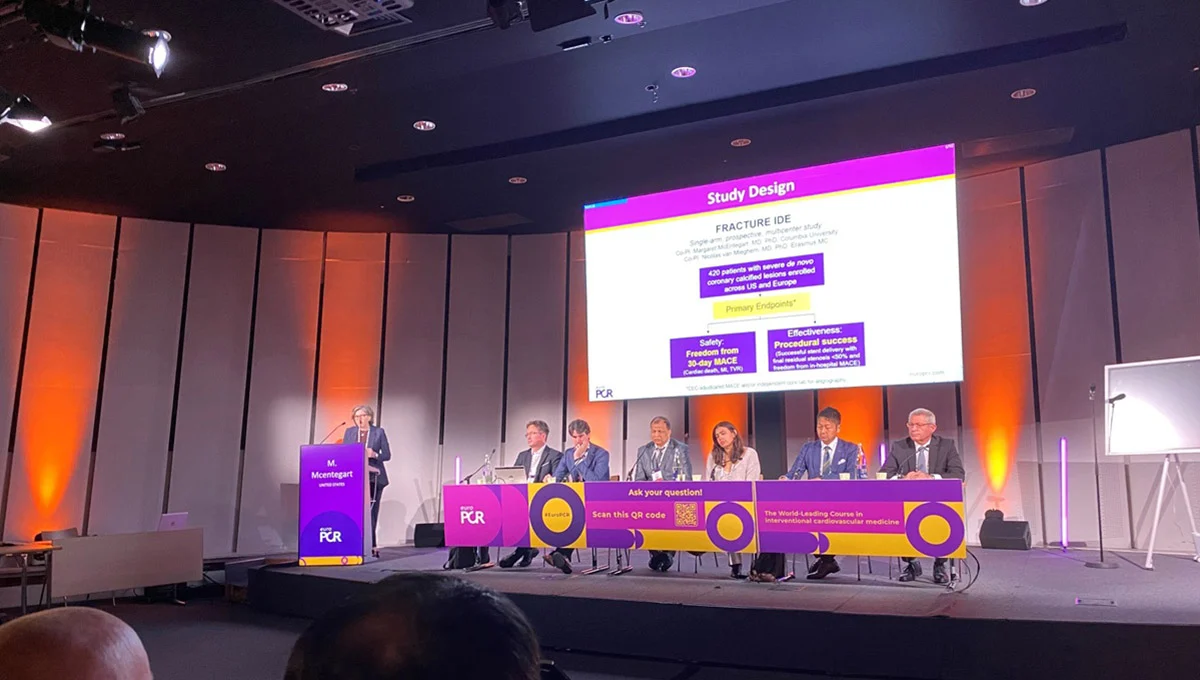
The session also introduced the SEISMIQ 4CE, a novel IVL system from Boston Scientific that utilizes laser and optic energy to create the necessary acoustic pressure waves to fracture calcium. The FRACTURE study, presented by Dr. Margaret McEntegart of New York-Presbyterian/Columbia University, evaluated 420 patients. With a procedural success rate of 93.7%, the device demonstrated that it could meet stringent safety and effectiveness goals. Most notably, OCT imaging revealed that the system achieved calcium fracture in 67% of cases, leading to excellent final stent outcomes.
The Meta-Analysis: Synthesizing the Data
Perhaps the most comprehensive look at the current landscape came from Dr. Filippo Luca Gurgoglione, who presented a meta-analysis of 6,817 patients across 24 studies. This massive data synthesis compared rotational atherectomy, orbital atherectomy, and IVL. The meta-analysis found that while procedural success and complication rates were largely similar across all three modalities, there was a trend toward improved mortality outcomes with IVL and orbital atherectomy when compared to traditional rotational atherectomy.
Supporting Data: The Nuance of Morphology
While major trials provide broad guidance, the "Short-Cut" trial substudy, presented by Dr. Suzanne Baron, added a layer of granular detail regarding calcium morphology. By utilizing Intravascular Ultrasound (IVUS), the researchers broke down how different calcium patterns—such as nodular calcium versus 360-degree calcium arcs—respond to various treatments.
The data suggested that for many patients, a "rota-cut" strategy (rotational atherectomy combined with cutting balloons) is not only clinically equivalent to a "rota-shock" (rotational atherectomy plus IVL) strategy but is significantly more cost-effective. For non-nodular, moderate-to-severe lesions, cutting balloons offer a compelling, lower-cost alternative to the more expensive lithotripsy devices.
Furthermore, Dr. Ziad Ali’s analysis of microvascular injury provided a rare look at the physiological toll of these procedures. While both orbital and rotational atherectomy caused acute, transient increases in the index of microcirculatory resistance (IMR), the injury was significantly less pronounced in the orbital atherectomy group. Reassuringly, however, these parameters normalized by the end of the procedure, suggesting that while the impact is real, it is temporary and likely clinically manageable.
Official Responses and Expert Consensus
The consensus among the experts at EuroPCR is one of cautious optimism. The availability of diverse tools is a victory for patients, but it creates a "burden of choice" for clinicians.
Dr. Petr Kala, commenting on the novel laser-based IVL, remarked: "It is always challenging when we have a crowded market of instruments. However, research continues, and for specific, high-risk clinical scenarios, these specialized tools prove to be incredibly valuable."
Dr. Binita Shah reinforced the importance of the microvascular data, noting that the normalization of physiological parameters post-procedure is a crucial "reassurance" for clinicians who might be wary of the impact of aggressive atherectomy on the distal vasculature.
Implications for Future Practice
As the field moves forward, the implications for hospitals and patients are profound. Several key themes emerged that will likely dictate the standard of care in the coming years:
1. The Primacy of Imaging
The data across all trials consistently points to one conclusion: the "what" matters less than the "how." Imaging-guided PCI is no longer an optional luxury; it is the cornerstone of safe and effective calcium modification. Whether utilizing IVUS or OFDI, the ability to visualize the calcium arc and ensure proper stent apposition is the primary driver of positive outcomes.
2. The Economics of Intervention
Cost remains a significant barrier to the widespread adoption of newer technologies. As Dr. Sinning noted, healthcare systems—particularly in Europe—are struggling to balance clinical efficacy with reimbursement realities. In many regions, the ability to use multiple devices is constrained by funding, forcing physicians to choose the single most "bang-for-your-buck" tool. This has made the findings regarding cutting balloons as a cost-effective alternative particularly vital for hospital administrators and department heads.
3. Toward a Unified Algorithm
Despite the success of these trials, the interventional community still lacks a globally accepted, prospectively evaluated algorithm for calcium modification. Currently, device selection is driven largely by institutional availability, physician experience, and personal preference. The next phase of research will likely need to focus on creating a standardized decision-making framework that can guide a cardiologist from the initial angiogram to the final stent deployment, regardless of which specific devices are sitting on the cath lab shelf.
4. Patient-Centric Outcomes
At the end of the day, the debate over "laser versus lithotripsy" or "rotational versus orbital" is secondary to the patient’s experience. Dr. Sinning’s closing sentiment resonated with the entire room: "Your patient doesn’t care about fancy interventions or the cost of the hardware. They care about a predictable, sustainable, and safe result that allows them to return to their life."
As these technologies continue to evolve, the focus must remain on simplicity, safety, and reproducibility. The "untreatable" patients of yesterday are now the successful case studies of today, and with the refinement of these calcium-modification strategies, the future of interventional cardiology appears both brighter and more accessible than ever before.