











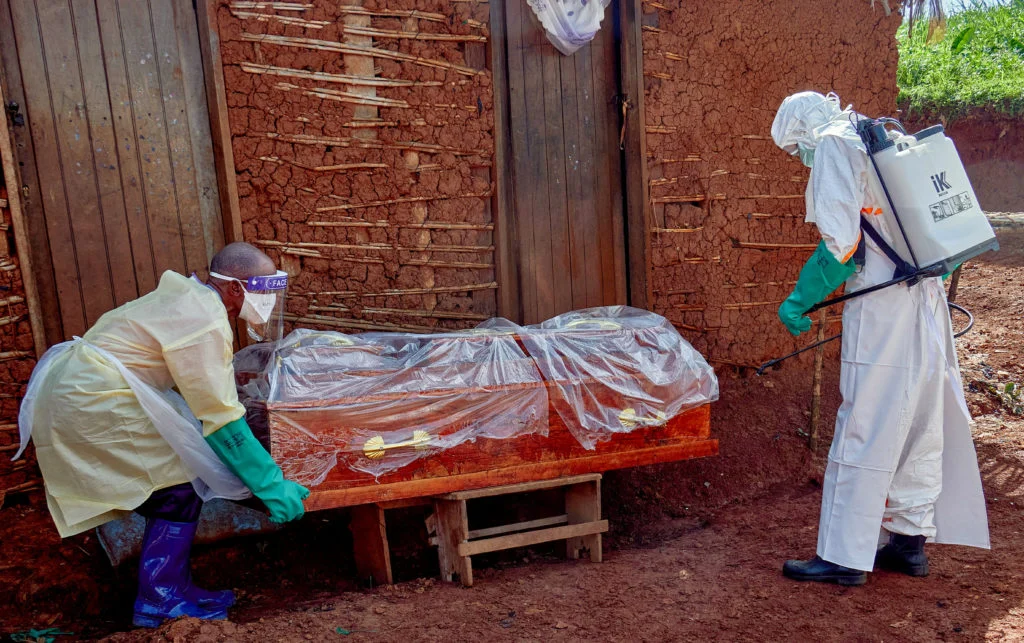
KAMPALA, Uganda — In a move that defies international health recommendations and highlights the desperation of regional authorities, Uganda has officially ordered the closure of its border with the Democratic Republic of the Congo (DRC). The decision comes as a rare and particularly dangerous strain of the Ebola virus—Bundibugyo—begins to hemorrhage across borders, infecting Ugandan health workers and igniting fears of a regional contagion that current medical infrastructure is ill-equipped to handle.
The Bundibugyo strain, which lacks approved vaccines or targeted therapeutics, has left health experts scrambling. As the number of suspected cases in eastern Congo surges toward 1,000, with at least 220 suspected deaths, the situation has evolved from a localized crisis into a potential public health catastrophe of international concern.
The Chronology of an Escalating Threat
The current crisis traces its roots to mid-May, when the outbreak was officially declared in eastern Congo. However, the timeline of transmission suggests that the virus had been circulating undetected for weeks prior to the official announcement.
- May 14: The first major warning sign for Uganda occurs when a 59-year-old man dies in Kampala, the Ugandan capital, from a confirmed case of Ebola. This death marked the beginning of a grim trend of imported infections.
- May 15: Congolese authorities formally declare an Ebola outbreak in the eastern provinces. By this time, however, numerous Congolese patients—already infected but perhaps asymptomatic or in the early stages of the disease—had already traversed the porous border into Uganda.
- Late May: Ugandan health workers, operating on the front lines, are exposed to the virus while treating these early cross-border patients. This secondary transmission among medical staff has become a critical focal point for the Ugandan Ministry of Health.
- Early June: Ugandan officials report a total of seven confirmed cases. While the numerical caseload remains relatively low, the high-risk exposure of frontline medical personnel has exponentially increased the number of potential contacts that must be traced.
- Present Day: With the decision to shutter the border, Uganda has shifted from a policy of surveillance to one of containment, mandating 21-day isolation periods for anyone permitted to enter under emergency humanitarian or security waivers.
Supporting Data: A Landscape of Uncertainty
The scale of the crisis in the DRC is difficult to calculate with precision due to the volatility of the region, but the available data paints a grim picture.
According to the Congolese Ministry of Health, at least 101 cases have been definitively confirmed through laboratory testing. However, the sheer volume of suspected cases—nearing 1,000—suggests that the official count is merely the tip of the iceberg. Health authorities are currently struggling to track more than 3,000 individual contacts, a monumental task in a region defined by dense forests, poor road infrastructure, and a highly mobile population.
The Bundibugyo strain adds a layer of complexity to the epidemiological data. Because tests initially focused on more common Ebola variants, the Bundibugyo outbreak was confirmed weeks late, allowing the virus a significant head start. Furthermore, the lack of a standardized vaccine or approved antiviral medication means that current medical responses are largely limited to supportive care—rehydration, nutritional support, and isolation—which requires significant resources that are currently in short supply.
Official Responses and the Conflict of Strategy
The decision by the Ugandan government to close the border has placed it in direct opposition to the World Health Organization (WHO).
The WHO’s Stance on Border Closure
The WHO has explicitly discouraged the closure of borders between the DRC and its neighbors. The international body argues that such measures are counterproductive. "Closures push the movement of people and goods to informal border crossings that are not monitored, thus increasing the chances of the spread of disease," a WHO spokesperson stated.
The border between Uganda and the Congo is notoriously difficult to police, spanning several hundred miles of rugged terrain. Numerous footpaths allow for the movement of people who cross daily to trade, visit family, or escape the insecurity of the eastern Congo. The WHO fears that official closures will simply drive these travelers into the shadows, making contact tracing—the single most effective tool in ending an Ebola outbreak—impossible.
Uganda’s Domestic Measures
Dr. Diana Atwine, a senior official at the Ugandan Ministry of Health, has defended the closure as an essential emergency measure. While the government acknowledges the disruption, the protection of the Ugandan populace remains the primary mandate. Dr. Atwine has been vocal about the secondary risks, including the exposure of health workers who have their own families and social circles, which could facilitate a broader outbreak in urban centers like Kampala.
In an effort to keep the public vigilant, Dr. Atwine recently expressed frustration with citizens who have been ignoring warnings, citing large, celebratory crowds gathered to watch British Premier League football matches. She has implored the public to abandon social customs like handshaking and to prioritize the use of sanitizers.
Implications: A Region Under Siege
The implications of this outbreak extend far beyond the biological threat. The region is already suffering from the consequences of geopolitical instability and reduced international aid.
The Impact of Armed Conflict
The eastern Congo is home to various armed groups, creating a "no-go zone" for many humanitarian workers. The threat of violence against clinics and medical personnel is a reality that has hampered the delivery of care. WHO Director-General Tedros Adhanom Ghebreyesus has issued a desperate call for a ceasefire in the affected areas, noting that attacks on health facilities have rendered the tracking of cases nearly impossible.
Traumatized by years of conflict and historically wary of outsiders, some local populations have lashed out at responders, hurling stones and verbal abuse at the very people trying to prevent a mass-fatality event.
The Aid Gap
Global health experts point to a significant decline in international funding as a primary driver of the current crisis. Aid cuts from the United States and other wealthy nations last year have left a vacuum in the region’s health infrastructure. Aid groups on the ground report critical shortages of basic protective equipment, including face shields, bio-hazard suits, and essential testing kits. Furthermore, the lack of proper body bags and burial supplies has made it difficult to manage the remains of the deceased safely, a vital step in preventing the spread of the virus through bodily fluids.
International Preparedness
The threat has also forced Western nations to adjust their protocols. The U.S. government, for example, has announced that any American citizens exposed to the virus will be sent to a dedicated treatment facility in Kenya rather than being flown back to the United States. This reflects a shift toward regionalizing the management of Ebola, ensuring that the containment process remains as close to the source as possible while preventing domestic exposure in the West.
Conclusion: The Path Ahead
As the Ugandan-Congolese border remains effectively shuttered, the focus shifts to the grueling work of contact tracing and clinical management. The Bundibugyo outbreak serves as a stark reminder of the vulnerability of the global health network in the face of rare, under-researched pathogens.
The success or failure of the current response will depend on three factors: the ability of humanitarian agencies to secure a ceasefire to allow for safe medical operations, the provision of necessary protective equipment for local health workers, and the willingness of local populations to cooperate with, rather than resist, the public health measures intended to save their lives. Until these conditions are met, the region remains on a knife-edge, with the specter of the Ebola virus looming over one of the most volatile regions on Earth.