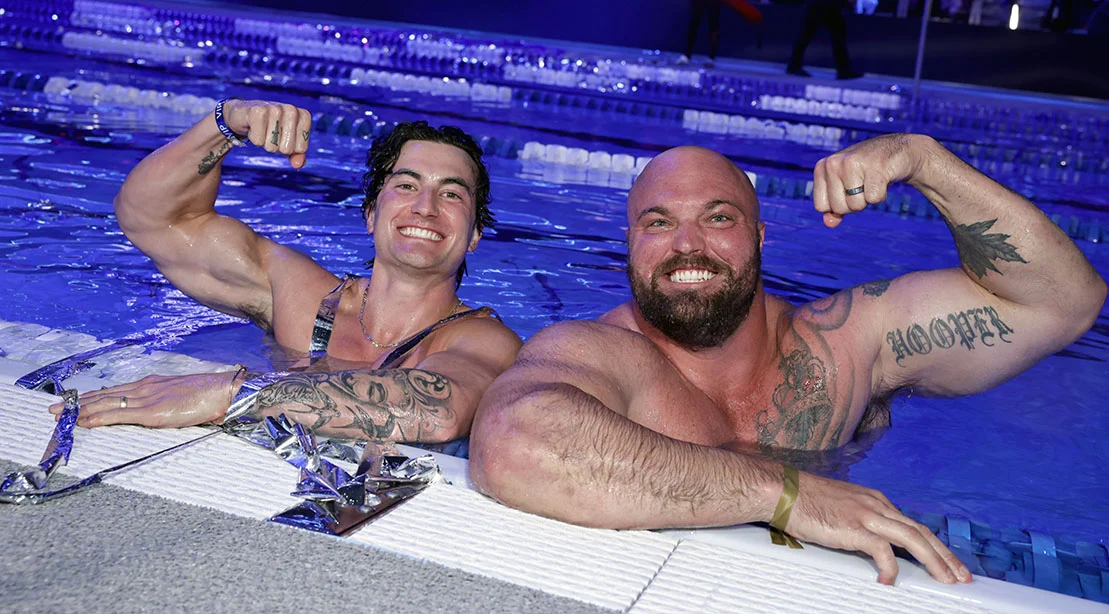
To the casual spectator, Mitchell Hooper is an avatar of raw, primal power—a man who moves immovable objects and stands as the reigning World’s Strongest Man. Known affectionately as “The Moose,” he represents the zenith of human strength, a figure capable of feats that defy biological convention. Yet, to define Hooper solely by his plate-loaded accomplishments is to miss the most compelling aspect of his character.
In an era where elite athletes often curate polished, invulnerable personas, Hooper has emerged as a refreshing, albeit unconventional, voice in the world of strength sports. He is a man who dismantles the myth of the “perfect athlete,” speaking with brutal honesty about the mental health struggles, the crushing weight of insecurity, and the profound, humbling reality of fatherhood. His journey is not just one of iron and grit, but of a man attempting to reconcile the pursuit of peak performance with the fragile reality of being human.
The Unlikely Genesis of a Strongman
Long before he was synonymous with the world’s most prestigious strongman titles, Hooper was an athlete in search of a home. His early years were defined by a restless, wandering athletic spirit. He tried his hand at golf, marathon running, football, and endurance sports—none of which hinted at the trajectory he would eventually take.
Looking back at his childhood, Hooper notes that his younger self would likely be the most surprised by his current reality. While many professional athletes are groomed from youth to believe in their own inevitable greatness, Hooper grew up with a deep sense of self-awareness that bordered on skepticism. He never saw himself as a future NFL or NHL star. In fact, his early years were marked by a period of profound insecurity.
“Being fat,” he admits when asked about the primary source of his teenage self-doubt. It is a jarring admission from a man currently standing at the pinnacle of strength, but for Hooper, that struggle was defining. It was a time of severe social anxiety, characterized by panic attacks and a reflexive need to hide. He recalls wearing hoodies in school—not as a fashion statement, but as a protective barrier to conceal the physical symptoms of his anxiety. That period of his life was the crucible that forged his eventual mindset: if he couldn’t rely on being the most athletic kid in the room, he would learn to be the most resilient.
Chronology of a Champion: From Insecurity to Icon
Hooper’s rise to prominence was anything but linear. His trajectory from a self-conscious adolescent to a global sporting icon serves as a case study in the power of mental reframing.
- The Adolescent Crucible: A period defined by body image struggles, social anxiety, and a sense of detachment from traditional athletic success.
- The Shift: During his late teens, Hooper began to transmute his feelings of inadequacy into a singular, unwavering ambition. He adopted the belief that he could achieve anything, using that intellectual justification to bypass his ingrained feelings of worthlessness.
- The Rapid Ascent: In recent years, Hooper’s ascent has been meteoric. He secured consecutive victories at the Rogue Invitational, the Arnold Strongman Classic, and the World’s Strongest Man.
- The Modern Era: His participation in the inaugural Enhanced Games marked a departure from traditional strength circuits, positioning him not just as a competitor, but as a vocal participant in the debate surrounding human performance, pharmacology, and longevity.
Mental Health: Refusing the “Cured” Narrative
As Father’s Day approaches, the conversation surrounding men’s mental health has reached a fever pitch. In this space, Hooper has become an unlikely, yet powerful, advocate. What separates his narrative from the typical “success story” is his explicit refusal to claim he is “cured.”
Hooper argues that the industry of self-help and athletic inspiration often falls into the trap of the “finish line” narrative—where people look back from a place of total recovery and offer advice as if the battle is permanently won. For Hooper, that is a disservice to those still in the trenches.
“I’m not cured, and I still struggle a lot,” he asserts. “I manage to put one foot in front of the other.” He is candid about the fact that discussing his struggles doesn’t provide him with personal relief or catharsis. Instead, he views his public transparency as an “olive branch” to those who feel isolated. By showing that one can be the strongest human on the planet while still battling anxiety, he provides a more realistic, and therefore more helpful, blueprint for what it means to be a man in the 21st century.
The Reality of Fatherhood: A New Kind of Strength
The most significant shift in Hooper’s worldview occurred with the advent of fatherhood. When discussing the realities of being a new parent with creators like Jesse James West, Hooper strips away the sentimental varnish often applied to the topic.
He speaks of the first six months of parenting with refreshing bluntness, noting that for the father, those early days can feel surprisingly isolating. “You add a family member, and you’re kind of less useful,” he explains, noting that the biological bond between mother and infant naturally prioritizes the maternal role.
However, this period of feeling “less useful” forced a pivot in his definition of success. He shifted from measuring his life through prize money and podiums to measuring it through his role as a provider and protector. This new responsibility introduced a different, more mature form of anxiety—the fear for a dependent’s future. His advice to new fathers is practical, grounding, and characteristically Hooper: “Change the diapers. Change all the diapers that you can, because you’re not needed for anything else.”
The Enhanced Games: Science Over Sentiment
Perhaps the most controversial chapter of Hooper’s recent career is his involvement in the Enhanced Games. While critics focus on the moral or health implications of the event, Hooper frames his participation through a lens of scientific curiosity.
To Hooper, the event represents a controlled environment to study two things: the limits of medically supervised performance enhancement and the true ceiling of human aging. His observations from the games were telling: the average age of a personal best among competitors was 30, suggesting that human performance potential may be significantly higher than currently accepted sports science dictates.
Furthermore, Hooper views the event as a data-gathering exercise. He is vocal about his belief that the sports community should prioritize evidence over emotion. When pushed on the risks of performance-enhancing substances, he pivots to the reality of his own health profile. He cites a family history of cardiac events as his primary health concern, followed by his body mass (330 lbs), his total exercise volume, and his cardiovascular health. In his view, the hyper-focus on PEDs in public discourse acts as a distraction from the more immediate, manageable health factors that actually impact an athlete’s lifespan.
Performance vs. Longevity: The 505kg Lesson
The 505kg deadlift attempt at the Enhanced Games is the perfect microcosm of Hooper’s current philosophy. To the public, a failed lift is a failure. To Hooper, the fact that he was able to move that weight after a grueling, injury-riddled season was a victory of management over ego.
Hooper intentionally opted not to use his signature Airwaav performance mouthpiece for that attempt—a tool he credits with increasing his force production by up to 20% and reducing cortisol. Why forgo an advantage? Because he recognized that his body was at its limit. “Something that increased my rate of force development was going to be a major injury risk for me,” he explains.
He chose to prioritize a controlled, safe pull over the potential for an explosive, catastrophic injury. This decision—the deliberate choice to sacrifice a record in favor of structural integrity—is the hallmark of an athlete who has moved beyond the short-sightedness of his early career.
Implications: A Legacy Beyond the Platform
Mitchell Hooper is currently navigating a delicate balance. He is arguably the most dominant force in strength sports, yet he is actively preparing for a life where his value is not determined by his ability to deadlift a house.
His mission has expanded. He no longer seeks merely to occupy the podium; he seeks to use his platform to destigmatize mental health, challenge the status quo of sports science, and model a version of masculinity that is both physically powerful and emotionally vulnerable. Whether it is through his honest discourse on the isolation of early fatherhood or his cold, data-driven approach to the Ethics of performance enhancement, Hooper is carving out a legacy that is significantly more complex than the title “World’s Strongest Man” implies.
Ultimately, Hooper’s message is one of endurance—not just the endurance of muscle fibers under stress, but the endurance of the human spirit through the highs of victory and the lows of anxiety. He reminds us that true strength is not the absence of struggle, but the persistence of the individual in spite of it. As he continues to compete, we are watching a man redefine what it means to be “strong,” proving that the most difficult weights to carry are often the ones the public cannot see.