For years, the gold standard of fitness nutrition was clear: if you wanted to change your body composition, you measured, weighed, and tracked every gram of protein, carbohydrate, and fat that passed your lips. It was a practice rooted in data, precision, and the promise of objective results.
But for Dr. Gabrielle Fundaro, a PhD in Human Nutrition and a seasoned powerlifting competitor with over a decade of coaching experience, the math eventually stopped adding up. Despite her professional expertise, she found herself trapped in a cycle of dependency, terrified that one unmeasured meal would result in a total loss of her physique.
Her struggle highlights a growing crisis in the fitness community: the transition from "tracking for performance" to "tracking for survival." In response, Dr. Fundaro has pioneered a new framework known as RPE-Eating, a method that trades rigid digital logging for the lost art of bodily intuition.
The Chronology of a Shift: From Data to Intuition
Dr. Fundaro’s professional journey began like many in the elite fitness sphere: with an obsession for optimization. For over a decade, she meticulously tracked macros to fuel her powerlifting career. The method worked—until the psychological cost outweighed the physiological benefits.
"I worried that if I stopped tracking macros, I would lose my physique," she reflects. The anxiety wasn’t just about body weight; it was an identity crisis. If an expert in nutrition couldn’t fuel herself without an app, what did that say about the validity of the field?
The turning point came when she applied the "Rate of Perceived Exertion" (RPE) scale to her strength training. Developed by Gunnar Borg in the 1960s, RPE allows athletes to gauge their effort level on a scale of 1–10. By focusing on how the weight felt rather than just the number on the plates, Fundaro found she was recovering faster and performing better.
It was a "Newton’s apple" moment. She realized that if she could trust her body to regulate training intensity, she could learn to trust her body to regulate energy intake. This realization marked the birth of the RPE-Eating framework—a bridge between rigid control and total chaos.
The Mechanism: What is RPE-Eating?
At its core, RPE-Eating is a pedagogical tool designed to restore interoceptive awareness—the body’s ability to sense its internal state. While traditional macro-tracking relies on external data (apps, scales, and databases), RPE-Eating relies on internal data (hunger, fullness, and satisfaction).
The Scale of Satiety
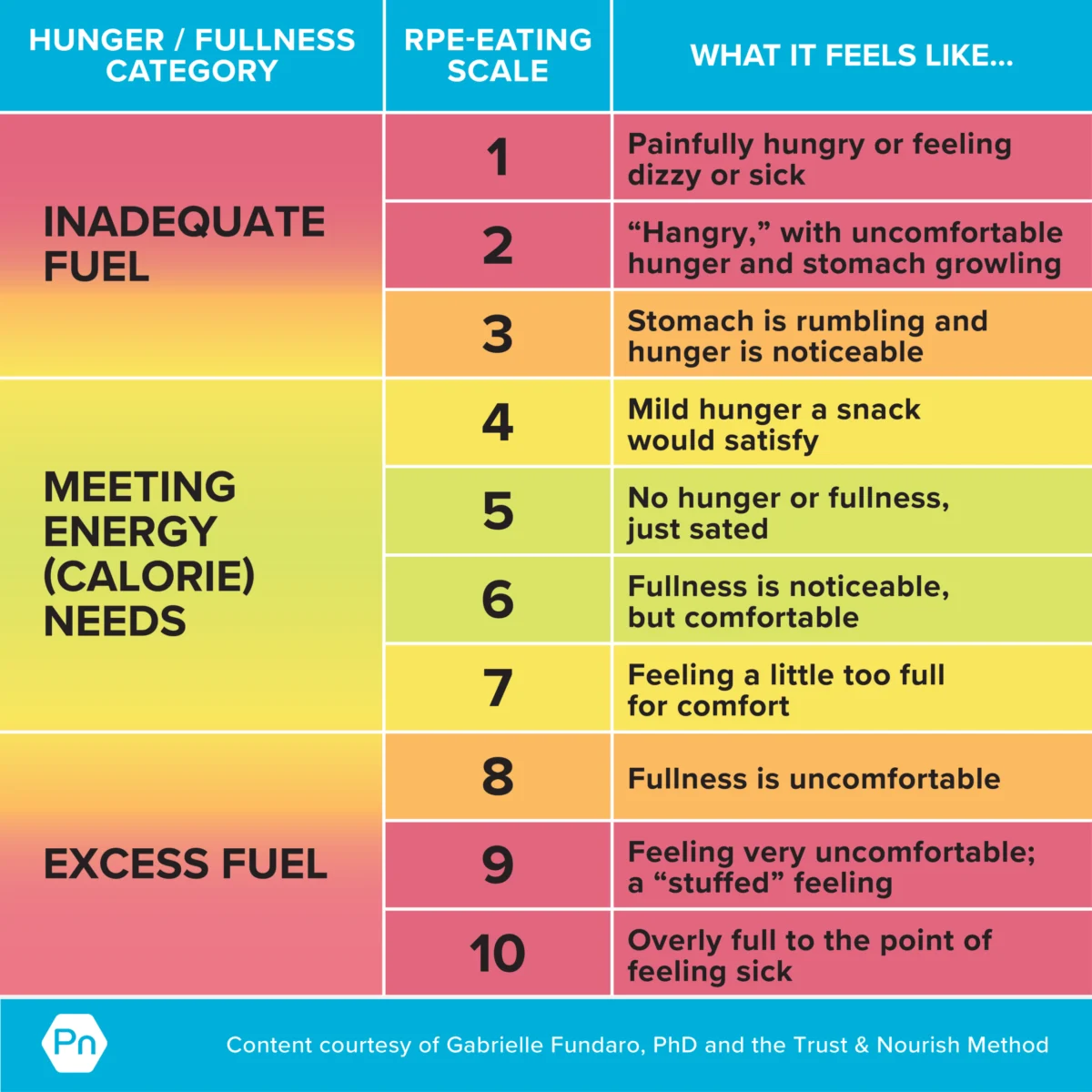
The RPE-Eating scale functions as a navigational map for daily intake:
- 1–3 (Inadequate Fuel): Characterized by physical emptiness, dizziness, or intense "hangry" irritability.
- 4–7 (Adequate Fuel): The sweet spot. Mild hunger is satisfied, and the individual reaches a point of comfortable fullness.
- 8–10 (Excess Fuel): Ranges from feeling "stuffed" to physical discomfort or sickness.
The objective is not to be perfect, but to be present. By recording hunger levels before and during a meal, individuals "download" the sensation of satiety into their nervous system, effectively retraining their biological hunger signals that were often muted by years of restrictive dieting.
Supporting Data and Psychological Implications
The shift toward RPE-Eating is supported by the growing body of research into "mindful eating" and "intuitive eating." However, unlike traditional intuitive eating—which can feel daunting to those who have spent years ignoring their cues—RPE-Eating provides the structure that high-performers crave.
The "Notice and Name" Methodology
Dr. Fundaro integrates a psychological technique called "Notice and Name." When a client feels the urge to overeat, they are encouraged to identify the trigger. Is it physical hunger, or is it an emotional response to stress, anxiety, or boredom?

This distinction is vital. Research consistently shows that compulsive eating is rarely about the food itself; it is a coping mechanism. By learning to distinguish between appetite (the desire for pleasure) and hunger (the physical need for fuel), individuals gain the agency to choose non-food coping mechanisms—such as walking, breathing, or resting—instead of defaulting to food.
The Role of Satisfaction
A common critique of "mindful eating" is that it ignores the pleasure of food. Dr. Fundaro counters this by emphasizing that satisfaction is just as important as satiety. If a person eats to physical fullness but denies themselves a food they truly crave, they often set the stage for a "restrict-binge" cycle. RPE-Eating encourages the inclusion of diverse, enjoyable foods to ensure that the individual feels emotionally satisfied, not just physically fed.
Implications for the Fitness Industry
The implications of this shift are profound for the fitness industry, particularly for individuals at risk of disordered eating.
The "Off-Ramp" Strategy
For the average fitness enthusiast, macro-tracking is a useful entry-level tool. However, it is rarely a sustainable lifelong strategy. RPE-Eating serves as a vital "off-ramp" for those who want to maintain their health without being tethered to a digital log. It helps dissolve the binary mindset of "good" and "bad" foods, promoting a more flexible relationship with nutrition.
When to Avoid the Scale
Dr. Fundaro is quick to note that this method is not a "one-size-fits-all" solution. For athletes preparing for specific weight-class sports or those with clinical eating disorders, RPE-Eating cannot replace professional medical guidance.
"I am not anti-weight modification," Dr. Fundaro clarifies. "I am pro-safe weight modification." She views RPE-Eating as a safer, more sustainable alternative for those who find the intensity of tracking to be a trigger for disordered behavior.
Expert Analysis: Is it "Feelings Over Facts"?
Critics often argue that RPE-Eating is merely "eating by feelings," lacking the empirical rigor required for serious body composition goals. Dr. Fundaro pushes back against this skepticism. She points out that just as RPE training was once mocked by the "if it isn’t quantified, it doesn’t count" crowd, it is now an accepted standard in elite athletics.
"The bar slowing down on a heavy squat is the physical indicator of intensity," she explains. "Similarly, the absence of hunger at the end of a meal is the biological indicator of sufficiency."
By learning to interpret these internal signals, individuals are not ignoring facts; they are interpreting a more complex and personalized set of data: their own biology.
Conclusion: A New Standard of Autonomy
The true success of the RPE-Eating framework is not measured in grams or percentages, but in the restoration of self-trust. For those who have lived under the tyranny of the "perfect diet," the ability to walk into a restaurant and choose a meal based on hunger, preference, and intuition is the ultimate sign of nutritional competence.
As Dr. Fundaro concludes, the goal of nutrition coaching should not be to make a client a slave to a spreadsheet. The goal is to provide them with the skills to nourish themselves in any environment, without the crutch of an app. In an age where digital surveillance of our health has become the norm, reclaiming our internal compass may be the most radical and effective fitness choice we can make.