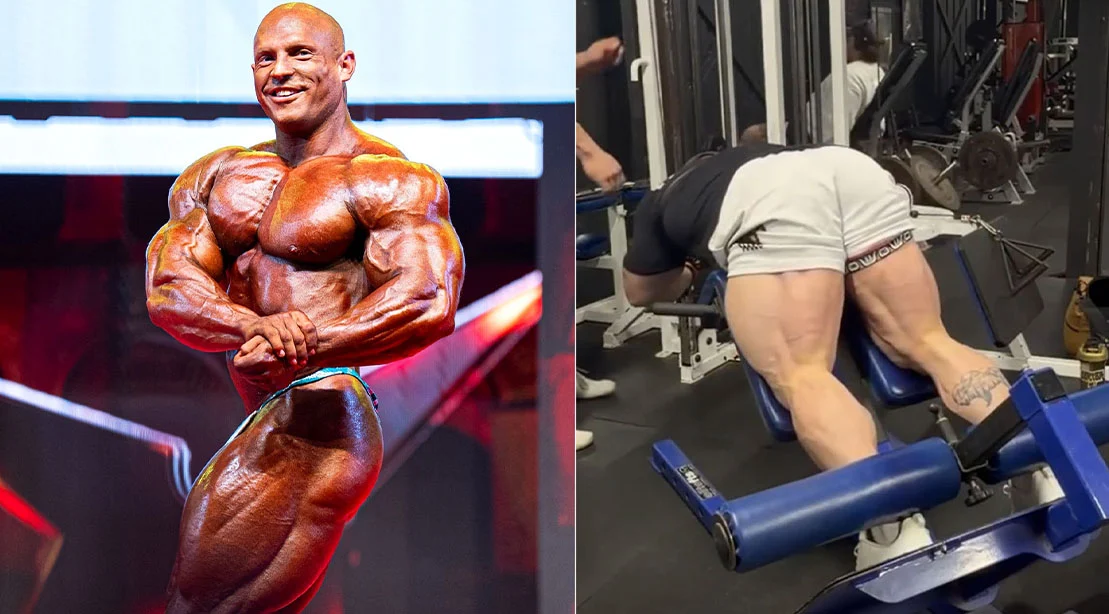
After a challenging fifth-place finish at the 2025 Mr. Olympia, Martin “The Martian” Fitzwater is doing more than just reflecting on his performance; he is aggressively innovating his training methodology. As the bodybuilding world looks toward the 2026 Olympia in Las Vegas, Fitzwater has already secured his ticket to the stage following a dominant victory at the EVLS Prague Pro. To bridge the gap between his current physique and the caliber of reigning champion Derek Lunsford, former titlist Samson Dauda, and perennial contender Hadi Choopan, Fitzwater has turned to a novel, high-intensity exercise: the Cable Nordic Curl.
This movement, which blends the biomechanical demands of a traditional Nordic hamstring curl with the constant tension of cable resistance, is rapidly becoming a cornerstone of his off-season growth phase.
The Evolution of a Contender: Context and Chronology
The trajectory of Martin Fitzwater’s career has been one of consistent, calculated ascension. In the high-stakes environment of professional bodybuilding, a fifth-place finish at the Olympia is objectively an elite achievement; however, for an athlete of Fitzwater’s caliber, it served as a catalyst for a re-evaluation of his training stimulus.
The 2025 Olympia Turning Point
The 2025 Mr. Olympia contest was a showcase of structural density and conditioning. While Fitzwater brought an impressive package to the stage, the judges prioritized a specific level of lower-body separation and hamstring development that separated the top-three finishers from the rest of the pack. Recognizing the competitive landscape, Fitzwater understood that incremental improvements would no longer suffice. He needed to shock his musculature into new growth.
Securing the 2026 Path
Following the Olympia, Fitzwater did not rest on his laurels. By winning the EVLS Prague Pro in October, he effectively punched his ticket to the 2026 Mr. Olympia. This early qualification is a strategic luxury; it grants him the freedom to experiment with specialized training techniques—like the Cable Nordic Curl—without the immediate pressure of chasing points or qualifying spots. This luxury of time allows him to focus on hyper-specific hypertrophy goals, ensuring that when he steps back onto the Las Vegas stage, his posterior chain will be the most developed it has ever been.
Anatomy of the Movement: The Cable Nordic Curl
In a recent communication to his nearly 320,000 followers on Instagram, Fitzwater unveiled this "new favorite" movement, which he developed in collaboration with fellow professional bodybuilder Brett Wilkin.
Understanding the Biomechanics
Traditional Nordic curls are legendary for their ability to isolate the hamstrings. By anchoring the lower legs, the lifter uses their hamstrings to control the eccentric descent and the concentric rise of the torso. However, the limitation of the standard Nordic curl is that it relies solely on body weight.
Fitzwater’s variation, the Cable Nordic Curl, shifts the paradigm by introducing external, variable resistance. By utilizing a Roman chair (or hyperextension bench), a cable belt, and a pulley system, Fitzwater effectively turns a bodyweight movement into a loaded, high-tension exercise.
Step-by-Step Execution
According to Fitzwater, the setup is as critical as the movement itself:
- Anchoring: Position yourself on a Roman chair or hyperextension bench. Your ankles and knees must be firmly pressed into the pads. The lower body must be completely immobilized to ensure that the force is generated entirely through the knee joint.
- The Hookup: Wear a cable belt attachment secured just below the armpits. The cable should be positioned in front of you, attached to a low-pulley stack.
- The Movement: Instead of allowing the lower back to take the brunt of the movement, the goal is to keep the upper body in a rigid, straight line. As you curl at the knee, focus on pulling your hips straight back.
- Avoiding Compensation: Fitzwater emphasizes, "Ankle and knees firmly pushed into the pad—don’t hyperextend, but rather pull hips straight back, curling at the knee." He warns against allowing the lower back to initiate the motion, as this removes the tension from the hamstrings and increases injury risk.
Supporting Data: Why the Hamstrings Need New Stimuli
The hamstring complex is a three-headed powerhouse comprised of the biceps femoris, semimembranosus, and semitendinosus. These muscles are responsible for knee flexion and hip extension, and in the context of professional bodybuilding, they are the key to a “full” look from the side and back.
The Hypertrophy Advantage
By reducing the accessibility of the lower legs through firm anchoring, the hamstrings are forced to bear the full brunt of the load. When adding cable resistance, you move from a strength-based exercise to a pure hypertrophy movement.
Unlike a barbell or a dumbbell—where gravity dictates a static path—the cable provides constant tension throughout the entire range of motion. This constant tension is a known driver of metabolic stress, which is a primary mechanism of muscle growth. Furthermore, because the path of the cable is fixed, there is a significantly lower risk of injury compared to free-weight variations, allowing the athlete to push closer to failure with greater confidence.
Official Responses and Professional Perspectives
The bodybuilding community has responded with keen interest to Fitzwater’s technical transparency. While many top-tier professionals keep their training secrets guarded, Fitzwater’s willingness to share his "hacks" speaks to a broader trend of athletes acting as their own strength coaches.
The "Humbling" Reality
Fitzwater’s advice to those looking to integrate this into their own leg day is pragmatic: "Start light. It’s very heavy and humbling."
The professional consensus on this movement is that it acts as an "accessory killer." By placing it at the end of a workout—or as a primary movement following a compound lift like the Romanian Deadlift—the athlete can fully exhaust the hamstring fibers. Because the cable system allows for quick weight adjustments, it is also an ideal candidate for drop sets, allowing for an even greater accumulation of volume.
Implications for the 2026 Olympia
The implications of this training shift are significant. In a sport where the difference between a top-five finish and a top-three finish is often measured in millimeters of muscle separation, the inclusion of high-tension, isolation-focused movements like the Cable Nordic Curl could be the deciding factor for Fitzwater.
The Competitive Landscape
When Fitzwater steps on the stage in 2026, he will be facing a lineup of legendary proportions. Derek Lunsford continues to refine his back-to-front density, while Samson Dauda has proven that sheer mass paired with elegance is a winning combination. To stand out, Fitzwater cannot simply be "big"; he must be structurally superior.
By prioritizing his posterior chain through advanced biomechanical applications, he is signaling that he is not just chasing a title, but evolving his physique to meet the future standards of the IFBB Pro League.
Final Takeaway
For the average gym-goer, the Cable Nordic Curl represents an accessible, safe, and highly effective way to build hamstring mass. For Martin Fitzwater, it is a tool of precision. As he continues to document his journey toward the 2026 Olympia on social media, fans and competitors alike will be watching to see if this "Martian" experiment translates into the sandow trophy.
Whether you are a professional bodybuilder or a dedicated enthusiast, the lesson remains the same: the most progress is often found by challenging your comfort zone with movements that force your muscles to work harder, not just heavier. As Fitzwater continues to refine his technique, one thing is certain: he is leaving nothing to chance in his pursuit of greatness.
To stay updated on Martin Fitzwater’s training progress and his preparation for the 2026 Olympia, follow him on Instagram here.