




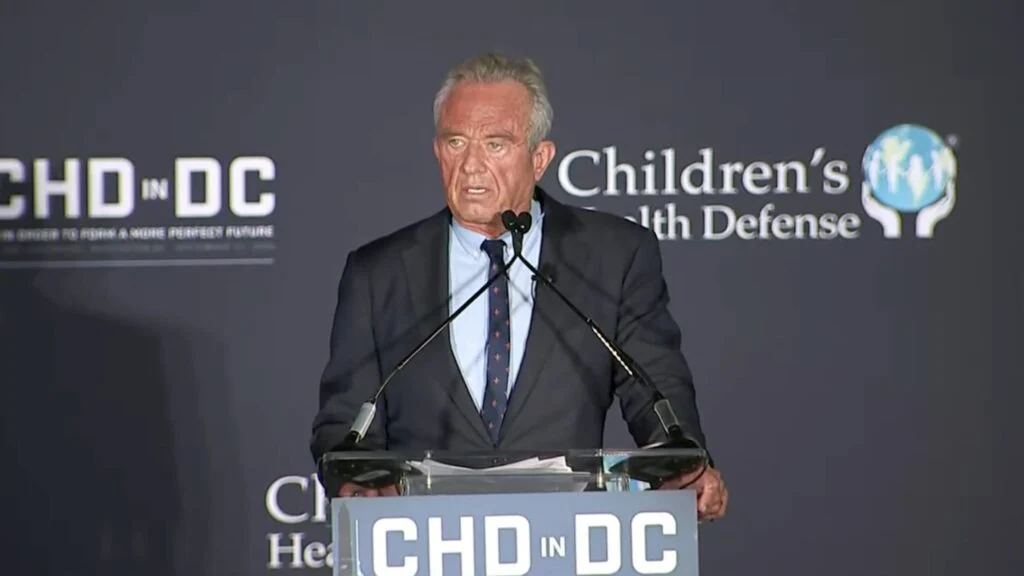
WASHINGTON — In a move that signals a profound shift in the federal government’s approach to public health, Health and Human Services (HHS) Secretary Robert F. Kennedy Jr. returned to his ideological home on Thursday. Addressing a conference hosted by Children’s Health Defense (CHD)—the anti-vaccine nonprofit he helped found—Kennedy utilized the platform to deliver what felt like a victory lap for the Make America Healthy Again (MAHA) movement.
The speech, coming just days before midterm elections that could serve as a pivotal referendum on the GOP’s health care reform agenda, underscored a transformation in Kennedy’s political identity. Once known for downplaying his history of casting doubt on vaccine safety, Kennedy has now firmly institutionalized those skepticism-driven priorities into the official legacy of his tenure as the nation’s top health official.
The Evolution of the MAHA Agenda: From Food to Frequency
Kennedy’s address began as a standard recapitulation of the administrative accomplishments of the past year. He highlighted the ongoing efforts to overhaul the federal food pyramid, the aggressive scrutiny of synthetic chemical additives in the American diet, and the structural changes aimed at improving the quality of hospital meals.
However, the tone shifted decisively halfway through the presentation. After briefly mentioning his agency’s controversial investigations into electromagnetic frequency and the widely debunked theory of "chemtrails," Kennedy pivoted toward his core constituency: those who harbor fundamental distrust of the nation’s vaccine infrastructure.
"The question is: Should we be looking at the potential that some of these chronic illnesses are associated with vaccines?" Kennedy asked the audience, gesturing toward a screen displaying a hepatitis B vaccine package insert. The visual served as the centerpiece of his argument, highlighting a section labeled "ADVERSE REACTIONS" that detailed data from a clinical trial of 147 infants.
"They were monitored for only five days, and there was no placebo," Kennedy asserted. "There’s no way any other product would get FDA approval with that few people."
Chronology of a Shifting Policy Landscape
The context of Kennedy’s remarks exists within a rapidly changing regulatory environment. Historically, the Food and Drug Administration (FDA) accepted smaller trials for the hepatitis B vaccine because they were supplemented by extensive data from thousands of children who had already received earlier versions of the shot. Decades of post-market surveillance and peer-reviewed studies have consistently reinforced the efficacy and safety profile of the vaccine.
The impact of these policies was historically significant: universal newborn vaccination programs were credited with a 99% reduction in chronic hepatitis B infections among children and teens. However, the current administration—under the direction of President Trump—formally ended the universal newborn vaccination recommendation last year, marking a clean break from decades of established public health precedent.
This move is part of a broader, ongoing series of events:
- Early 2025: Secretary Kennedy initiates a review of the childhood immunization schedule, sparking significant friction within the medical establishment.
- Mid-2025: The Trump administration officially halts the universal recommendation for the hepatitis B vaccine for newborns.
- Late 2025 – Early 2026: HHS launches an expansive, cross-agency review of vaccine safety, timing, and sequence.
- April 2026: A lawsuit challenging the legality of the administration’s changes to Advisory Committee on Immunization Practices (ACIP) policy begins winding through the courts.
- August 2026: President Trump issues an executive order formally aligning the administration with the MAHA vaccine ideology.
Supporting Data and the "Adverse Event" Debate
Kennedy spent over 20 minutes of his speech attempting to decouple the medical consensus on vaccine safety from the public’s perception. He claimed the public has "no idea" about the actual risk profile of vaccines, despite these products being administered hundreds of millions of times. While he conceded that serious harm is "very rare," he repeatedly implied that the current epidemic of chronic illness in the United States is rooted in the childhood vaccine schedule—a claim that lacks support from mainstream medical literature.
The Misinterpretation of Package Inserts
A critical point of contention is Kennedy’s reliance on package inserts. Vaccine manufacturers are legally required to list all adverse events reported by participants during clinical trials, regardless of whether a causal link to the vaccine has been established. The hepatitis B insert itself explicitly states: "It is not possible to reliably estimate their frequency or establish a causal relationship to a vaccine exposure."
Despite this, Kennedy pointed to a list of 454 adverse events—including diabetes, sudden infant death syndrome (SIDS), and various autoimmune diseases—as evidence of systemic danger. His speech suggested that these reports are not merely temporal coincidences but potential indicators of systemic health failures.
Official Responses and Bureaucratic Realignment
The response from the public health community has been one of alarm. Physicians, research scientists, and biotech leaders have expressed deep concern over the politicization of immunization science. Yet, within the halls of HHS, the directive is clear.
Kennedy announced that his department is currently conducting deep-dive research into more than 150 of the most serious reported adverse events to determine potential links to specific vaccines. Furthermore, he outlined plans to modernize the Vaccine Adverse Event Reporting System (VAERS).
"We are working to make the system more user-friendly," Kennedy noted, adding that HHS plans to compensate physicians for the time spent reporting potential side effects. The goal, he explained, is to automate data collection to ensure that no "signal" goes unnoticed. Critics argue that such changes, if not implemented with rigorous scientific controls, could flood the system with unverified reports, further muddying the waters of public health data.
Implications for Public Health and Future Policy
The implications of Kennedy’s rhetoric are already being felt on the ground. As the administration leans into its skepticism of established schedules, the country is witnessing the resurgence of preventable diseases. Measles, once considered eliminated in the U.S., has seen a significant uptick in cases, resulting in at least four deaths in Pennsylvania this year.
When questioned about this trend, Kennedy’s response was minimal, acknowledging only that "we care about every child who dies from measles." This brief mention stood in stark contrast to the fervor with which he discussed the potential risks of the vaccines themselves.
The political backing for this agenda remains robust. Kennedy used the CHD platform to reassure his base of his proximity to the Oval Office. "Let me be clear: You have a strong and steadfast friend at the White House," he told the cheering crowd.
The event concluded with a symbolic passing of the torch. As Kennedy exited the stage to thunderous applause, the conference organizers introduced the next speaker: Andrew Wakefield. Wakefield, the disgraced British physician whose fraudulent 1998 study linking the MMR vaccine to autism served as the catalyst for the modern anti-vaccine movement, remains a potent figure in this ecosystem.
The presence of both the Secretary of Health and the man who ignited the global vaccine controversy on the same stage signals a new era for American health policy. As the midterms approach, the country is left to grapple with the outcome of this experiment: a federal health department that is no longer acting as a safeguard of established scientific consensus, but rather as an active participant in questioning it.
Reporting by Nicholas Florko and Matthew Herper.