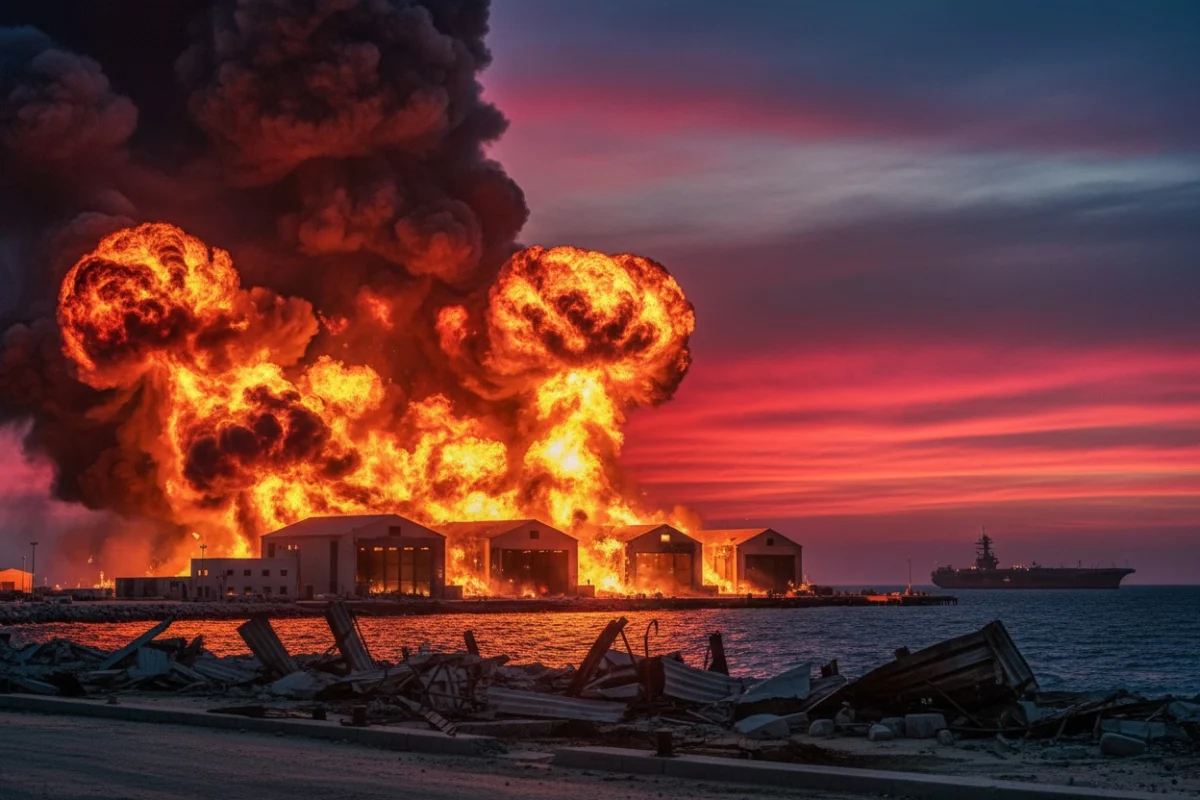
In a candid and potentially disruptive departure from established administration rhetoric, Acting Navy Secretary Hung Cao has acknowledged the severe extent of the damage sustained by the U.S. Fifth Fleet headquarters at Naval Support Activity (NSA) Bahrain. During an interview with the Epoch Times on Thursday, September 10, Cao stated that Iranian forces had “blew the hell” out of the critical installation, a comment that provides a rare, direct confirmation of the efficacy of Iranian strike capabilities against U.S. assets.
This admission has sent shockwaves through Washington, creating a stark contrast with the prevailing narrative of the current administration, which has consistently characterized Iran’s military capabilities as degraded and neutralized. The remarks, which were later highlighted by The New Republic, have prompted intense scrutiny regarding the long-term viability of U.S. naval operations in the Persian Gulf and have fueled a burgeoning debate over the transparency of the U.S. military’s strategic assessments.
The Chronology of Conflict: From February 28 to Present
The degradation of the Bahrain facility did not occur in a vacuum; it is the culmination of a rapidly escalating regional conflict. The timeline of hostilities suggests a significant shift in the strategic landscape of the Middle East.
The Catalyst: February 28 Strikes
On February 28, a joint U.S. and Israeli military operation targeted key Iranian military infrastructure. In what appears to be a direct retaliatory measure, Iranian forces initiated a series of sophisticated drone and missile attacks against U.S. outposts, with NSA Bahrain becoming a primary target. The base, which has served as the bedrock of American naval power in the region for decades, was hit by a coordinated drone strike that effectively crippled its operational capacity.
Persistent Hostilities
Following the February 28 attack, the facility suffered repeated waves of incoming fire. For months, the status of the Fifth Fleet headquarters remained shrouded in ambiguity, with official press briefings focusing on "degraded" Iranian capacity rather than the specific tactical successes achieved by Tehran. However, the operational reality on the ground—characterized by the inability of U.S. warships to conduct standard pier-side maintenance—suggests that the facility has been effectively neutralized as a logistical hub for the foreseeable future.
The USS Abraham Lincoln Dilemma
The operational fallout extends to the U.S. carrier strike group presence. Cao confirmed that the Iranian assault has left the Navy unable to "pull in" the aircraft carrier USS Abraham Lincoln. The carrier, which deployed from San Diego on November 21, 2025, has been trapped in a state of perpetual deployment in the Middle Eastern theater. With no safe port for replenishment or crew rotation in the immediate vicinity, the vessel has become a symbol of the logistical overstretch currently plaguing the U.S. Navy.
Supporting Data: The Logistics of Attrition
The inability to utilize NSA Bahrain has forced the U.S. military into a state of ad-hoc crisis management. Naval analysts have long warned that the loss of a primary regional logistics hub would drastically increase the "wear and tear" on both ships and personnel.
Crew Morale and Deployment Fatigue
The USS Abraham Lincoln is currently approaching the nine-month mark of a deployment defined by combat operations and substandard conditions. Reports have surfaced detailing a lack of basic supplies, inadequate living conditions, and rising mental health crises among the crew. In August, top Navy leadership held meetings with the families of deployed sailors and Marines, an acknowledgment that the stress of the mission—compounded by the lack of a secure home port—is reaching a breaking point.
Chief of Naval Operations Adm. Daryl Caudle has attempted to reassure the public, noting that the Navy is actively working to apply "hard lessons" learned from the similarly grueling deployments of the USS Gerald R. Ford and the USS Lincoln. However, these administrative reassurances do little to mitigate the strategic reality that the U.S. Fifth Fleet lacks a secure, functional anchor point in the region.

The Task Force Review
When questioned regarding any potential return to normal operations at the Bahrain facility, Secretary Cao revealed that a specialized task force is currently reviewing the situation. This follows an earlier statement from the Navy’s top leadership in early September, which explicitly stated there were no plans to return to the Bahrain base "anytime soon." This lingering uncertainty suggests that the Pentagon is currently weighing the cost of rebuilding against the strategic risk of re-occupying a facility that has proven vulnerable to persistent Iranian strike capabilities.
Official Responses and Political Fallout
The political ramifications of Cao’s comments are intensified by the fact that his own nomination as Navy Secretary remains stalled in Congress. His status as an "Acting" official provides him with a degree of bluntness rarely seen in confirmed cabinet-level appointees, yet it also leaves him politically isolated.
The Fox News and Media Reaction
Journalists have been quick to note the abnormality of the statement. Fox News correspondent Jennifer Griffin remarked that the admission was "stunning," noting that she had not heard a senior official confirm such a tactical defeat on the record since the conflict began. The silence from the Department of War (the current administrative body overseeing defense operations) is particularly notable; there has been no formal, on-the-record refutation of Cao’s claims, nor has there been a release of a comprehensive damage assessment.
The Quincy Institute Perspective
Trita Parsi, a leading voice from the Quincy Institute, suggests that Cao’s remarks confirm a disturbing pattern of deception regarding the war’s trajectory. According to Parsi, the U.S. government has consistently engaged in a strategy of denying strategic losses, only to admit to them months after the fact. "This creates a prolonged false impression that the war is going much better than it actually is," Parsi noted. He argues that the Western narrative, which emphasized the supposed failure of Iranian forces, was fundamentally decoupled from the tactical reality that Tehran was successfully demonstrating high-end missile and drone capabilities.
Iranian Utilization of the Narrative
Perhaps most damaging to the U.S. position is the reaction from Tehran. Iranian Foreign Minister Abbas Araghchi utilized social media to amplify Cao’s admission, publicly thanking the Secretary for his "honesty." By echoing Cao’s own words—that the Iranian Armed Forces did indeed "blow the hell" out of the base—Tehran has effectively turned a U.S. government statement into a propaganda victory, undermining the image of American military invulnerability in the region.
Strategic Implications: A New Era of Naval Warfare?
The situation in Bahrain raises existential questions about the future of U.S. naval presence in the Persian Gulf.
The Question of Rebuilding
The Washington Post reported in August that the War Department is actively considering a pivot away from the current footprint in the Persian Gulf. With eight sources confirming that the department is weighing the possibility of not rebuilding damaged bases, it is increasingly clear that the "old" model of fixed, large-scale naval support hubs is becoming obsolete in an era of cheap, long-range, and highly accurate Iranian drone swarms.
The End of Hegemony?
The failure to protect a key installation like NSA Bahrain—and the subsequent inability to provide a clear timeline for its return to service—serves as a case study in the limitations of traditional naval power. If the U.S. is unable to maintain a base due to the threat of ongoing fire, the entire concept of a "forward-deployed" presence must be re-evaluated.
As of mid-September, the U.S. Navy remains in a defensive crouch. With no independent, public damage assessment available and the Department of War maintaining a strategic silence, the fate of the Fifth Fleet’s regional headquarters remains the most significant unresolved variable in the conflict. Whether this leads to a permanent withdrawal from Bahrain or a massive, costly, and high-risk effort to harden and rebuild the base remains to be seen. What is clear, however, is that the era of uncontested American naval logistics in the Gulf has, at least for the moment, come to a definitive and violent close.