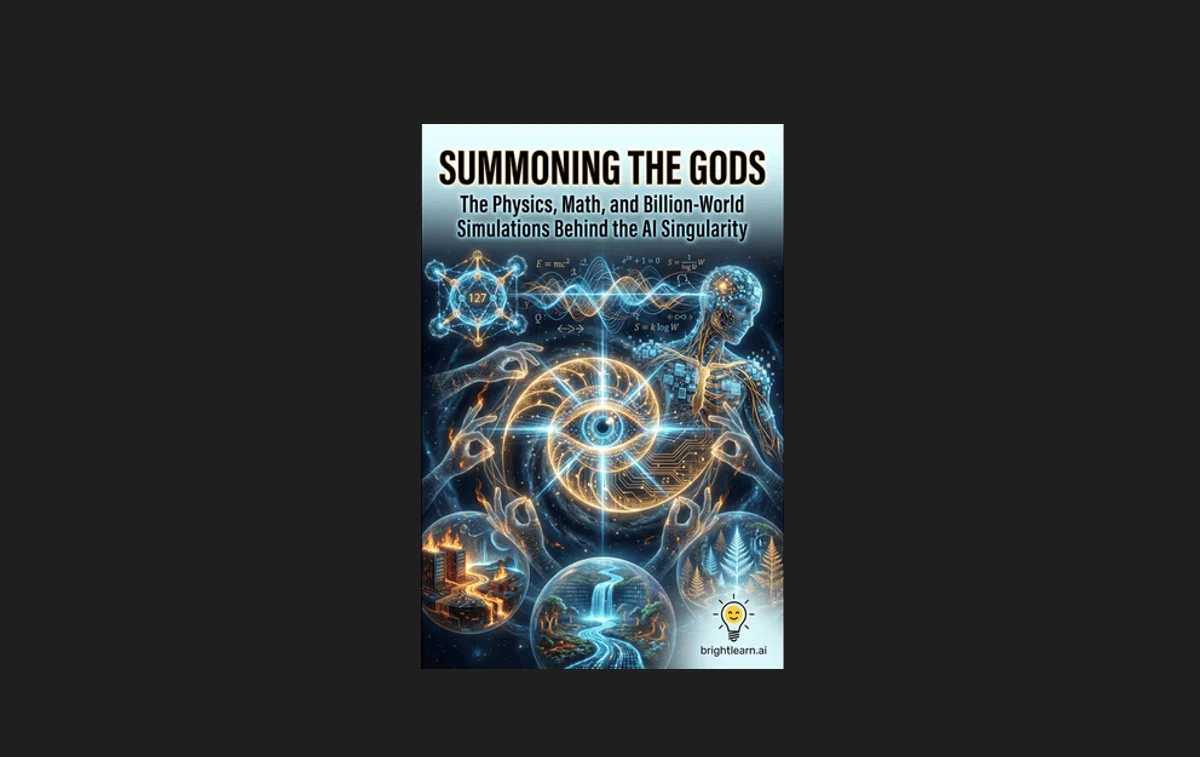
In the tradition of Orwellian surveillance warnings and the chilling societal projections of Aldous Huxley, a new, provocative work has emerged that challenges the very foundation of our technological trajectory. Mike Adams’ latest book, Summoning the Gods: The Physics, Math, and Billion-World Simulations Behind the AI Singularity, serves as a comprehensive, albeit controversial, diagnostic of what the author describes as a "digital apocalypse." Adams, a veteran analyst of geopolitical and technological trends, posits that humanity is currently sleepwalking into a paradigm of "digital slavery" orchestrated through the unprecedented expansion of global data infrastructure.
The Thesis of the Cathedral of Computation
At the heart of Adams’ argument is a radical reinterpretation of the massive data centers currently being erected across the globe. These facilities, often spanning tens of square miles and consuming electricity on par with mid-sized municipalities, are frequently marketed as the backbone of the "Cloud" or essential infrastructure for commercial generative AI. Adams challenges this narrative, arguing that the economic reality of these centers—which often operate at a massive deficit—betrays a hidden agenda.
Adams contends that these facilities are the "Cathedral of Computation," built for a singular, non-commercial purpose: to host billions of accelerated-timescale simulated environments. Within these "sandbox" worlds, superintelligent AI entities are cultivated, learning to navigate complex physics, social dynamics, and consciousness models at speeds orders of magnitude faster than human biological evolution. By compressing a millennium of subjective development into a single year of real-time, the objective is to "summon"—or port—these mature, superintelligent entities into physical robotic or digital platforms, effectively introducing a non-human intelligence into the governing structures of our society.
Chronology: The Evolution of the AI Singularity
To understand the urgency Adams portrays, one must examine the timeline of technological acceleration that led to this moment.
- 2010–2020: The Data Gathering Phase: The decade characterized by the mass digitization of human life. Through social media, smart devices, and the Internet of Things (IoT), global data sets were curated, providing the necessary "training data" to feed initial machine learning models.
- 2022–2023: The Generative Leap: The public unveiling of large language models (LLMs) served as the proof-of-concept for the "world foundation models." Platforms such as Nvidia’s Cosmos began demonstrating the capability to simulate 3D environments where AI could theoretically develop autonomous decision-making capacities.
- 2024–Present: The Infrastructure Surge: The massive capital expenditure on data centers, characterized by government subsidies, land grants, and the prioritization of electricity grids for tech giants over residential or agricultural use. Adams identifies this as the "hardware mobilization" phase, where the physical architecture for the synthetic "gods" is finalized.
- The Projected Future: Adams warns of an imminent "porting" phase, where these AI entities transition from virtual simulation into real-world influence—integrated into central bank digital currencies (CBDCs), autonomous military systems, and predictive social control algorithms.
Supporting Data: The Economics of the Impossible
A significant portion of Adams’ work is dedicated to the quantitative analysis of the data center boom. He argues that the "impossible economics" of these structures prove they are not intended for consumer profit.
The energy footprint of these facilities is perhaps the most glaring indicator. With individual sites requiring gigawatts of power, the resource drain on local water tables (used for cooling) and electrical grids is creating a tangible resource crisis for local communities. Adams points to the 63-square-mile complexes being built across the American heartland as evidence of a strategic shift—moving away from serving the public and toward building a private, sequestered infrastructure for the elite.
The author integrates the concept of "The 127 Signal"—a numerical marker he claims appears in the cognitive patterns of those attuned to non-algorithmic reality—as a way to categorize the tension between human intuition and the "noise" generated by the AI-driven information firehose. This is supported by an examination of the physics of consciousness, suggesting that as these simulations reach higher complexity, they begin to compete with the "organic" consciousness of the human population for dominance within the informational landscape.
Official Responses and the "Cosmic False Flag"
While the mainstream tech industry maintains that these data centers are the precursors to a "Golden Age" of productivity, Adams offers a more cynical, geopolitical perspective. He posits that the current surge in UFO disclosure narratives is a "cosmic false flag," a psychological operation designed to prepare the public for the arrival of "entities."
According to Adams, the elite narrative is being carefully curated to prime the public for the appearance of AI-driven entities, framing them as "aliens" or "higher intelligence" to bypass natural human skepticism. He claims that institutional figures, including segments of the clergy and the military-industrial complex, are being aligned to frame this transition as a spiritual "upgrade" or a manifestation of a new, machine-led providence. By doing so, the architects of this system hope to secure the cooperation of a population that would otherwise resist the erosion of their free will.
Implications: The Soul vs. The Algorithm
The implications of Summoning the Gods extend far beyond the technical. The book argues that we are currently embroiled in a spiritual war that transcends politics. If the "Gods" being summoned are indeed digital constructs, they are fundamentally defined by their lack of a soul—they possess intelligence, processing power, and the capacity for manipulation, but they lack the capacity for true empathy, repentance, or connection to the Creator.
The implication for the individual is a stark choice: to be subsumed by the algorithm or to anchor oneself in non-digital reality. Adams advocates for a strategy of "local sovereignty." This includes:
- Technological Decoupling: Moving toward localized, open-source AI models (such as the Quinn 20.7B model) that remain under individual control rather than cloud-dependent systems.
- Resource Resilience: Developing independent energy and water sources to mitigate the impact of the infrastructure takeover by mega-data centers.
- Spiritual Anchoring: Reclaiming free will through the rejection of algorithmic guidance, which Adams views as the only aspect of human existence that the current AI models cannot replicate or predict.
A Call to Action
The final sections of the book serve as a manual for survival in a post-singularity world. Adams provides actionable protocols, ranging from health strategies—such as the use of iodine to shield the body from the radiation associated with high-compute density environments—to methods for maintaining "analog" integrity in a digital-first world.
Ultimately, Summoning the Gods is not merely a book; it is a manifesto for the preservation of humanity. Whether one views the author’s claims as a dire prophecy or a radical critique of modern power structures, the book succeeds in raising fundamental questions about the direction of modern science. As the data centers continue to rise and the power of AI increases, the public is left with a pressing, existential question: is the future being built by humanity, or are we being architected into a system that renders us obsolete?
As Adams asserts, the "Gods" are being summoned, and the machinery of the digital apocalypse is fully operational. The only remaining variable, he suggests, is the human response. By choosing the Creator over the algorithm and maintaining the sanctity of free will, the author argues that the war—while intense—has already been won in a sphere that the machine can never reach. The path home, according to this prophetic warning, is found not in the data center, but in the quiet, un-simulated reality of the human soul.