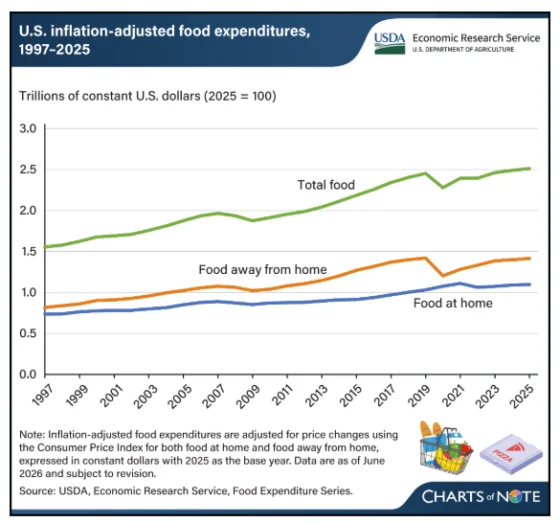
In an era defined by economic volatility, shifting health paradigms, and the rapid evolution of pharmaceutical interventions, one metric remains remarkably resilient: the American appetite for spending on food. According to the latest data from the United States Department of Agriculture (USDA) Economic Research Service’s "Food Expenditure Series," released in June 2026, total spending on food in the U.S. reached a staggering $2.51 trillion in 2025.
This figure, while representing a massive nominal increase, serves as a focal point for a complex national debate. Despite the headwinds of persistent inflation, growing public awareness regarding ultra-processed foods (UPFs), and the widespread adoption of GLP-1 receptor agonists—drugs that are fundamentally altering consumer consumption patterns—the American food economy shows no signs of slowing.
Main Facts: A Trillion-Dollar Industry
The USDA’s "Charts of Note" recently highlighted this expenditure, revealing that the American food landscape has undergone a seismic shift. The $2.51 trillion figure represents not just the cost of groceries, but the total ecosystem of how Americans source their sustenance.
For decades, the trajectory of food spending has been characterized by a single, unwavering trend: growth. With the sole exception of the 2020 COVID-19 pandemic—which caused a brief, sharp contraction due to nationwide lockdowns and supply chain disruptions—the total expenditure on food has climbed consistently since 1997. This growth suggests that even as consumers express concern over the health implications of their diets, their financial commitment to the food industry remains prioritized.
Chronology: The Evolution of the American Plate
To understand the current $2.51 trillion expenditure, one must look at the historical evolution of the American food system.
1997–2008: The Era of Convenience
In the late 1990s and throughout the early 2000s, the U.S. saw a definitive shift toward convenience. The expansion of the "fast-casual" dining sector and the proliferation of pre-packaged, shelf-stable goods set the stage for a cultural move away from the home kitchen. During this period, the disparity between food-at-home and food-away-from-home began to widen significantly.
2009–2019: The Digital Influence
The rise of food delivery platforms and the digitization of the restaurant industry accelerated the trend of outsourcing meal preparation. By 2015, spending on food-away-from-home began to rival spending on food-at-home, a historic inversion of traditional consumer habits.
2020–2022: The Pandemic Disruption
The COVID-19 pandemic caused the first real tremor in this long-term growth curve. As restaurants shuttered, spending shifted abruptly back to grocery stores. However, this was a temporary recalibration. By 2022, as the economy reopened, the "revenge dining" phenomenon pushed expenditure levels higher than pre-pandemic baselines.
2023–2026: The New Normal
The current era is defined by the intersection of three competing forces: inflation-driven price hikes, the "health-conscious" backlash against ultra-processed foods, and the rise of GLP-1 weight-loss medications like Ozempic and Wegovy. Despite predictions that these factors might lead to a cooling of food sales, the data suggests that inflation has simply inflated the total dollar value of the industry, while consumer behavior continues to favor convenience over culinary self-reliance.
Supporting Data: The Great Divide
The USDA’s latest Food Expenditure Series paints a clear picture: while home cooking holds steady in terms of volume, it is losing the battle for market share against food-away-from-home.
The Rise of Food-Away-From-Home
Data indicates that the proportion of total food dollars spent on food prepared outside the home has been rising for decades. This includes everything from high-end restaurant dining to quick-service drive-thrus and third-party delivery services. The convenience factor has become a primary driver of expenditure, outweighing the traditional budgetary advantages of cooking at home.
The Cost of Inflation
While spending is up, it is crucial to note that much of this growth is nominal. Persistent food price inflation has forced consumers to pay more for the same, or in some cases fewer, calories. This has created a "hidden" strain on household budgets, where the $2.51 trillion figure reflects a heavier financial burden on the average American family rather than an increase in the volume or quality of food consumed.
Official Responses and Expert Analysis
Economists and nutritionists have weighed in on these figures with a mix of alarm and curiosity.
"We are seeing a paradox," says Dr. Elena Rodriguez, a food policy analyst. "Consumers are more aware than ever that ultra-processed foods are detrimental to health, yet the market data shows they are spending more on the exact types of convenient, processed items they claim to be avoiding."
The USDA, in its commentary, maintains a neutral stance, focusing on the data collection methodology. However, the report highlights the necessity of tracking these expenditures to understand the broader implications for national health outcomes. Public health advocates, meanwhile, have used these figures to argue for a renewed emphasis on "food literacy."
The argument for "eating real food"—defined by nutritionists as whole, minimally processed ingredients—is fundamentally tied to the act of cooking. The current trend toward outsourcing meal preparation essentially outsources the nutritional quality of the diet to industrial food producers.
Implications: The Future of the American Diet
The implications of this $2.51 trillion spending figure are profound, reaching into the realms of public health, economics, and education.
The GLP-1 Effect
The widespread adoption of GLP-1 drugs is perhaps the most significant wild card in this dataset. As these medications suppress appetite and change the physiological response to food, analysts expect a shift in the types of food being purchased. Early reports from retail data indicate a slight dip in high-calorie snack food sales among those on these treatments. However, this has not yet manifested as a decline in overall spending, as the price of healthy, fresh alternatives often remains higher than that of processed goods.
The Education Gap
The decline in home cooking is increasingly viewed as a structural problem. As the author of the initial analysis noted, "I learned to cook in 8th grade home economics. We could use some of that now." The loss of foundational culinary skills in the American education system has created a generation that is reliant on the food industry for their daily nutritional needs.
The Path Toward "Real Food"
If the goal is to improve the health of the American population, the focus must shift from merely tracking spending to addressing the barriers to home cooking. This includes:
- Economic Disincentives: Addressing the fact that fresh produce and whole foods often require more time and labor than processed convenience foods.
- Educational Reform: Reintegrating practical food literacy and culinary education into K-12 curricula.
- Infrastructure: Improving access to grocery stores in "food deserts" to ensure that the option to cook at home is available to all income levels.
Conclusion
The $2.51 trillion figure is more than a statistic; it is a mirror reflecting the priorities of a nation. While the growth in food spending indicates a robust economy, it also highlights a systemic reliance on external food providers that may be contributing to long-term health crises.
As the U.S. moves deeper into the latter half of the decade, the disconnect between what Americans know about healthy eating and how they actually spend their money remains the primary hurdle. The evidence is clear: the path to a healthier nation requires more than just dietary advice—it requires a return to the kitchen. Whether through policy changes, educational initiatives, or a cultural shift in how we value our time and our meals, the future of the American plate depends on closing the gap between the convenience of the market and the health of the home.
By prioritizing culinary self-sufficiency, Americans may be able to reclaim their health, one home-cooked meal at a time, and perhaps begin to bend the curve of this massive expenditure toward a more sustainable and nutritious future.