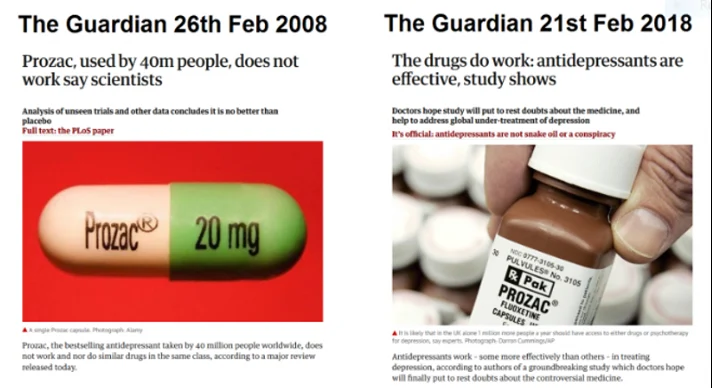
For more than three decades, Selective Serotonin Reuptake Inhibitors (SSRIs) and other antidepressants have been the cornerstone of mental health treatment in the Western world. Marketed under a name that implies a specific curative function, these drugs have been hailed by psychiatric leaders as highly effective tools for managing major depressive disorder. However, a growing body of investigative research and meta-analyses is challenging this narrative, suggesting that the clinical benefits of antidepressants may be largely illusory, while their potential for harm has been systematically underestimated.
Dr. Peter C. Gøtzsche, a prominent researcher and co-founder of the Cochrane Collaboration, argues that the "antidepressant" label is fundamentally misleading. According to Gøtzsche and a cohort of skeptical scientists, the data used to approve and promote these drugs is marred by industry bias, flawed trial designs, and "statistical alchemy."
Main Facts: The Discrepancy Between Clinical Claims and Patient Experience
The central tension in the antidepressant debate lies in the difference between how doctors rate a drug’s success and how patients experience it. In clinical trials, psychiatrists often use the Hamilton Depression Rating Scale (HAM-D), a 52-point tool, to measure progress. However, research consistently shows a significant gap in perception.
In meta-analyses of placebo-controlled trials involving children and adolescents, psychiatrists reported an "effect size" of approximately 0.25. In contrast, the patients’ own self-ratings yielded an effect size of only 0.05—a figure so low it is statistically indistinguishable from zero. This pattern repeats in adult trials. For example, older drugs like amitriptyline showed a doctor-rated effect size of 0.25, while patient ratings sat at a negligible 0.06.
Critics argue that the small "benefit" reported by doctors is not a result of the drug’s chemical efficacy against depression, but rather a byproduct of "unblinding." Because antidepressants cause conspicuous side effects (such as dry mouth, nausea, or sexual dysfunction), both patients and doctors can often guess who is receiving the active drug and who is receiving the placebo. This "active" placebo effect creates a psychological bias that inflates the perceived effectiveness of the medication.
Chronology: From the "Prozac Revolution" to the "STAR*D Scandal"
The modern era of psychopharmacology began in December 1987, when the FDA approved fluoxetine (Prozac). While it was celebrated as a breakthrough, some international regulators were skeptical from the start. The German drug regulator initially found fluoxetine "totally unsuitable" for treating depression, noting that patient self-ratings showed little to no response.
The following timeline highlights the shift from universal acclaim to growing scientific scrutiny:

- 1987: Prozac is approved by the FDA, sparking a global surge in SSRI prescriptions.
- 2004: Research into "active placebos" (placebos that mimic drug side effects using substances like atropine) suggests that when trials are effectively blinded, the perceived benefit of antidepressants shrinks significantly.
- 2008: A landmark meta-analysis published in PLOS Medicine by Irving Kirsch and colleagues concludes that the difference between antidepressants and placebos is not clinically significant for most patients.
- 2015: The Lancet Psychiatry reports on the "landmark" STAR*D study, claiming a 70% remission rate for depressed patients. This study becomes the primary evidence used in textbooks to support long-term antidepressant use.
- 2018: Andrea Cipriani and colleagues publish a massive meta-analysis in The Lancet. While the media portrays it as "the final answer" proving the drugs work, the actual effect size reported (0.30) remains below the threshold for clinical relevance.
- 2023-2024: Independent re-analyses of the STAR*D study’s raw data reveal significant protocol violations and "scientific misconduct." Researchers find that the 70% remission claim was fraudulent, as the original data showed much lower success rates and failed to account for patients who dropped out.
Supporting Data: The Illusion of Clinical Relevance
To understand why critics like Gøtzsche are so vocal, one must look at the mathematical definition of "improvement." On the Hamilton Depression Scale, the smallest effect that a patient can actually perceive as a change in their condition is generally considered to be 5 to 6 points.
Recent meta-analyses, even those funded or conducted by proponents of the drugs, show an average improvement of only about 2 points over a placebo. This means that even when the drug "works" better than a sugar pill, the difference is so minute that the patient cannot feel it.
The Problem of "Number Needed to Treat" (NNT)
Psychiatric establishments often point to the "Number Needed to Treat" to argue for drug efficacy. They claim, for instance, that only three patients need to be treated to prevent one recurrence of depression. However, Gøtzsche argues this is a "mathematical illusion." These "maintenance studies" often involve taking patients who are already on a drug and abruptly switching half of them to a placebo. The "recurrence" of depression in the placebo group is often actually a manifestation of withdrawal symptoms, which include extreme anxiety and low mood.
Documented Harms
The argument against antidepressants is not merely that they are ineffective, but that they are actively harmful for a significant portion of the population:
- Suicidality: Clinical study reports suggest that antidepressants double the risk of suicide in both adults and children compared to placebos.
- Sexual Dysfunction: Approximately 50% of patients experience sexual impairment, and in some cases, Post-SSRI Sexual Dysfunction (PSSD) can become permanent even after the drug is discontinued.
- Withdrawal: Roughly half of all patients who attempt to stop taking antidepressants experience withdrawal symptoms, with 25% of those describing the symptoms as "severe."
- Physical Frailty: In elderly populations, these drugs are linked to an increased risk of falls and hip fractures, which carry a high mortality rate.
Official Responses and the Defense of Orthodoxy
The psychiatric establishment, including the Royal College of Psychiatrists and the American Psychiatric Association, maintains that antidepressants are essential tools. Their defense typically rests on three pillars:
1. "It Works for Severe Depression"
Proponents often concede that antidepressants may not work for mild cases but insist they are "life-saving" for severe depression. Critics counter this by pointing to mathematical artifacts in the data. They argue that studies claiming a correlation between severity and drug efficacy often use flawed regression analyses where the initial severity is mathematically tied to the final score, creating a spurious relationship.
2. "Clinical Experience Overrides Trials"
Many clinicians argue that they see patients get better in their private practices. Researchers respond that this is "anecdotal evidence" that fails to account for the natural recovery over time. Because most depressive episodes are self-limiting, patients who start a drug at their lowest point will likely improve regardless of the treatment—a phenomenon known as "regression to the mean."

3. "The Final Answer" Framing
When major studies like the 2018 Cipriani meta-analysis are released, they are often framed by psychiatric leaders as the "final word" on the controversy. However, investigative journalists have noted that many of these "opinion leaders" have significant financial ties to the pharmaceutical industry, creating a conflict of interest that may color their interpretation of the data.
Implications: A Crisis of Trust in Mental Health
The persistent promotion of antidepressants despite marginal data has profound implications for public health and the integrity of medical science.
The Influence of Artificial Intelligence and Media
The "misinformation" regarding these drugs has become so embedded in the medical literature that it has infected modern technology. When queried about the efficacy of fluoxetine in children, AI models like Grok often cite "strong evidence" for its use, despite the original clinical study reports showing the trials were plagued by discrepancies and protocol violations. This creates a feedback loop where fraudulent or biased data is treated as objective truth by both the public and automated systems.
The "Third Leading Cause of Death"
Perhaps the most startling implication is the claim that psychiatric drugs, led by antidepressants, have become the third leading cause of death in Western countries, trailing only heart disease and cancer. This calculation includes suicides, homicides linked to drug-induced akathisia (extreme restlessness and agitation), and the fatal consequences of falls in the elderly.
A Call for Market Removal
For critics like Dr. Gøtzsche, the conclusion is absolute: because the harms of antidepressants outweigh their negligible, placebo-level benefits, they should be removed from the market. He argues that psychiatry is the only medical specialty that "survives on lies," relying on the "Texas sharpshooter" fallacy—where researchers draw a bullseye around wherever the bullet happens to land by changing trial outcomes after the data has been collected.
As the debate continues, the focus is shifting toward "deprescribing" and finding non-pharmacological interventions for emotional distress. The challenge for the next generation of medical professionals will be to reconcile the multi-billion dollar antidepressant industry with a growing mountain of evidence that suggests the "chemical imbalance" theory of depression was, at best, an oversimplification and, at worst, a marketing triumph over science.