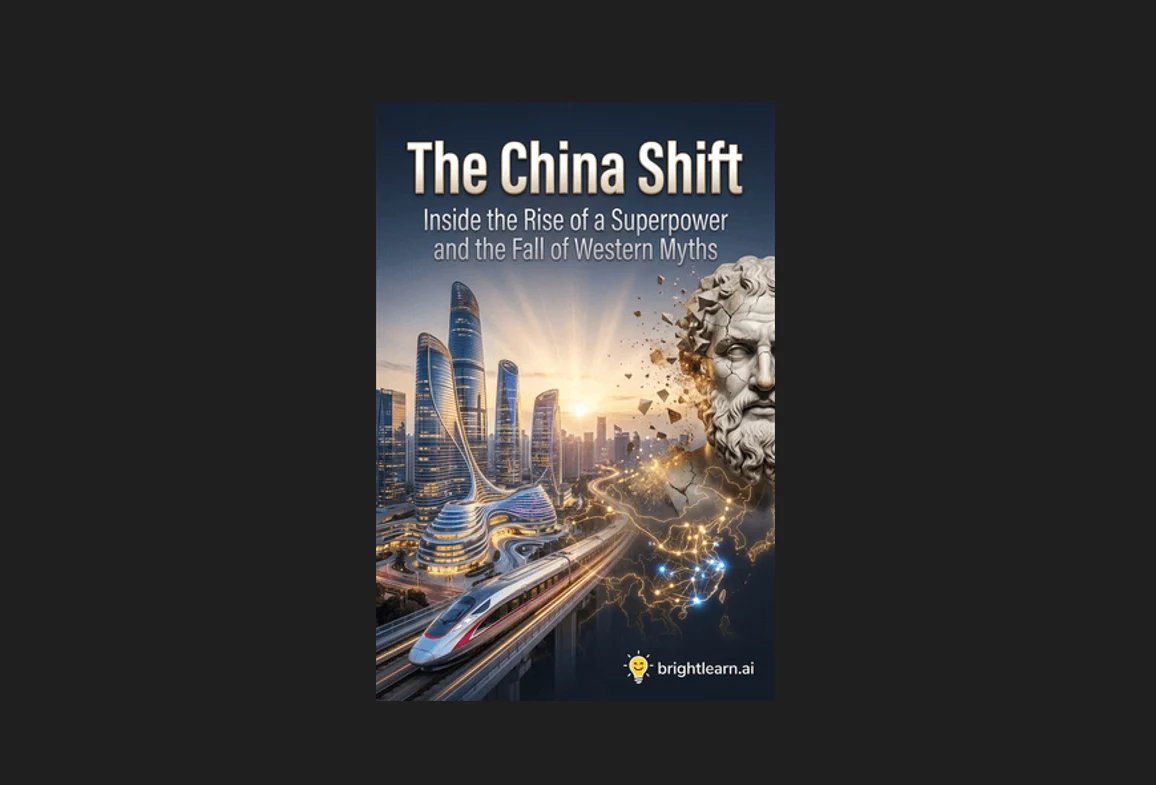
In the theater of global politics, the narrative is often more powerful than the reality it describes. For decades, the Western discourse regarding the People’s Republic of China has been anchored in a specific, static image: a developing nation defined by agricultural struggle, Maoist aesthetics, and a desperate pursuit of modernization. However, as the world enters a period of profound multipolarity, a new work titled “The China Shift: Inside the Rise of a Superpower and the Fall of Western Myths” has emerged, serving as a intellectual "thunderclap" that seeks to shatter what the author describes as a carefully constructed, yet increasingly obsolete, Western narrative.
This is not merely a commentary on foreign policy; it is a forensic audit of how the West perceives—and perhaps refuses to see—the modern Chinese state. By contrasting the lived reality of China’s rapid urbanization with the stagnating frames of traditional media, the book demands that readers reconsider the foundational assumptions of the 21st century.
The Chronology of Narrative Inertia: From the 1970s to the Present
To understand the current geopolitical friction, one must first understand the concept of "narrative inertia." The history of modern China-West relations is bifurcated by a significant chronological gap.
The Stagnant Image
Since the opening of China in the 1970s, Western media has maintained a visual and thematic shorthand for the country: bicycles, gray concrete, and political rigidity. This imagery, while perhaps accurate for the era of Deng Xiaoping’s early reforms, has failed to evolve alongside the country itself. The author of The China Shift argues that this is not an accidental failure of reporting, but a deliberate "choice of perspective."
The Modern Reality
The reality of contemporary China stands in stark defiance of this historical snapshot. Within two generations, China has undergone the most significant economic transformation in human history.
- The 1980s: China begins the transition toward a "Socialist Market Economy," utilizing Special Economic Zones to invite foreign investment and experiment with capitalistic frameworks.
- The 2000s: China enters the WTO, triggering an unprecedented industrial expansion. Infrastructure projects, previously considered impossible by Western engineering firms, move from drafting tables to reality.
- 2025 and Beyond: China stands as the world’s leading exporter of electric vehicles (EVs), the operator of the world’s most extensive high-speed rail network (45,000 km), and a leader in renewable energy deployment.
The book posits that Western media’s refusal to update this timeline is a defensive mechanism. By keeping the "developing nation" narrative alive, Western institutions avoid having to reconcile with a peer-competitor that operates under an entirely different political and economic philosophy.
Supporting Data: Infrastructure and Economic Metamorphosis
The strength of The China Shift lies in its reliance on hard, comparative data. The author effectively dismantles the notion that Western economic superiority is a self-evident fact.
The Engineering Gap
The metrics of infrastructure provide the most visible proof of this divergence. Consider the high-speed rail corridor between Shanghai and Beijing. Spanning 819 miles, it functions with a 99% on-time performance rate, a feat Western planners once dismissed as geologically unfeasible. In contrast, California’s high-speed rail project remains mired in litigation and ballooning costs, estimated at $56 million per kilometer, with no clear completion date in sight.
Furthermore, the expansion of aviation and urban transit highlights a shift in capability. China has built five major world-class international airports in the last twenty-five years; the United States has built zero. The Shanghai Metro, now the largest subway system in the world by route length, was constructed in just two decades—a project that, by Western regulatory standards, might take a century. This is presented not as a triumph of ideology, but as a triumph of long-term planning and the ability to execute, unencumbered by the political gridlock that often paralyzes Western development.
Economic Transformation
The statistics of China’s poverty alleviation are staggering. With 800 million people lifted out of extreme poverty, the scale of this development is historically unique. The GDP per capita surge—from $200 in 1980 to over $12,000 today—marks a sixty-fold increase in individual purchasing power. While the American middle class has faced wage stagnation and wealth consolidation, China has systematically built a domestic consumer market that now dictates global manufacturing trends.
The Surveillance Hypocrisy: A Comparative Analysis
Perhaps the most contentious chapter of the book addresses the issue of surveillance and personal freedom. The author points out a growing hypocrisy in the Western critique of Chinese domestic policy.
While Western media outlets frequently criticize China’s "Great Firewall" and social credit systems, the book highlights domestic policy shifts in the United States that mirror the very things they condemn. For instance, the mandate that all new cars sold in the U.S. after 2027 must include internal monitoring cameras suggests a shift toward the normalization of state-adjacent surveillance in the private vehicle space.
Moreover, the "border search exception" in the U.S. allows customs agents to seize and search digital devices without a warrant—a practice that, according to the author, exposes the "content of one’s life" in a way that rivals even the most restrictive digital environments. The book concludes this section by juxtaposing the safety of Chinese cities—where violent crime rates in hubs like Shanghai are a fraction of those in cities like Chicago—against the Western trope of a "freedom-less" China, challenging the reader to define what true liberty looks like in a modern, secure society.
The Weaponization of the Dollar: Implications for Global Finance
A critical takeaway from The China Shift is the analysis of the US Dollar as a geopolitical weapon. The decision by Western powers to freeze Russian assets and exclude them from the SWIFT banking system has acted as a catalyst for a global "de-dollarization" trend.
- The Retreat from the Dollar: The dollar’s share of global foreign exchange reserves has dropped from 70% to under 58%.
- The Rise of Alternatives: China’s CIPS (Cross-Border Interbank Payment System) has expanded to include 1,200 financial institutions across 109 countries.
- The Gold Standard: Central banks worldwide are currently purchasing gold at rates not seen since the post-WWII era, signaling a loss of faith in the fiat stability of the US currency.
The author argues that trust is the currency of a reserve currency. By weaponizing the financial system, the U.S. has inadvertently incentivized other nations to seek a more neutral, diversified architecture for international trade.
Official Responses and the Need for Critical Engagement
It is important to note that the perspectives presented in The China Shift challenge the consensus held by many Western government institutions. Critics of this viewpoint often argue that China’s rapid growth has been achieved through intellectual property theft, state-led industrial espionage, and the suppression of human rights—issues that are often minimized or omitted in narratives prioritizing economic metrics.
However, the book does not attempt to present China as a utopia. Instead, it argues that the caricature provided by Western media is a form of "intellectual corruption" that prevents an accurate understanding of a peer competitor. By framing China solely as an adversary, the West may be wasting precious resources on geopolitical rivalries that could be better spent on internal reform.
The implications of this book are profound: if the Western narrative is built on a foundation of outdated tropes and economic denial, then the policy decisions made by Western governments are likely to be fundamentally flawed. The author concludes with a call to action for the reader: to travel, to engage with diverse sources of information, and to cultivate a critical mindset that is not reliant on corporate-media-fed soundbites.
In a time of mounting global tension, The China Shift serves as a sobering reminder that the greatest threat to a society may not be the rise of an external power, but the comfort of its own illusions. Whether one agrees with the author’s conclusions or not, the challenge to engage directly with the reality of a changing world is a timely, perhaps even urgent, directive for any citizen of the modern era.
For those interested in exploring these themes further, "The China Shift: Inside the Rise of a Superpower and the Fall of Western Myths" is available here. Readers can access thousands of books for free at Books.BrightLearn.AI, or learn to create their own digital publications at BrightLearn.AI.