In a move that has sent shockwaves through the public health and policy communities, the U.S. Department of Agriculture (USDA) has announced a sweeping, multi-state relocation and restructuring plan for the Food and Nutrition Service (FNS). Under the leadership of Secretary Brooke Rollins, the agency—now rebranded as the Food and Nutrition Administration (FNA)—will see its core components fragmented and scattered across the country.
Critics argue that this restructuring is not a logistical improvement, but a systematic effort to erode the efficacy of the nation’s primary food safety net, including the Supplemental Nutrition Assistance Program (SNAP). By dispersing the institutional knowledge of the agency, the administration risks creating a bureaucratic labyrinth that could effectively stifle access for millions of vulnerable Americans.
The Chronology of Change
The restructuring process began in early May 2026, building upon previous efforts to shift federal agency operations out of the Washington, D.C. orbit.
- May 1, 2026: The USDA formally announces the renaming of the Food and Nutrition Service (FNS) to the Food and Nutrition Administration (FNA).
- May 2, 2026: Official directives are released detailing the geographical dispersion of the agency’s key pillars.
- May 3, 2026: Industry experts and advocates begin to sound the alarm, noting the potential for severe operational bottlenecks.
This is not the first time the USDA has moved to decentralize its workforce, but the scope of this particular reorganization is unprecedented. By separating policy, oversight, and operational units, the USDA has essentially dismantled the centralized command structure that has historically ensured the uniform administration of federal food assistance.
A Geographical Dispersion: The Breakdown
The core of the controversy lies in the physical relocation of these vital units. The USDA’s new map for the FNA is as follows:
- Dallas, Texas: Now the hub for all Child Nutrition Programs.
- Kansas City, Missouri: The new headquarters for SNAP operations and general safety protocols.
- Raleigh, North Carolina: The home for agency research and analytical departments.
- Denver, Colorado: The designated location for emergency management services.
- Multiple Hubs (Atlanta, Los Angeles, Dallas, and New York City): Retailer compliance monitoring.
While the agency retains an administrative figurehead in Washington, D.C., the functional reality is a disconnected network. Critics argue that this geographic spread creates a "silo effect," where departments that should be working in lockstep—such as research and policy development—are instead separated by thousands of miles and disparate time zones.
Official Rationalization: The Case for Efficiency
Secretary Brooke Rollins has championed this move as a triumph of "heartland" governance. In a statement posted to social media, Secretary Rollins emphasized that the goal is to shift staff "closer to those they support."
The official narrative posits that moving these functions out of the D.C. metropolitan area will make the agency "more efficient and responsive." According to the Secretary, the move is designed to provide "faster, better service for families who need nutrition assistance" while simultaneously fostering "stronger support for American farmers."
The rhetoric employed is one of populist decentralization—the idea that the federal government is more effective when it is removed from the influence of the capital and placed squarely in the geographic center of the country. However, many career civil servants and policy analysts remain skeptical, noting that the "efficiency" promised rarely accounts for the loss of institutional expertise that occurs when veteran staff choose not to relocate.
The Implications: A Silent Erosion of Services
The primary concern among food policy experts is that this reorganization is a "soft" form of institutional sabotage. By breaking up the agency, the USDA is effectively stripping it of its ability to maintain a cohesive, high-level response to food insecurity.
The Loss of Institutional Knowledge
Effective government requires the retention of experts who understand the nuances of legislative intent and the realities of administrative implementation. Historically, mass relocations of federal agencies have led to a "brain drain," where a significant percentage of the workforce chooses to resign rather than uproot their families. When these experts leave, they take decades of institutional memory with them. If the USDA loses its most experienced staff, the inevitable result will be a decline in the accuracy and speed of benefit processing.
The Fragmentation of Oversight
SNAP is a complex program that requires constant coordination between federal policy, state administration, and retailer compliance. By spreading these units across five different states, the USDA is making it nearly impossible for leadership to maintain the tight oversight necessary to ensure program integrity. When communication is hindered by distance and organizational fragmentation, the most vulnerable citizens are the first to experience the "gaps" in the system.
Supporting Data and Historical Context
The suspicion that this move is intended to reduce enrollment is not unfounded. Recent data from states like Arizona, as reported by investigative outlets such as ProPublica, shows a marked decline in SNAP participation following shifts in administrative policy.
When the bureaucratic barrier to entry is raised, or when the administrative infrastructure is weakened, the first victims are those who lack the resources to navigate a convoluted system. If a mother in a rural county has an issue with her child’s school lunch program or her own SNAP benefits, she is now looking at a web of disparate agencies that are no longer speaking the same language.
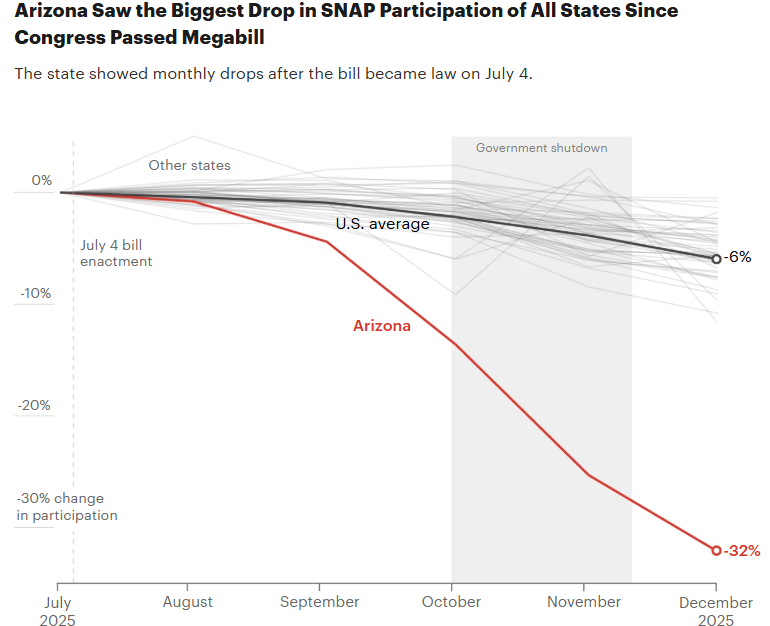
The data suggests a pattern:
- Administrative Complexity: Higher rates of "churn" (when eligible participants are dropped from the program due to clerical errors).
- Compliance Barriers: A reduction in retailer monitoring often leads to less access in low-income "food deserts."
- Policy Decoupling: When research (Raleigh) is separated from implementation (Kansas City), the programs become stagnant and unresponsive to emerging hunger trends.
The Future of Food Security
The move to restructure the FNA is emblematic of a larger ideological shift in how the federal government views the social safety net. By framing the agency as a bloated entity in need of a "heartland" reset, the current administration is utilizing the aesthetics of reform to disguise a reduction in functionality.
For advocates of food security, the next few years will be a period of intense vigilance. The true test of this reorganization will not be found in the press releases or the rhetoric about "efficiency." It will be found in the enrollment numbers, the efficiency of benefit delivery, and the stories of the families who depend on these programs to survive.
If the goal of the USDA was truly to serve the American people better, one would expect to see increased investment in technology, simplified enrollment portals, and better support for the staff on the ground. Instead, we are witnessing a geographical dismantling that, by design or by default, creates an environment where the safety net is intentionally frayed.
As the units settle into their new, disparate homes, the administrative capacity of the USDA will be tested. If the result is, as many fear, a decrease in access and a degradation of service, the administration will have a difficult time justifying the move as "service-oriented." Until then, the burden of this transition falls squarely on the shoulders of the low-income Americans who rely on these programs for their daily sustenance.
The "national tragedy" described by critics is not merely about where a building is located; it is about the fundamental commitment of a government to the welfare of its most vulnerable constituents. When that commitment is sacrificed for the sake of political optics and administrative fragmentation, it is the public that pays the ultimate price.