








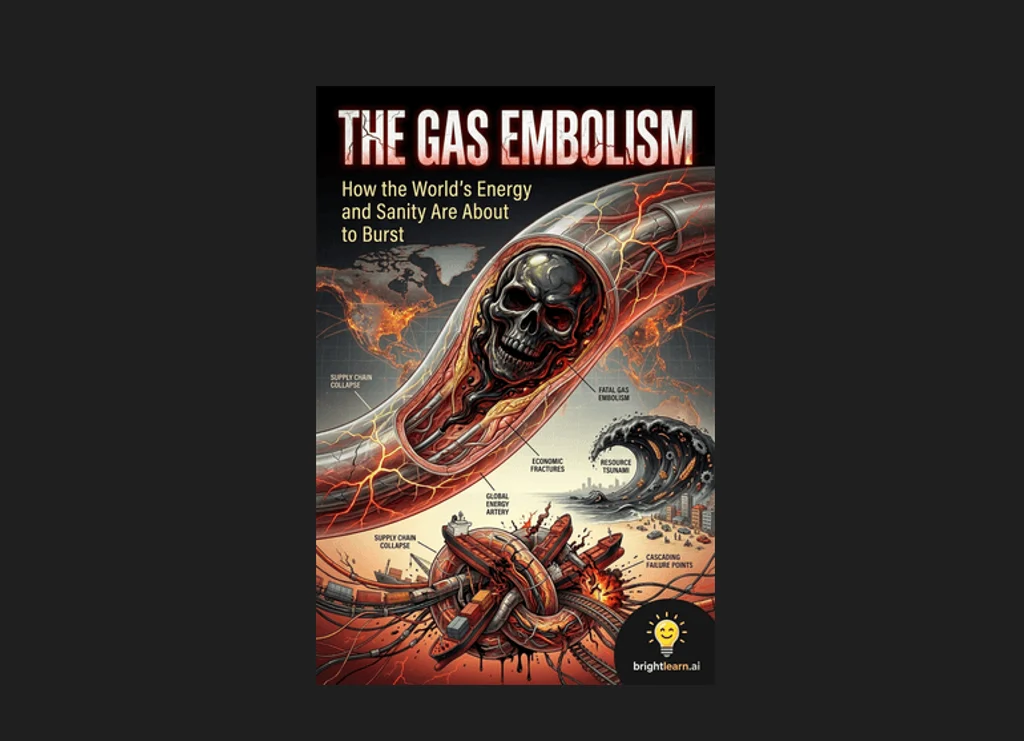
The modern world operates under a persistent, comforting illusion: that energy—the gasoline in our tanks, the electricity in our grids, and the heat in our homes—is an infinite, self-replenishing resource. We treat the global energy supply chain as a background utility, invisible and reliable. However, according to the sobering analysis presented in the book “The Gas Embolism: How the World’s Energy and Sanity Are About to Burst,” this perception is a dangerous fantasy.
The global energy sector is not a resilient network; it is a rigid, hyper-extended "just-in-time" conveyor belt. When one segment of this industrial marvel jams, the entire mechanism does not merely slow down—it grinds to a catastrophic halt. As global geopolitical tensions rise and infrastructure ages, the fragility of this system is no longer a theoretical concern; it is an impending systemic risk.
The Anatomy of a Fragile Machine
To understand the gravity of a potential collapse, one must first grasp the staggering complexity of the oil supply chain. It begins in the volatile geography of subterranean reservoirs, moves through thousands of miles of high-pressure pipelines, and is loaded onto massive, slow-moving supertankers that traverse the oceans at a pace reminiscent of the industrial age.
Unlike manufacturing, where inventory can be warehoused, the global oil market operates with almost zero "slack." Global consumption sits at roughly 100 million barrels per day. Yet, the total global storage capacity—the buffer that separates modern civilization from total energy starvation—covers only a few weeks of demand. There is no "Plan B." There is no strategic reserve capable of replacing the constant, heartbeat-like flow of daily deliveries if the conveyor belt is severed.
The Choke Point Vulnerability
The system’s integrity relies on a handful of narrow maritime corridors known as geographic choke points. These include the Strait of Hormuz, the Suez Canal, and the Strait of Malacca. When these arteries are restricted, the global economy faces an immediate, localized infarction. Because the system is built for continuous flow, any blockage causes a backup that ripples backward through the supply chain, rendering refineries idle and distribution networks empty.
Chronology of a Crisis: February 28, 2026
The book “The Gas Embolism” highlights a harrowing hypothetical—and potentially prophetic—timeline starting on February 28, 2026, when the flow of tankers through the Strait of Hormuz effectively ceased.
- Phase I: The Illusion of Normalcy: Initially, the global markets barely reacted. Mainstream media outlets dismissed the disruption as a "logistical hiccup." Because tankers already at sea continued to arrive at their destinations, the average consumer saw no change at the local pump. This created a false sense of security, fueled by "normalcy bias"—the psychological tendency to believe that tomorrow will look exactly like today.
- Phase II: The Emptying Pipeline: While the public remained calm, military analysts and intelligence agencies recognized the gravity of the situation. Satellite imagery revealed a massive, stalled fleet of tankers unable to enter or exit the region. The "conveyor belt" had been cut, but the lag time inherent in global shipping masked the impending shortage.
- Phase III: The Collapse of Distribution: As existing stocks were depleted, the lack of replenishment hit the distribution centers. Trucks stopped moving, refineries went cold, and the "just-in-time" model collapsed. The delay between the supply disruption and the public realization of the shortage provided a deceptive, and ultimately deadly, window of time during which preventative measures could have been taken but were ignored.
Supporting Data: The Physics of Civilization
The crisis is exacerbated by the concept of "energy density." Gasoline and diesel are not merely fuels; they are concentrated batteries of solar energy stored over millions of years. A single gallon of gasoline contains the energy equivalent of roughly 500 hours of human physical labor.
Current alternative technologies, such as battery-electric storage or hydrogen, lack the volumetric energy density required to move 200,000-ton tankers across the ocean or to power the heavy industrial machinery that builds our civilization. Our entire infrastructure—from the massive shipping fleets that feed the world to the chemical plants that produce our medicines—is engineered specifically for the high energy density of hydrocarbons. If that specific fuel source is removed, there is no immediate drop-in replacement that can maintain our current standard of living.
The Cascade Effect: How Shortages Poison Society
A fuel shortage is never just about transportation. It is the first domino in a chain reaction that destabilizes every sector of human life.
1. The Agricultural Infarction
Modern agriculture is fundamentally a process of converting fossil fuels into food. Synthetic fertilizers, large-scale irrigation pumps, and the heavy machinery used for harvesting and transport all rely on oil. A disruption in the energy chain is, by extension, a disruption in the food chain. As fuel prices spike and supplies vanish, the cost of calories skyrockets, leading to immediate food insecurity.
2. The Medical Emergency
Hospitals operate on a 24/7 cycle of energy dependency. While large facilities utilize backup generators, these are designed for short-term outages, not sustained, weeks-long energy crises. When fuel supply chains are broken, these generators go silent. Furthermore, the refrigerated supply chains for life-saving medicines—from insulin to vaccines—will fail, leading to a secondary health crisis that far outpaces the immediate effects of the energy shortage itself.
3. The Industrial Necrosis
Modern industry is a series of interconnected nodes. If a manufacturing plant cannot get raw materials due to shipping delays, or cannot power its lines due to electricity shortages, it stops. When one node dies, it becomes "necrotic tissue," poisoning the surrounding nodes. This creates a feedback loop of economic contraction, where even companies that have access to limited resources cannot function because their suppliers and customers have already shuttered.
Official Responses and Systemic Denial
Government responses to such crises are often hindered by the same normalcy bias that affects the public. In the early stages of a supply chain rupture, political leadership is incentivized to maintain calm, often downplaying the severity of the situation to prevent panic.
However, the "suck-back" effect—the period where the water pulls back from the shore before a tsunami—is the most dangerous phase. Officials often focus on short-term price caps or limited rationing, which do nothing to address the fundamental lack of supply. By the time the full extent of the collapse is acknowledged, the tools available to mitigate the damage have already been exhausted.
Implications for the Future
The warning provided in “The Gas Embolism” is clear: we are living on a knife’s edge. The global energy system is being pushed to its breaking point by three primary pressures:
- Geopolitical Instability: The concentration of supply in volatile regions makes the system susceptible to regional conflicts.
- Aging Infrastructure: Much of the pipeline and refinery network is decades old, requiring constant maintenance that is increasingly difficult to perform in a global economy strained by debt and supply shortages.
- Deliberate Sabotage: As global tensions increase, the infrastructure itself becomes a target for asymmetric warfare, where small-scale disruptions can have continental-scale consequences.
The Wise Elephant or the Curious Animal?
The analogy of the beachgoers is perhaps the most haunting takeaway. The tsunami is building on the horizon. The water has already receded, revealing the decay and the fragility that was hidden by the abundance of the last few decades.
To survive the coming shift, society must move beyond the illusion that energy will "just appear." Awareness is the first step toward resilience. Understanding that the system has no off switch and no significant buffer is critical for any individual or community looking to prepare for the inevitable disruptions that accompany a hyper-complex, fragile civilization.
As the world stands on this conveyor belt, the question remains: will we continue to marvel at the seashells on the shore, or will we recognize the signs of the receding tide and seek higher ground before the wave arrives?
For further analysis on the global energy collapse, you can explore the insights provided in "The Gas Embolism: How the World’s Energy and Sanity Are About to Burst," available for free download at Books.BrightLearn.AI. Additionally, expert perspectives on these economic shocks can be found through the Health Ranger Report on Brighteon.com.