





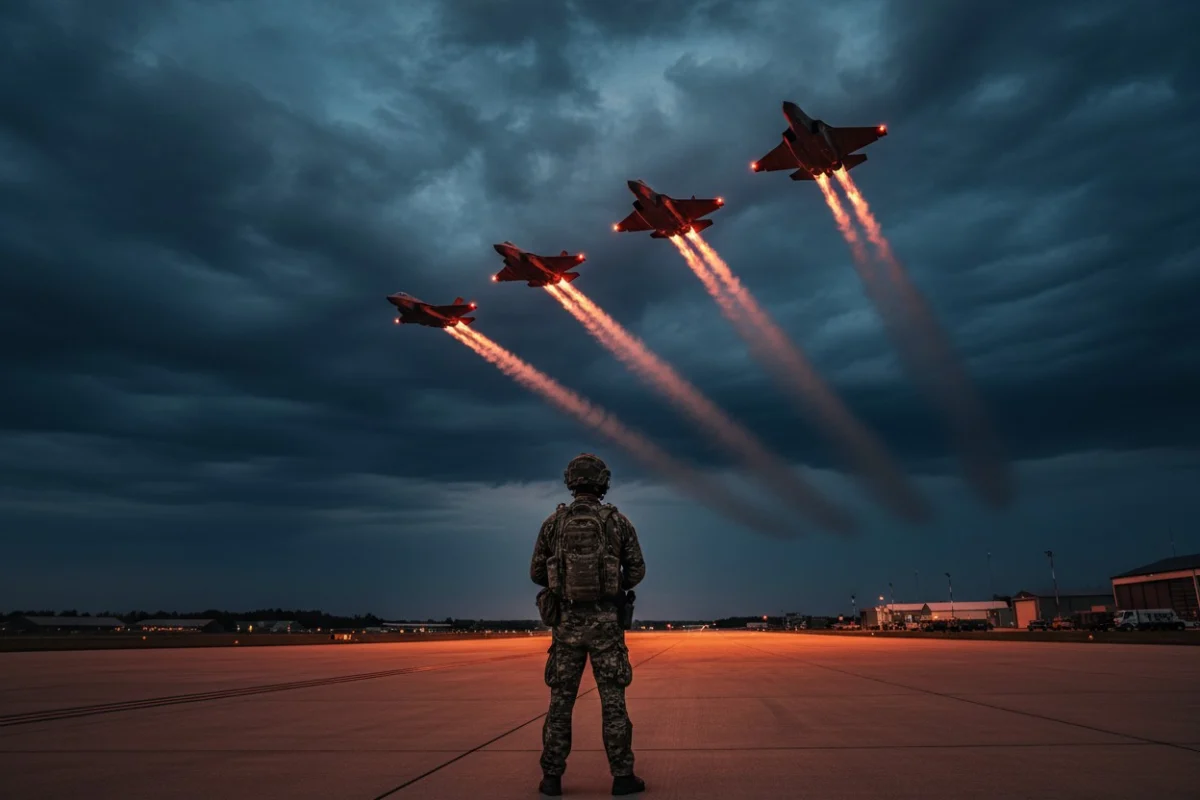
The strategic landscape of Europe, once defined by the carefully managed stability of the post-Cold War era, is undergoing a seismic and dangerous transformation. Beneath the surface of public diplomatic discourse, a "highly confidential" chess match is playing out, with the United States reportedly considering the expansion of its nuclear footprint across NATO member states. As Washington recalibrates its conventional military presence, the specter of a new nuclear arms race has moved from the realm of abstract theory to the forefront of geopolitical reality.
The potential deployment of additional atomic warheads—or the expansion of the "nuclear umbrella" to include nations previously outside its immediate tactical reach—has triggered an aggressive response from Moscow. The Kremlin has signaled that any nation opting to host such assets will be prioritized as a strategic target, effectively ending decades of status quo in European security architecture.
The Chronology of Escalation: From Deterrence to Deployment
The current shift in nuclear posture did not emerge in a vacuum; it is the culmination of a multi-year breakdown in security treaties and a fundamental realignment of NATO’s eastern flank strategy.
- Early 2023: Finland officially joins NATO, shattering decades of military non-alignment. By March 2024, Helsinki signals its intent to amend national legislation to permit the transit and hosting of nuclear devices.
- March 2024: French President Emmanuel Macron articulates a "forward nuclear deterrence strategy," proposing the integration of French atomic assets into a broader European security framework.
- Late 2024: Warsaw and Paris announce deep-seated military cooperation, with reports surfacing of simulated nuclear strike exercises targeting the Russian and Belarusian border regions.
- Early 2025: The Pentagon enacts a reduction in conventional troop rotations in Germany and Poland, triggering intense internal debates within NATO regarding how to fill the resulting security vacuum.
- Current Period: Reports emerge from the Financial Times and other outlets detailing classified discussions in Washington regarding the distribution of B61-series gravity bombs to new host nations, potentially including Poland and the Baltic states.
Supporting Data: The Paradox of Power
The strategic shift is characterized by a glaring contradiction: while the physical presence of conventional NATO "boots on the ground" is shrinking, the lethality of the remaining hardware is being upgraded.
In 2025, the U.S. maintains a presence of over 80,000 troops across Europe. However, recent decisions—such as the cancellation of a 4,000-troop rotation into Poland and the withdrawal of 5,000 personnel from Germany—have led to anxiety among eastern NATO members. For nations like Poland, Lithuania, Latvia, and Estonia, the reduction in conventional forces is perceived as a weakening of the "tripwire" force.
To mitigate this, Washington is reportedly turning to the "most dangerous currency of all": nuclear deterrence. By increasing the number of dual-capable aircraft (DCA) and nuclear-certified infrastructure in these regions, the U.S. hopes to provide a psychological and strategic guarantee that conventional forces no longer provide. However, the data suggests this "substitution strategy" carries a high risk of miscalculation. If the threshold for a nuclear response is lowered to compensate for smaller conventional numbers, the margin for error during a regional crisis shrinks significantly.
Official Responses: The Rhetoric of "Closer Scrutiny"
The Kremlin has responded to these reports with a mixture of warnings and direct threats. Russian officials, including Deputy Foreign Minister Sergey Ryabkov, have framed the potential expansion as a "process of accelerated militarization" that directly violates the spirit of previous European security agreements.
Moscow’s stance is categorical: the Kremlin has explicitly stated it has no intent to initiate a conflict with any NATO member. However, it has clarified that the deployment of nuclear weapons on its doorstep creates a "mathematical certainty" of targeting. Under this doctrine, any state that agrees to host U.S. or French nuclear weapons effectively places its own population in the crosshairs of Russia’s strategic deterrence apparatus.
"The general security level of those nations will not increase," Ryabkov noted in a recent briefing. "On the contrary, they will fall under the closer scrutiny of our military forces responsible for strategic deterrence."
Meanwhile, NATO officials maintain that these measures are purely defensive, designed to counter the modernization of Russia’s own tactical nuclear arsenal and its recent integration of nuclear assets into the Kaliningrad exclave and Belarus.
France’s Independent Nuclear Gambit
A significant, and often overlooked, driver of this escalation is the evolving role of the French Force de Frappe. President Macron’s assertion that France must move toward a "forward nuclear posture" represents a departure from traditional reliance on the U.S. nuclear umbrella alone.
The cooperation between Paris and Warsaw is particularly sensitive. By exploring the potential for French nuclear-capable aircraft to operate out of Polish bases, the two nations are challenging the established NATO chain of command regarding nuclear control. This shift complicates Moscow’s "deterrence calculus," as it is forced to account for a fragmented and more unpredictable European nuclear architecture rather than a centralized American one.
Implications: The High Cost of the New Nuclear Age
The implications of this shift are profound and potentially irreversible.
1. The Erasure of Strategic Depth
By pushing nuclear assets closer to the Russian border, the "reaction time" for both sides is reduced to a matter of minutes. This "use it or lose it" dilemma is the classic recipe for accidental nuclear war. When nations share direct borders with adversaries, the deployment of tactical nuclear weapons turns the entire geography into a front-line zone.
2. The Collapse of Arms Control
The "highly confidential" nature of these talks suggests that the era of transparent arms control—where the U.S. and Russia negotiated parity—is effectively over. When strategic decisions are made behind closed doors without international oversight, the risk of misinterpretation during a crisis escalates exponentially.
3. Domestic Political Volatility
For the host nations, the decision to accept nuclear weapons is not merely a military one; it is a profound political gamble. Hosting nuclear weapons often requires significant changes to national law, which can trigger domestic protests and political instability. As seen in Finland, the legislative shift toward becoming a nuclear host is met with significant internal pushback, forcing governments to choose between NATO integration and domestic security preferences.
4. The "Escalation Ladder"
The current trajectory points to a dangerous climb up the escalation ladder. If the U.S. and its allies increase their nuclear posture, Russia is almost certain to respond with further deployments in Belarus and enhanced strategic patrols. This "tit-for-tat" cycle leaves little room for de-escalation, as both sides view their actions as purely reactive to the other’s "aggression."
Conclusion: A Continent at the Brink
The silence that previously surrounded the U.S. nuclear game in Europe is indeed cracking, revealing a reality that many hoped belonged to the history books. As Washington weighs the expansion of its nuclear footprint, and as Moscow reaffirms its commitment to targeting those who host these weapons, the European continent finds itself in a precarious position.
The strategy of replacing conventional troops with nuclear deterrents may provide a temporary sense of security to eastern NATO members, but the long-term cost is the permanent destabilization of the European security environment. Whether this represents a genuine shift in defense doctrine or a high-stakes bluff, the result is the same: the threshold for nuclear conflict has never been lower in the 21st century. The world now watches as the "highly confidential" discussions of today transform into the hard security realities of tomorrow, with the peace of a continent hanging in the balance.