For decades, the oncology narrative has been defined by the battle against established, invasive tumors. We diagnose, we treat, and we manage recurrence. However, a seismic shift is underway in how the scientific community approaches the malignancy lifecycle. For the first time, the Cancer Research Institute (CRI) has designated a singular, ambitious theme for its CLIP (Cancer Immunology Project) applications: primary and secondary cancer prevention and interception.
This initiative seeks to fund multi-investigator teams capable of bridging the chasm between basic mechanistic discovery and clinical application. The goal is no longer just to treat cancer—it is to stop it before it fully forms or to eliminate the microscopic seeds of recurrence before they can take root.
The Window Before the Scan: Understanding the Biology of "Pre-Cancer"
Cancer does not manifest on the day of diagnosis. It is a slow, methodical process that often begins years, or even decades, before a tumor becomes visible on a medical scan. Take pancreatic cancer as a prime example; it can gestate for over a decade, with cells accumulating genetic mutations and quietly remodeling their surrounding tissue architecture long before the patient presents with symptoms.
For much of medical history, this "pre-cancerous" interval was a biological blind spot—a period that was both difficult to visualize and impossible to treat. Today, that is changing. The convergence of high-resolution genetics, advanced immune monitoring, and sophisticated precancer mapping is bringing these earliest stages into sharp focus.
Much like modern cardiology, where clinicians manage cholesterol and blood pressure years before a patient suffers a heart attack, oncology is moving toward a model of preventative maintenance. By utilizing new technologies to identify biological risk, doctors may soon be able to work with patients to monitor subtle molecular changes and intervene long before a disease becomes life-threatening.

Three Windows to Act: A Strategic Framework
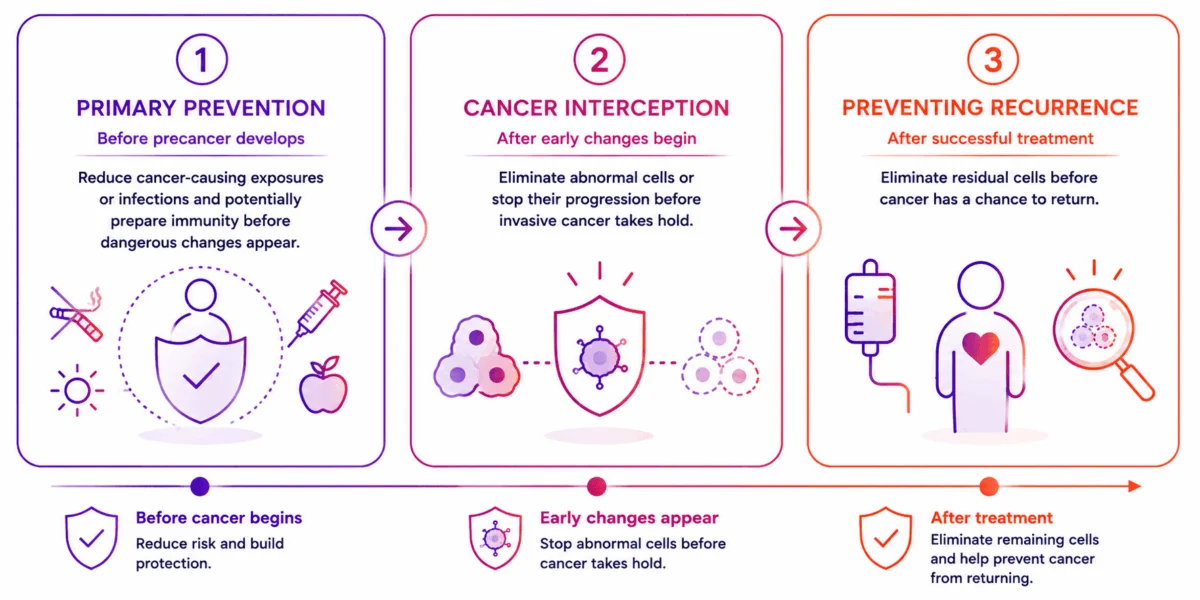
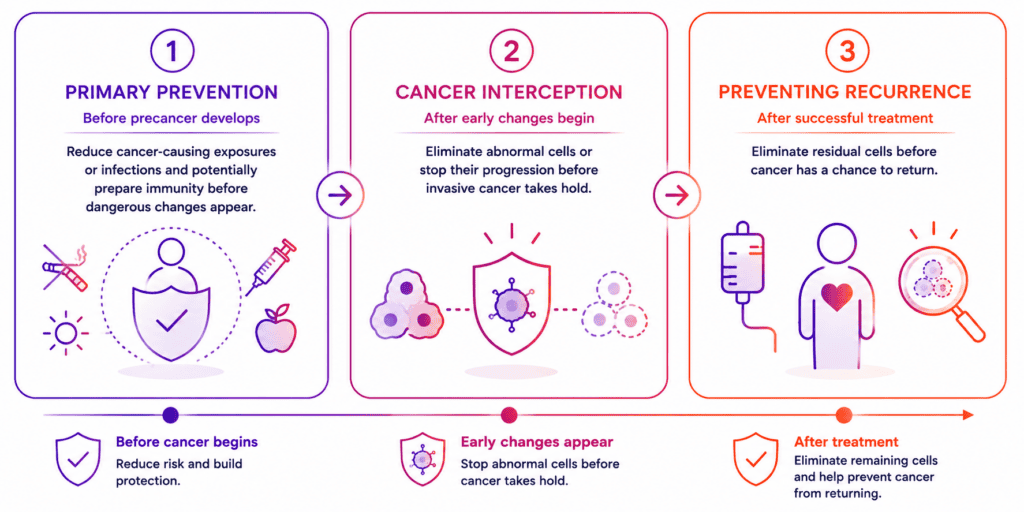
To effectively intercept cancer, researchers have categorized the intervention timeline into three distinct "windows of opportunity":
- Primary Prevention: This involves acting before any precancerous lesions even exist. It focuses on reducing environmental exposures, mitigating viral infections, and potentially priming the immune system to recognize and eliminate dangerous cells the moment they arise.
- Cancer Interception: This occurs after the earliest dangerous mutations have appeared but before invasive cancer has taken hold. The objective here is to "clean up" abnormal cells before they gain the ability to spread.
- Preventing Recurrence: This addresses the window after an initial, successful treatment. The goal is to identify and eradicate residual, microscopic cells that are currently invisible to standard imaging but remain a high risk for later relapse.
Across all three windows, the immune system remains the most potent tool. In the earliest stages, abnormal cells are few, and the immune system has not yet been fully suppressed by the tumor microenvironment—providing a strategic advantage to therapies designed to bolster natural immunity.
Chronology: From Viral Vaccines to Precision Immunology
The proof of principle for immune-based prevention is not theoretical; it is already a cornerstone of public health.
- 1999: The Cancer Research Institute (CRI) provided early, foundational support to Dr. Ian H. Frazer. His pioneering research into virus-like particles became the scientific bedrock for the Gardasil® HPV vaccine.
- The Global Impact: Today, vaccines targeting Hepatitis B and HPV have prevented millions of cancer cases worldwide. Data from Gavi, the Vaccine Alliance, suggests that current HPV vaccination programs have protected 86 million girls, potentially averting 1.4 million cervical cancer deaths. Projections indicate that 80% global coverage could prevent 50 million cases over the next century.
- The Current Frontier: While viral-induced cancers have paved the way, the next challenge is to extend these principles to non-viral cancers. By training the immune system to identify "neoantigens"—proteins that appear on early-stage, mutated cells—scientists are attempting to replicate the success of the HPV vaccine for solid tumors like breast, colon, and pancreatic cancer.
Supporting Data: Lessons from the Laboratory and Clinic
The journey toward universal cancer interception has been marked by both breakthroughs and hard-learned lessons. Recent clinical trials highlight the complexities of human immune responses.
The MUC1 and Nivolumab Trials
In a trial targeting MUC1, a protein often altered on precancerous colon growths, researchers found that only 25% of participants developed a strong immune response. However, among those who did respond, recurrence was 38 percentage points lower than in the placebo group. Crucially, researchers discovered that "non-responders" had higher levels of immune-suppressing cells and inflammatory signals. This data suggests that successful interception may require a "pre-treatment" phase to optimize the immune environment before the vaccine is even administered.
Similarly, trials using the immunotherapy drug nivolumab on high-risk mouth lesions showed that while the drug shrank lesions in one-third of participants, it did not eliminate the risk of invasive cancer in everyone. Furthermore, one in five patients experienced severe side effects. The clinical takeaway is clear: in a healthy or at-risk individual who does not yet have cancer, the standard for "safety" is significantly higher than for someone with advanced disease.
The KRAS and Lynch Syndrome Breakthroughs
The most promising data currently comes from targeting well-defined mutations. Over 90% of pancreatic cancers carry a mutation in the KRAS gene. A recent vaccine targeting six common KRAS mutations achieved an immune response in 90% of 20 high-risk participants, with immune activity detectable for up to two years.
Furthermore, research into Lynch syndrome—an inherited condition that leads to a high frequency of colorectal cancers—has yielded a vaccine that triggered an immune response in every participant. While long-term prevention is still being studied, these trials confirm that the human immune system can be "taught" to keep watch for specific genetic errors long before they manifest as a tumor.
Official Perspective: The Five Challenges of Interception
The transition to a prevention-first model requires overcoming five systemic hurdles, as outlined by the research community:
- Early Detection: We must refine our ability to identify the "precancerous" state with high specificity.
- Validating Targets: We need to identify proteins and markers that are truly unique to early-stage disease.
- Human-Reflective Models: Current laboratory models often fail to replicate the complex, long-term evolution of human precancer.
- Clinical Trial Design: We must move away from "time-to-death" metrics and toward "time-to-lesion-clearance" or "immune-memory" metrics.
- Predictive Biomarkers: We need a way to know who will respond to a vaccine and who needs additional immune support before treatment starts.
These challenges are deeply intertwined. A biomarker is only useful if it leads to a therapeutic intervention; an intervention is only successful if we can measure its efficacy in a clinical setting.
Implications: A New Future for Oncology
The implications of this shift are profound. In August 2026, the announcement that a personalized mRNA vaccine combined with pembrolizumab reduced the risk of melanoma returning after surgery represents the tip of the iceberg. If we can treat "microscopic" disease successfully in a post-surgical setting, the leap to treating "precancerous" cells in high-risk individuals becomes much shorter.
CRI’s decision to focus its funding on this theme is an acknowledgment that the "wait and watch" approach is no longer sufficient. By shifting the paradigm from reactive treatment to proactive interception, we have the potential to prevent millions of people from ever experiencing the trauma of a cancer diagnosis.
As we look toward the future, the window before cancer is no longer a dark space of uncertainty. It is a well-lit stage where the next great victory in medicine will be fought. With sustained commitment to interdisciplinary team science, the dream of "intercepting" cancer is moving from the realm of abstract theory to a tangible, life-saving reality. We are no longer just chasing cancer; we are learning to stop it before it begins.