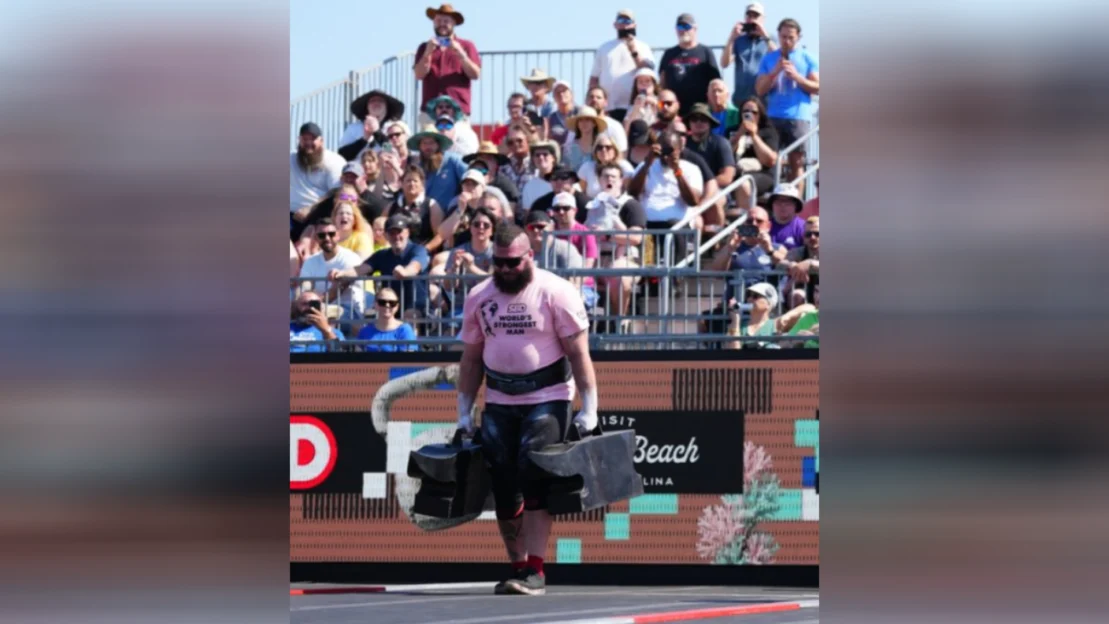
The World’s Strongest Man (WSM) competition is a theater of the extraordinary. Every year, in the crucible of heat, heavy steel, and unyielding concrete, legends are minted and history is rewritten. The 2026 edition was no exception; while the headline was dominated by Mitchell Hooper’s masterful reclamation of the title—cementing his status as one of the few multi-time champions in the modern era—the event also served as a stage for a significant cultural milestone. For the first time in the competition’s storied history, the state of Mississippi was represented on the global stage, courtesy of a man whose very name seems to have predestined him for the iron game: Levi Strong.
Standing at a towering 6’8" and weighing in excess of 370 pounds, Strong is a physical anomaly, possessing the raw, functional mass required to challenge the world’s elite. Yet, his journey to the WSM podium is not merely a story of genetics; it is a testament to the intersection of blue-collar grit, professional sacrifice, and the relentless pursuit of human potential.
The Genesis of a Strongman: From Lineman to Elite Athlete
Levi Strong’s path to the pinnacle of strength sports was unconventional. A career high-voltage electrical lineman, Strong’s life was defined by the grueling, high-stakes nature of power grid restoration. He was not a product of the collegiate track-and-field pipeline or the Olympic lifting circuit. Instead, his initial foray into physical culture began through a chance encounter with a bodybuilder on a job site in New Orleans.
While bodybuilding introduced him to the rigors of disciplined training, it was the raw, unvarnished power displayed in Eddie Hall’s seminal documentary that sparked a transformation in Strong. Watching the "Beast" push the boundaries of human capacity, Strong recognized a mirror of his own temperament. "I thought that looked cool," Strong recalls of his first exposure to the sport. "So, I found a competition, entered it, and I did well. So, I just kept doing it."
That initial spark ignited a rapid ascent. Strong quickly transitioned from a curious amateur to the first professional strongman in the history of Mississippi. His rise was not solitary; he brought his partner, Rebecca Strong, into the fold, coaching her to become the state’s first professional strongwoman. This partnership has become a cornerstone of his success, providing both a training environment and a logistical support system that most professional athletes struggle to replicate.
Chronology of a Contender
The path to the 2026 WSM was paved with both triumph and trial. Strong’s career has been defined by his ability to maintain elite performance while balancing the unpredictable demands of his trade.
- 2024: A year of baptism by fire. While preparing for the America’s Strongest Man contest, Strong was deployed for over two weeks to Florida to lead storm recovery efforts following back-to-back hurricanes. The physical toll was immense. Flying directly from the disaster zone to Las Vegas, Strong faced a significant weight loss of 25 pounds, resulting in a performance that fell short of his own high expectations.
- 2025: The year of redemption. Strong refined his approach to his craft, focusing on specialized event training. His dedication culminated in back-to-back international victories at the Magnus Ver Magnusson Classic in Gimli, Canada, and the prestigious Magnus Classic in Iceland. These wins provided the qualifying metrics necessary to punch his ticket to the 2026 WSM.
- April 2026: The debut. At the WSM in Myrtle Beach, South Carolina, Strong was thrust into a "group of death," sharing the qualifying heat with three-time champion Tom Stoltman and veteran finalists Austin Andrade and Matthew Ragg. Though he did not advance to the final round, the experience served as a tactical masterclass, fueling his resolve for the 2027 campaign.
The Infrastructure of Strength: Challenges in Training
One of the most profound challenges Strong faces is the logistical barrier to entry for aspiring strongmen. Unlike traditional gym disciplines, strongman requires specialized apparatus—log press bars, atlas stones, yokes, and frame carries—that are rarely found in standard commercial fitness centers.
Strong’s profession as a lineman only complicates this. His work is nomadic and physically taxing, leaving little room for the recovery protocols typical of elite athletes. "Traveling and finding ways to train for a specific sport like strongman isn’t as easy as it is for a bodybuilder or powerlifter," he explains.
However, his wife, Rebecca, has been instrumental in bridging this gap. "She definitely knows about it, including the time to set up and take down the events for training, which is sometimes the hardest part," says Strong. "She is a strong asset for that, and she takes care of our two kids when I work out." This domestic synergy allows Strong to sustain a level of intensity that would otherwise be impossible given his professional commitments.
Expert Insights: Levi Strong’s Blueprint for Beginners
Strongman is currently experiencing a global surge in popularity. As the sport moves from the fringe into the mainstream, new athletes are looking for a roadmap to success. Levi Strong offers three foundational pillars for those looking to transition from the squat rack to the competition field.
1. The Art of Adaptive Training
Strong emphasizes that in the real world, the "perfect" training cycle is a myth. Life, work, and unforeseen opportunities are constant variables. He cites a recent example where a late invitation to a contest in Siberia—five weeks out—required a complete pivot in his training strategy. When the visa process fell through, he immediately transitioned back to his WSM prep. "You must be able to make adjustments," he asserts. "Being able to adapt your training, nutrition, and recovery is a must if you want to make the most of the work you put in."
2. Developing Mental Fortitude
Strongman is as much a test of psychological endurance as it is physical capacity. Strong argues that the sport requires an ability to transcend pain thresholds that would force the average person to quit. "There are events that are grueling and make you want to give up, but you must shut those thoughts out," he advises. "The only way to do that is to keep doing it and pushing yourself." This mental hardening, he believes, is developed through consistent exposure to "high-discomfort" scenarios during training.
3. The Power of the Sled Push
For athletes training in facilities that lack specialized strongman gear, Strong recommends the weighted sled push as the ultimate equalizer. "Aside from the strength it takes to move it, it will teach you the footwork you need for a truck pull and help with that mental fortitude." By focusing on heavy, high-volume sled work, beginners can build the posterior chain stability and cardiovascular endurance required for the sport’s most iconic events.
Implications for the Future of the Sport
Levi Strong’s entry into the WSM represents a broader shift in the sport’s demographics. As Strongman grows, it is moving beyond its traditional European strongholds and finding a home in the American South, where a culture of blue-collar labor aligns perfectly with the demands of the sport.
His performance at the 2026 WSM serves as a warning to the rest of the field: the "Mississippi Giant" is only just beginning. By demonstrating that one can maintain a full-time, high-stress career while operating at an elite athletic level, Strong is redefining the archetype of the modern professional strongman.
As he sets his sights on 2027, the focus for Strong is clear: continued technical refinement and increased consistency. With his growing social media presence on Instagram (@levistrong) and his YouTube channel, he is also serving as an ambassador for the sport, providing transparency to a new generation of athletes.
The World’s Strongest Man is more than a trophy; it is a pursuit of the outer limits of human capability. Men like Mitchell Hooper may hold the crown, but athletes like Levi Strong provide the depth, the narrative, and the heart that keep the sport evolving. As the 2027 qualification cycle begins, all eyes will be on the lineman from Mississippi to see if he can take the next step and transform his "first-timer" experience into a permanent fixture in the finals.