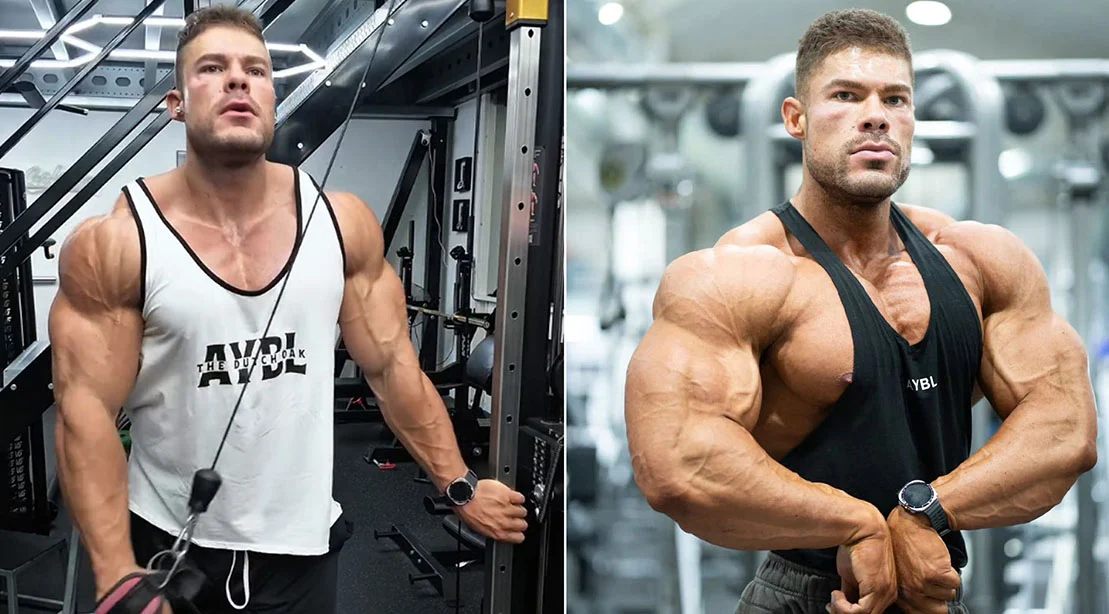
The world of professional bodybuilding is currently witnessing a renaissance of the "Golden Era" aesthetic, and standing at the forefront of this movement is Wesley Vissers. Known affectionately as "The Dutch Oak," Vissers has captivated the fitness community not only with his vacuum-tight midsection and classical proportions but also with his transparent, methodical approach to hypertrophy. Following a monumental victory at the Arnold Classic, Vissers has set his sights on the ultimate pinnacle of the sport: the 2026 Mr. Olympia Classic Physique title.
To achieve this goal, Vissers recently pulled back the curtain on his training philosophy, sharing a streamlined yet brutal upper-body workout designed to build the dense, rounded musculature required to stand on the Olympia stage. While the workout is technically accessible to those with intermediate experience, the intensity required to replicate his results demands a level of focus and grit that few possess.
The Pursuit of Perfection: Contextualizing the 2026 Olympia Goal
The Classic Physique division has evolved rapidly since its inception. It is no longer enough to simply be lean; athletes must carry substantial, quality muscle mass while maintaining the narrow waist and elegant flow of the 1970s legends. Wesley Vissers represents the modern evolution of this standard. His Arnold Classic win cemented his status as a legitimate threat to the current throne, but Vissers is not content with his current physique.
His strategy for 2026 is a calculated accumulation of mass. By focusing on specific muscular weak points and prioritizing structural balance, Vissers is engineering a physique that can withstand the scrutiny of the judges at the highest level. His recent training disclosure serves as a window into the technical adjustments he is making to maximize mechanical tension and metabolic stress—the two pillars of muscle hypertrophy.
Chronology of the Dutch Oak’s Training Session
Vissers’ training is built on the principle that if an exercise does not directly facilitate muscle fiber recruitment, it is a waste of time. He rejects the "more is better" mentality, opting instead for high-quality, targeted movements. Here is the chronological breakdown of his current upper-body protocol:
Phase 1: Priming the Chest (Seated Chest Press)
Vissers begins his session with the seated chest press. This serves a dual purpose: it acts as a compound primer for the entire upper body and allows him to move significant weight safely. He emphasizes that the goal here is not to ego-lift but to master the full range of motion. By focusing on a deep stretch at the bottom of the movement and a forceful, controlled contraction at the top, he ensures that the pectoral muscles are flooded with blood before moving to more isolated movements.
Phase 2: Targeted Hypertrophy (Smith Machine Incline Press)
Transitioning to a 20-degree incline on the Smith machine, Vissers targets the upper shelf of the chest. The slight incline is a tactical choice; it mitigates the tendency to arch the back excessively, which can often shift the load away from the intended muscle groups. By pinning the torso into a fixed position, Vissers can isolate the upper pectorals, anterior deltoids, and triceps, creating a more cohesive, "full" appearance in the upper chest region.
Phase 3: Isolation and Exhaustion (Pec-Deck Fly)
To conclude the chest portion, Vissers employs the pec-deck fly. This movement is purely for exhaustion. By utilizing horizontal adduction, he isolates the sternal fibers of the pectorals. His instruction here is simple: find the full contraction. At this stage of the workout, the chest fibers are pre-fatigued, allowing for a deep, focused burn that forces the muscles to adapt to higher metabolic demands.
Phase 4: The Shoulder and Triceps Synergy
Vissers transitions seamlessly into lateral deltoid work. "I always like to train the side delts after doing some chest, because they’re warmed up anyway," he explains. Utilizing cable lateral raises with a cuff attachment, he ensures constant tension throughout the range of motion. He then moves to side triceps pushdowns—a movement he cites as a personal favorite—to specifically target the lateral head of the triceps. The session concludes with overhead dumbbell extensions, which place the long head of the triceps in a lengthened position, maximizing the stretch and encouraging the "sweep" that defines a world-class arm.
Supporting Data: The Science of Vissers’ Protocol
The efficacy of Vissers’ workout lies in its adherence to sports science principles. His routine focuses on three primary drivers of hypertrophy:
- Mechanical Tension: By utilizing heavy compound movements like the chest press and Smith machine incline press, Vissers creates the high-intensity tension required to stimulate muscle protein synthesis.
- Metabolic Stress: The use of cable-based movements and isolated flyes ensures that the muscle remains under tension for extended durations, leading to the "pump" that Vissers describes as a hallmark of his training.
- Range of Motion (ROM): Vissers’ constant emphasis on the "deep stretch" is supported by recent studies suggesting that training a muscle in a lengthened state—where the muscle is stretched under load—is arguably the most effective way to trigger long-term growth.
Furthermore, his choice of the Smith machine for the incline press is a clever application of "stability-based training." By removing the need to stabilize the weight through space, the lifter can direct 100% of their effort toward the target musculature, a tactic often used by elite bodybuilders to bypass secondary fatigue.
Official Perspectives: The Philosophy of the Dutch Oak
In his recent Instagram breakdown, Vissers expressed a refreshing lack of pretension regarding his training. "It isn’t that difficult to master," he noted, downplaying the complexity of his routine in favor of emphasizing consistency and intent. His approach is rooted in the belief that the "secret" to bodybuilding is not a hidden supplement or a complex training split, but the ability to execute the fundamentals with surgical precision.
Vissers views his body as an instrument. Every set, rep, and pause is a deliberate action taken to refine that instrument. For the aspiring bodybuilder, this represents a shift in mindset: moving away from chasing numbers on a bar and toward chasing the sensation of the muscle working. It is a philosophy that prioritizes the longevity and quality of the physique over short-term gains.
Implications for the Classic Physique Division
The implications of Vissers’ training style are significant for the broader Classic Physique division. As the category grows in popularity, the standard for what is considered "aesthetically perfect" is being pushed higher. Vissers’ commitment to high-intensity, controlled training suggests that the next generation of competitors will be defined by their technical proficiency.
If Vissers can successfully pack the desired mass onto his frame without sacrificing the classic flow that made him famous, he will undoubtedly be the man to beat in 2026. His workout plan serves as a blueprint for athletes who want to build a physique that is both massive and refined. By focusing on the synergy between the chest, shoulders, and triceps, he is building a "pushing" physique that looks powerful from every angle.
Conclusion: A Blueprint for the Ambitious
For those looking to replicate Vissers’ results, the path is clear. It requires three sets for the warm-up movements and two sets of "all-in" effort for the subsequent exercises, keeping the rep range between 8 and 12. This volume is manageable but intense, requiring the trainee to leave nothing in the tank.
As Wesley Vissers continues his journey toward the 2026 Olympia, his transparency remains a gift to the bodybuilding community. By sharing his methods, he is not just building his own legacy—he is elevating the standard for the entire sport. Whether or not you are competing for a title, the principles of the "Dutch Oak" offer a reliable roadmap to building a more aesthetic, powerful, and balanced physique.
For more updates on Wesley Vissers’ training and his road to the 2026 Olympia, you can follow him on Instagram.