











For most of human history, the transition from day to night provided a natural, restorative cooling period. However, as global climate patterns shift, that nightly reprieve is vanishing. A growing body of research indicates that the modern bedroom is becoming a battleground against heat, with rising nighttime temperatures actively disrupting the biological processes required for restful, restorative sleep.
The implications of this trend extend far beyond the frustration of tossing and turning. As nights grow warmer, the cumulative effect of sleep deprivation is beginning to manifest as a significant public health challenge, impacting cognitive function, productivity, and long-term well-being.
The Biological Necessity of the "Cool Down"
To understand why hot nights are so detrimental, one must first understand the physiology of sleep. Sleep is not a passive state; it is an active physiological process that relies heavily on thermoregulation.
Under normal conditions, the human body’s internal temperature follows a circadian rhythm, peaking in the late afternoon and dropping significantly as the body prepares for sleep. This drop is a critical signal to the brain that it is time to transition into deep, restorative stages of slumber.
When ambient temperatures remain high throughout the night, this natural cooling process is hindered. If the environment is too hot, the body struggles to dissipate heat, leading to fragmented sleep, increased wakefulness, and a reduction in the time spent in rapid eye movement (REM) and deep, slow-wave sleep. This disruption prevents the brain from performing the essential "housekeeping" tasks—such as clearing out metabolic waste and consolidating memories—that occur during the night.
Chronology of a Warming Trend
The relationship between ambient temperature and sleep loss has become increasingly evident over the past five decades. Researchers tracking climate data alongside sleep metrics have observed a consistent, upward trajectory in temperature-related sleep disruption.
- 1970s–1990s: Early climate studies began to document the rise in "tropical nights"—a meteorological term for nights when temperatures do not fall below 68°F (20°C). During this period, the correlation between urban heat islands and sleep disturbances began to emerge as a niche subject of study in environmental medicine.
- 2000–2015: As global temperatures climbed, the frequency of these heat-retaining nights accelerated. Data from this era showed a clear decoupling of historical sleep patterns from seasonal norms, particularly in densely populated urban centers where concrete and asphalt trap heat long after sunset.
- 2016–2020: Landmark studies, such as the 2016 investigation of students in Boston during a heatwave, provided empirical evidence that thermal stress directly correlates with cognitive decline. This period marked a shift from viewing heat as a "discomfort" to viewing it as a "cognitive impairment" risk.
- 2020–2026: Recent analyses by organizations like Climate Central have quantified the scale of the issue. The findings are sobering: the amount of temperature-related sleep loss has effectively doubled since the early 1970s. By 2026, the cumulative toll of lost sleep has become a global phenomenon, with millions of individuals losing dozens of hours of rest annually due to climate-driven temperature spikes.
Supporting Data: The Cost of a Warmer Planet
The metrics surrounding heat-induced sleep loss are staggering. A Climate Central analysis covering the years 2020 to 2025 estimated that high nighttime temperatures caused the average person globally to lose nearly 56 hours of sleep annually.
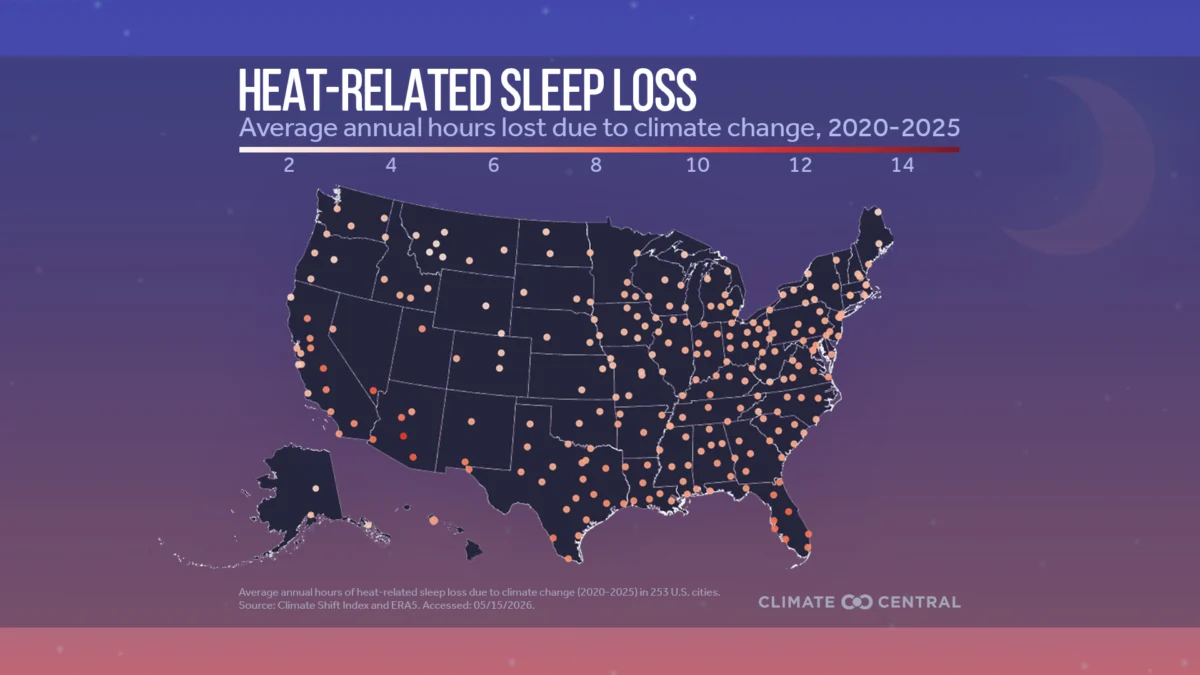
In the United States, the impact is pervasive across nearly every demographic. A study of 253 U.S. cities found that residents are losing an average of 36 hours of sleep per year due to rising nighttime lows. Arizona, California, Florida, and Nevada lead the nation, with residents in these states frequently losing between seven and nine hours of sleep annually solely due to climate-linked heat.
The One Earth study, which analyzed over 7 million sleep records alongside local weather data, offered a precise look at the threshold of impact. The study found that:
- On nights where temperatures exceeded 86°F (30°C), sleep duration dropped by approximately 14 minutes.
- Temperatures surpassing 77°F (25°C) significantly increased the likelihood of an individual obtaining fewer than seven hours of sleep, which is the recommended minimum for adult health.
- There is little evidence of human adaptation. Despite the warming trend, the human body’s physiological requirements for cooling during sleep have remained static, suggesting that as nights continue to warm, our sleep quality will continue to deteriorate.
Global Perspectives and Socioeconomic Disparity
The burden of heat-related sleep loss is not distributed equally. While the global north faces increasing challenges, regions already prone to high temperatures—including the Middle East, southern India, Southeast Asia, and parts of West Africa—are experiencing the most severe impacts.

Socioeconomic factors play a massive role in how individuals cope with these rising temperatures. While air conditioning (AC) serves as a vital mitigation tool, its accessibility is highly unequal. In developing nations, the lack of reliable energy infrastructure often leaves residents vulnerable to extreme heat. Furthermore, even in regions where AC is common, the cost of electricity during prolonged heat waves can create a "cooling poverty" cycle, where families choose to forgo sleep comfort to save on energy bills, leading to a direct decline in their ability to function the following day.
Implications: The "Next Day" Effect
The danger of a hot night does not end when the alarm clock rings. The "heat-hangover" is a real and measurable phenomenon. The 2016 PLOS Medicine study involving university students provided a clear window into how internal thermal conditions during the night dictate daytime performance.
Students living in buildings without air conditioning during a heat wave exhibited measurable deficits in:
- Attention: The ability to focus on complex tasks for extended periods.
- Processing Speed: The time required to receive, interpret, and respond to information.
- Working Memory: The ability to retain and manipulate information in real-time.
When these cognitive deficits are scaled up to a population level, the economic and societal implications are profound. Reduced productivity in the workforce, increased error rates in safety-sensitive industries, and impaired academic performance in students all contribute to a society that is, quite literally, operating in a state of chronic fatigue.
Practical Mitigation Strategies
While the broader climate trajectory is a global challenge, there are immediate, tactical steps individuals can take to protect their sleep environment from the encroaching heat:
- Optimize the Bedroom Environment: Keep the bedroom as cool, dark, and quiet as possible. During the day, keep blinds or curtains closed to prevent solar heat gain.
- Strategic Ventilation: If outside air is cooler than inside air, use fans or open windows in the evening to create cross-ventilation. If the night remains hot, switch to a fan that circulates air efficiently without blowing directly on the body.
- Bedding Choices: Opt for breathable, natural fibers like cotton or bamboo. These materials wick moisture away from the skin, aiding in the body’s natural evaporative cooling process.
- Thermoregulatory Habits: A lukewarm shower or bath before bed can help pull heat away from the core, tricking the body into beginning its natural cooling cycle. Avoid heavy meals and high-intensity exercise in the hours leading up to sleep.
When to Seek Professional Guidance
Occasional sleeplessness is a normal human experience. However, when sleep loss becomes a chronic pattern, it requires intervention. If poor sleep persists despite efforts to cool the bedroom, or if you find yourself experiencing excessive daytime sleepiness, cognitive lapses, or a decline in emotional regulation, it is time to consult a medical professional.
Persistent sleep issues can act as a catalyst for more serious health conditions, including cardiovascular disease, metabolic disorders, and compromised immune function. Sleep medicine experts, particularly those at AASM-accredited centers, can help distinguish between environmental heat stress and underlying sleep disorders, providing tailored strategies to restore health.
Conclusion: The Bottom Line
Climate change is no longer a distant, abstract threat; it is a nightly intruder in our bedrooms. As temperatures climb, the biological imperative for a cool sleep environment is being challenged on a global scale. While individual mitigation efforts are essential, the data suggests that we are witnessing a permanent shift in our relationship with the night.
Healthy sleep is the foundation of human health. As we face a warmer future, prioritizing the quality of our rest—through architectural innovation, urban planning that reduces heat islands, and personal sleep hygiene—must become a central pillar of our public health strategy. The cost of failing to address this "sleep deficit" will be measured in the long-term health and vitality of generations to come.