By Jacqueline Teti
Editor-in-Chief, Chronic Pain Partners
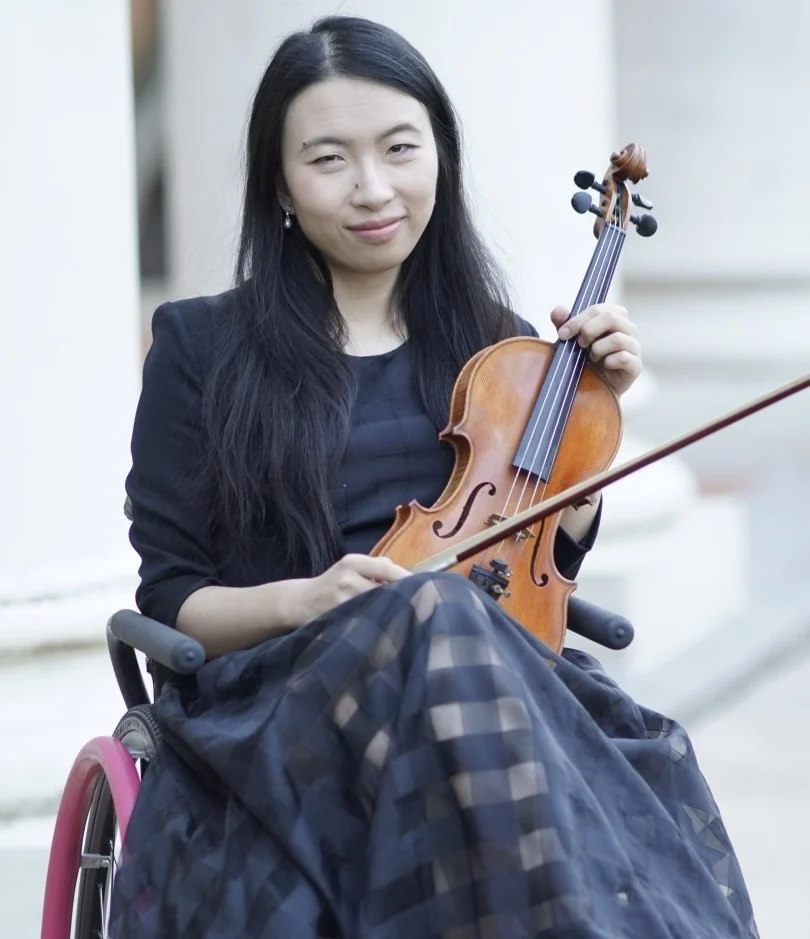
In the intersection of music, medicine, and human rights, few voices are as resonant as that of Amy Wang-Hiller. A classically trained violinist, educator, and visionary founder, Wang-Hiller’s life has been defined by a transformation from a virtuosic performer to a powerful advocate for patients navigating the labyrinth of invisible, complex neuro-connective tissue disorders. Living with quadriplegia, hypermobile Ehlers-Danlos syndrome (hEDS), and a constellation of associated conditions, she has turned the challenges of a fractured healthcare system into a clarion call for systemic change.
The Early Cadence: A Foundation in Music
Amy Wang-Hiller’s journey began not in the clinic, but in the practice room. Introduced to the violin at the age of three and a half, her musical development was initially a matter of practicality for her parents—a compact instrument that was easy to transport. However, it quickly evolved into an all-consuming passion.
“I think what really made me fall in love with it was watching the older students perform,” Wang-Hiller reflects. “I remember thinking, ‘Oh my God, they’re so good.’ I wanted to play like them.”
This competitive, driven spirit became her bedrock. Even during bouts of childhood illness—marked by high fevers and systemic fragility—the violin remained her anchor. This early habit of relentless practice served as a precursor to the discipline she would later require to navigate a medical journey defined by systemic neglect and physical deterioration.
A Chronology of Undiagnosed Decline
While Wang-Hiller’s musical career thrived, her physical health remained a series of disconnected, often dismissed, symptoms. Looking back, the signs were present throughout her youth: chronic tonsillitis, persistent jaw pain, unexplained fevers, and vision disturbances. For years, these symptoms were treated in isolation, with no clinician synthesizing them into a singular diagnostic picture.
The turning point occurred following a 2012 move to the United States. A car accident in 2012, followed by a significant fall in 2015, served as catalysts for a rapid decline. Wang-Hiller describes this period as a time of “weird” symptoms—balance issues, eating difficulties, and unexplained falls—that lacked a medical vocabulary. Because these symptoms did not mirror standard clinical presentations, she faced a wall of diagnostic uncertainty, leading to profound self-doubt and medical trauma.
The year 2020 proved to be the tipping point. A neck hyperextension injury triggered a cascade of severe neurological and physiological events. Over the subsequent two years, Wang-Hiller experienced:
- Severe POTS (Postural Orthostatic Tachycardia Syndrome)
- Dystonia and drop attacks
- Progressive loss of motor function
- Temporary paralysis and fainting
Eventually, the pieces of the puzzle were finally connected: a diagnosis of hypermobile Ehlers-Danlos syndrome (hEDS), accompanied by occult tethered cord and severe craniocervical instability.
The Spectrum of Paralysis
A central pillar of Wang-Hiller’s advocacy is dismantling the public and clinical misconceptions surrounding quadriplegia. While the term is often colloquially equated with complete, flaccid paralysis, Wang-Hiller’s experience—classified as AIS B, or sensory incomplete—reveals a more nuanced reality.
“I often tell people to imagine their body encased in cement,” she explains. “You know exactly what you want your body to do, but the signals simply aren’t able to easily pass through those injured segments.”
This state of “in-between” is fraught with social and medical challenges. Because she retains some sensation and minor movement, she is often subjected to the “gaze of skepticism.” Observers may witness a small, successful movement and assume she is capable of far more than she is, leading to a dangerous erosion of the support systems she requires to manage daily life. Her case underscores that paralysis exists on a spectrum, and the failure of healthcare providers to recognize this complexity often leaves patients without necessary accommodations.
The Cost of the "Functional" Label
Perhaps the most damaging aspect of Wang-Hiller’s journey has been the imposition of psychological and functional labels by the medical community. During her diagnostic struggle, several of her symptoms were misattributed to psychiatric causes or Functional Neurological Disorder (FND), a label often used when physicians fail to find a structural cause for physical symptoms.
The impact of this gaslighting was twofold: it not only delayed life-saving treatment for her cervical instability but also forced her to doubt her own reality. The most egregious instance occurred in 2022, when a neurologist utilized her ability to play the violin as “evidence” that her weakness was inconsistent, ignoring the progressive nature of her neurological decline.
“Once those labels are attached to a patient, they can continue to shape how future clinicians interpret new symptoms,” Wang-Hiller notes. The persistence of these labels in her medical record—even after structural diagnoses were confirmed—illustrates a systemic flaw in electronic health records (EHR) and the lack of a standardized process for correcting medical inaccuracies.
Diversity and the EDS Narrative
As a Chinese-born patient, Wang-Hiller is acutely aware of the lack of cultural and ethnic diversity in the discourse surrounding connective tissue disorders. The “face” of EDS in medical literature is often narrow, which leads to disparities in diagnosis for Asian patients.
“When people only encounter one picture of EDS, patients from different ethnic backgrounds tend to be overlooked or diagnosed much later,” she asserts. By sharing her own story, she aims to challenge these outdated assumptions and create a more inclusive environment for patients of all backgrounds. Her partnership with fellow advocates who share similar experiences—including those with severe respiratory complications—highlights a critical need for intersectional research that accounts for how genetic and environmental factors influence the presentation of connective tissue disease across different populations.
InclusiVibe: A Blueprint for Future Care
In response to the systemic fragmentation she navigated, Wang-Hiller founded the InclusiVibe Foundation. The nonprofit is designed to fill the void where specialists often fail to communicate.
“I realized the common thread wasn’t that everyone had the same diagnosis,” Wang-Hiller explains. “It was that so many of us were facing the same gaps in understanding and pathways to care.”
InclusiVibe operates on the principle that lived experience is a valid form of expertise. By integrating music, storytelling, and patient-led research, the foundation seeks to:
- Facilitate Multidisciplinary Care: Bridging the gap between disparate medical specialties.
- Educate Clinicians: Providing training on the nuances of complex neuro-connective tissue disorders.
- Create Community: Offering a platform for patients to share their narratives and feel validated.
Implications for the Healthcare System
The story of Amy Wang-Hiller is more than a personal narrative; it is a case study on the failures of modern medicine to address the “hidden” patient. Her journey highlights the necessity of:
- Integrating Patient Narratives: Valuing patient reports as primary data in diagnostic processes.
- Reforming Medical Records: Establishing clearer pathways for patients to challenge and correct clinical misattributions.
- Comprehensive Awareness: Moving beyond the "textbook" presentation of rare diseases to include a broader spectrum of patient experiences.
Finding Meaning in the Interdependence
When asked about the future, Wang-Hiller returns to the Chinese proverb, fú huò xiāng yī—fortune and misfortune are interdependent. For those currently trapped in the “middle” of a health crisis, she offers a message of profound patience.
“Healing doesn’t always mean getting better physically,” she says. “Sometimes it means discovering that your life can still have meaning, connection, creativity, and hope, even if it looks very different from what you imagined.”
Amy Wang-Hiller’s work serves as a reminder that even when the body feels encased in cement, the human spirit can find ways to resonate. Through her music and her advocacy, she is not merely surviving her diagnosis; she is orchestrating a movement to ensure that no patient has to walk their path alone.
For more information on Amy Wang-Hiller’s advocacy, to read her work, or to learn more about the InclusiVibe Foundation, please visit her official website at amywanghiller.com or inclusivibe.org.