








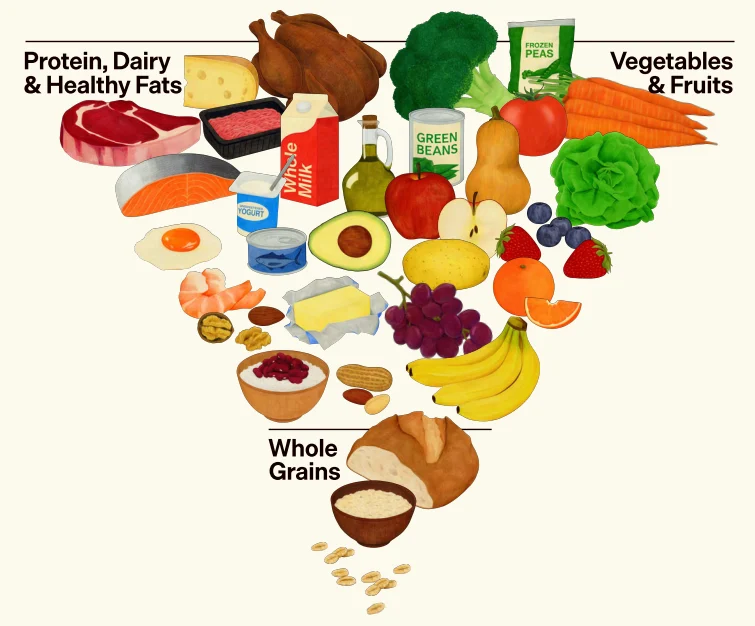
The release of the 2025–2030 Dietary Guidelines for Americans (DGAs) was met with high anticipation this week, arriving with the ambitious, consumer-facing tagline: “Eat Real Food.” While the document takes a commendable and long-overdue stance against the proliferation of ultra-processed foods and added sugars, it has simultaneously ignited a firestorm of controversy. Central to the debate is the return of a pyramid-style graphic—a visual mnemonic that, this time around, appears to invert traditional nutritional wisdom by placing significant emphasis on red meat, full-fat dairy, and butter.
For public health experts, the document represents a paradox: it offers sound, evidence-based advice in its text while presenting contradictory visual guidance that could inadvertently lead the American public toward higher saturated fat intake and elevated cardiovascular risk.
The Evolution of Federal Nutrition Policy: A Chronology of Change
The development of the DGAs is a multi-year, rigorous endeavor intended to provide a scientific foundation for federal food programs, school lunches, and clinical nutrition standards. Typically, the process begins with an independent Dietary Guidelines Advisory Committee (DGAC)—a panel of experts who synthesize the latest peer-reviewed nutrition science.
However, the 2025–2030 cycle has been defined by a significant departure from historical norms. After the Advisory Committee submitted its initial Scientific Report, it was, in a move that stunned the scientific community, largely rejected by the administration. In its place, a "supplemental scientific analysis" was conducted by a group selected through a federal contracting process rather than the standard public-facing committee structure.
Deirdre Tobias, an assistant professor in the Department of Nutrition at the Harvard T.H. Chan School of Public Health and a member of the original 2025–2030 Advisory Committee, has been vocal about the lack of transparency. “There has not been transparency in who wrote the new DGAs,” Tobias noted. “The reviews themselves, as well as their overall presentation and integration, deviate significantly from the rigorous process that was developed to ensure the evidence base was replicable, unbiased, and free from non-scientific influences.”
Furthermore, investigative reports from outlets like STAT News have highlighted that several reviewers involved in this supplemental process maintained disclosed financial ties to the beef and dairy industries—a detail that many critics argue is reflected in the prominent, top-tier placement of those exact food groups in the new pyramid graphic.
Dissecting the "New Food Pyramid" and Saturated Fat Math
The most glaring tension in the new guidelines lies between the written word and the visual representation. The text of the DGAs maintains the established scientific consensus: saturated fat intake should not exceed 10% of total daily calories. Yet, the accompanying "New Food Pyramid" features a visual hierarchy that highlights steak, cheese, and butter, potentially signaling to consumers that these items are cornerstones of a healthy diet.
To understand why this is problematic, one must perform the "saturated fat math." In a standard 2,000-calorie diet, the 10% threshold equates to roughly 22 grams of saturated fat. The guidelines recommend three daily servings of dairy. If a consumer follows the "full-fat" suggestions implied by the pyramid—one cup of whole milk (5g), three-quarters of a cup of full-fat Greek yogurt (6g), and one ounce of cheddar cheese (6g)—they have already consumed 17 grams of saturated fat.
Adding a single tablespoon of butter (7g) or beef tallow (6g) for cooking—both of which are prominently featured in the new visual guide—pushes the consumer well over the daily limit before they have even consumed a single gram of protein from meat or processed grains.
Dr. Frank Hu, chair of the Department of Nutrition at the Harvard T.H. Chan School of Public Health, expresses deep concern over these mixed signals. “The mixed messages surrounding saturated-fat-rich foods may lead to confusion and potentially higher intake of saturated fat and increased LDL cholesterol and cardiovascular risk,” Dr. Hu warns. He points out that while the pyramid includes olive oil, it ignores more robust sources of essential fatty acids like soybean or canola oil, which have been consistently shown in clinical trials to offer superior cardiovascular benefits compared to animal fats.
The War on "Highly Processed" Foods
A positive development in the 2025–2030 edition is the formal acknowledgement of "highly processed" foods as a distinct category to be limited. While previous guidelines focused on individual nutrients like sodium or added sugar, this edition attempts to address the "food matrix" by calling out sugary beverages, salty snacks, and ready-to-eat meals.
The guidelines are particularly firm on added sugars. The new text asserts that "no amount of added sugars or non-nutritive sweeteners is recommended or considered part of a healthy or nutritious diet." Furthermore, the guidelines have moved the goalpost for children, suggesting that added sugars should be avoided entirely until age 10—a significant increase from the previous recommendation of age 2.
However, critics note that while the advice is strict, it lacks implementation strategies. Telling a busy American family to avoid added sugars without providing the structural support or labeling clarity required to navigate a grocery store filled with ultra-processed options creates a "knowledge-action gap" that the guidelines fail to bridge.
Protein: A Call for Quality Over Quantity
The new DGAs suggest an increase in protein intake, recommending 1.2 to 1.6 grams of protein per kilogram of body weight—an increase of 50–100% over previous minimum requirements. While some athletes or aging populations may benefit from higher protein intake, many Americans are already consuming more than enough.
The danger of this broad recommendation, according to Dr. Hu, is the failure to distinguish between "protein packages." A piece of wild-caught salmon, a serving of lentils, and a processed beef hot dog all provide protein, but they deliver drastically different packages of fats, fiber, and micronutrients. By failing to emphasize plant-based proteins or lean fish over red and processed meats, the guidelines miss a critical opportunity to improve the average American’s health outcomes.
Environmental and Socioeconomic Blind Spots
The 2025–2030 guidelines continue a long-standing trend of ignoring the environmental impact of dietary choices. As climate change continues to stress global food systems, the omission of sustainability in federal dietary policy is increasingly viewed as a failure of foresight.
Furthermore, the guidelines lack a nuanced approach to the socioeconomic barriers that prevent many Americans from accessing "real food." A mandate to eat fresh produce and lean proteins is only as effective as the availability and affordability of those items. Without addressing food deserts, the cost of living, or the cultural context of eating, the guidelines risk becoming an aspirational document for the affluent rather than a practical tool for the general population.
Implications: Navigating the Confusion
The transition from a policy-heavy document to a more "consumer-friendly" format with interactive websites and bold graphics is an attempt to make nutrition more accessible. However, historical data suggests that Americans rarely follow the guidelines as written. When the messaging is contradictory—such as encouraging a reduction in saturated fat while visually promoting animal fats—the likelihood of adherence diminishes further.
For the average citizen, the release of the 2025–2030 DGAs serves as a reminder of the power of visual communication. Because images are often more memorable than the dense, nuanced text of a federal report, the "New Food Pyramid" may do more to shape eating habits than the actual scientific guidelines contained within the document.
As the dust settles on this release, the consensus among independent nutrition experts is clear: when in doubt, rely on evidence-based resources that prioritize long-term health outcomes. Tools like the Healthy Eating Plate, developed by institutions like the Harvard T.H. Chan School of Public Health, offer a more consistent, science-backed approach to building a meal.
Ultimately, the 2025–2030 guidelines represent a missed opportunity for clear, unified public health messaging. By choosing to navigate the crosswinds of political pressure and industry influence, the government has provided a document that asks consumers to read between the lines—a task that, in the realm of public health, is far more difficult than it should be.