











In a detailed account of a three-month institutionalization, a former patient challenges the efficacy of the biomedical model and warns of the lasting trauma inflicted by "prestigious" psychiatric facilities.
The promise of modern psychiatry is often framed as a lifeline—a scientific safety net for those navigating the darkest corridors of the human mind. However, for many who enter the system during a period of acute crisis, the reality of "treatment" can become a secondary trauma that eclipses the original ailment. A recently surfaced narrative from a former patient, who entered a high-ranking psychiatric unit three decades ago at the age of 25, sheds light on the systemic failures of acute care, the dangers of aggressive polypharmacy, and the profound impact of iatrogenic harm—injury caused by the medical treatment itself.
Main Facts: The Paradox of Professional Help
The core of this account rests on a stark contradiction: a young man, fearing for his life and sanity, voluntarily sought help from a facility with a national reputation for excellence, only to find an environment defined by dehumanization, clinical skepticism, and medical mismanagement.
At 25, the narrator—an intelligent, athletic, and musically talented individual—experienced a severe psychological crisis triggered by a tumultuous breakup and a haunting family history of mental illness. Fearing he was following the same path as his sister, who had never recovered from a breakdown at the same age, he presented himself to an emergency department.
What followed was a three-month stay in an acute psychiatric ward that the narrator describes as a "waking nightmare." Rather than receiving the reassurance and clarity he sought, he was subjected to a "cocktail" of potent psychotropic drugs, including Clozapine and Lithium, despite never having experienced a psychotic episode. Today, thirty years later, the narrator remains a functional member of society, having never been readmitted—directly contradicting the "90% chance of relapse" predicted by his lead psychiatrist. His story serves as a cautionary critique of the "prescribe first, ask questions later" culture that continues to dominate many psychiatric institutions.
Chronology: From Crisis to Institutionalization
The Descent and Voluntary Admission
The narrator’s journey began not with a sudden break from reality, but with an escalating cycle of anxiety, insomnia, and cognitive fog. Influenced by his sister’s permanent disability following her own psychiatric treatment, he viewed his symptoms through the lens of a "psychological cancer"—an unstoppable, malignant force disintegrating his identity.
In an act of self-preservation, he visited his local hospital’s emergency department, fearing he might take his own life. At the time, he believed he was entering a sanctuary of science where experts would use rigorous diagnostic tools to identify and "cure" his condition.
Life Inside the Acute Ward
Upon admission to the "prestigious" psych unit, the narrator’s expectations were immediately shattered. He describes a culture of "clinical skepticism," where psychiatrists and psychologists viewed patient testimonies with overt distrust. This power dynamic created a "wall of cynicism," where the vulnerable were treated not as partners in their recovery, but as unreliable subjects to be managed.
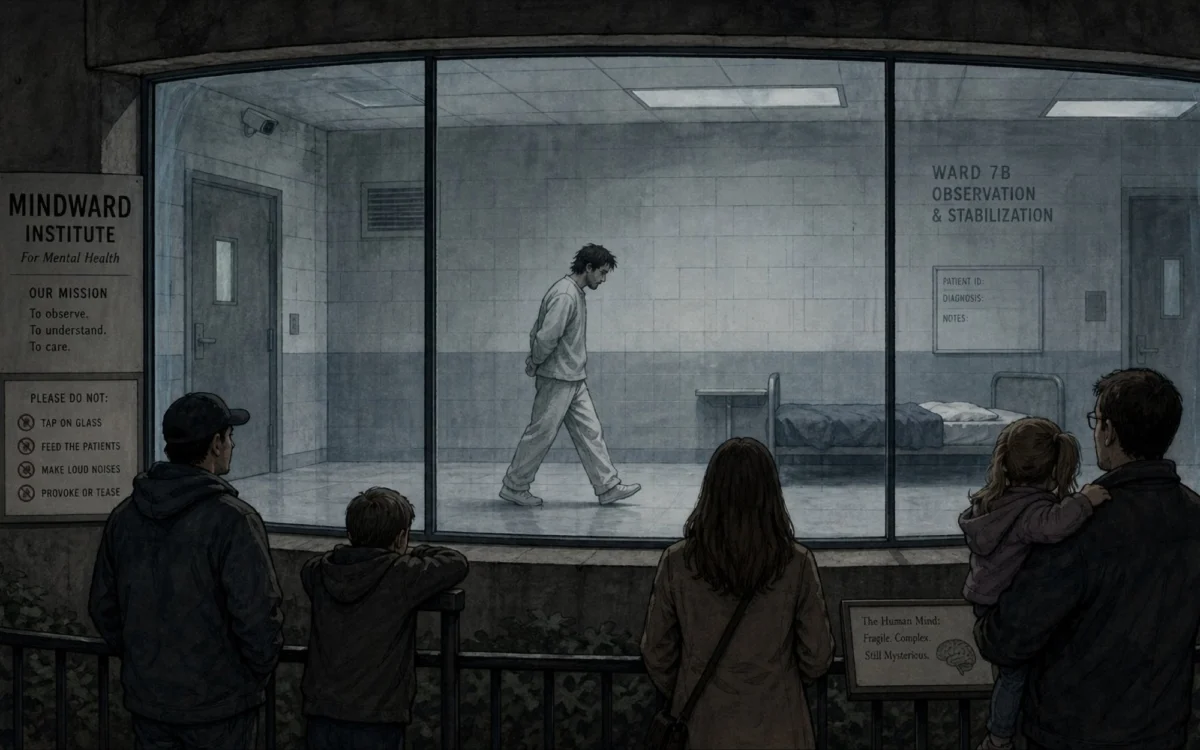
The physical environment was equally distressing. The ward was co-ed and poorly supervised, leading to incidents of sexual harassment and interpersonal tension that staff largely ignored. Patients, driven by "nervous energy" and the side effects of heavy sedation, engaged in "pacing"—walking robotically back and forth in confined spaces. The narrator compares this experience to that of a caged animal in a zoo, a memory that remains a source of visceral trauma decades later.
The Medical Intervention
The clinical approach to his treatment was characterized by aggressive polypharmacy. Without a definitive diagnosis, doctors administered a revolving door of medications:
- Clozapine: A potent antipsychotic typically reserved for treatment-resistant schizophrenia.
- Lorazepam: A strong sedative (benzodiazepine) for anxiety.
- Lithium: A mood stabilizer used primarily for bipolar disorder.
The narrator describes this period as a "complete farce," where he was forced to infer his diagnosis based on the drugs he was given, rather than receiving a clear explanation of his condition.
Supporting Data: The Science of Misdiagnosis and Polypharmacy
The narrator’s experience highlights several broader issues within the field of psychiatry that have been documented in clinical literature and critical psychology.

The Reliability of the DSM
A central theme in the narrative is the "discordant diagnosis." Research has long pointed to the lack of reliability in the Diagnostic and Statistical Manual of Mental Disorders (DSM). Unlike traditional medicine, where a blood test or MRI can confirm a pathology, psychiatric diagnoses are often subjective. Studies have shown that different clinicians frequently provide different diagnoses for the same patient, leading to the "illogical cocktail" of drugs described by the narrator.
Iatrogenic Harm and Informed Consent
Iatrogenic harm refers to the adverse effects or complications caused by medical intervention. In this case, the harm was both physical and psychological. One of the most harrowing moments in the account involves a loss of motor function. An avid basketball player, the narrator found himself unable to throw a ball 15 feet to a hoop—a side effect of Clozapine that no one had warned him about.
The lack of informed consent—the ethical and legal requirement that a patient be told about the risks and benefits of a treatment—is a recurring grievance. The narrator argues that had he been told his motor skills would be decimated, the experience would have been slightly less terrifying.
The Failure of Prognostic Accuracy
The "90% chance of readmission" given to the narrator is an example of what critics call "therapeutic nihilism." By labeling a patient with a chronic, deteriorating prognosis early in their treatment, doctors can create a self-fulfilling prophecy. However, longitudinal studies on recovery (often referred to as the "Vermont Study" or similar recovery-model research) suggest that many individuals who experience a first-break crisis can and do recover fully if provided with social support and minimal pharmacological interference.
Official Responses and Clinical Standards
While the specific hospital in this account has not been named for legal reasons, the psychiatric establishment generally defends the practices of acute wards by citing the necessity of "stabilization."
The Argument for Stabilization
From a clinical standpoint, the primary goal of an acute psych ward is to prevent immediate harm to the patient or others. Doctors often argue that in a state of high-risk crisis, the nuance of a long-term diagnosis is secondary to "symptom management." The use of heavy sedatives and antipsychotics is frequently justified as a means to "quiet the brain" and allow the patient to exit a state of hyper-arousal.
Modern Shifts in Care
In the decades since the narrator’s stay, there has been a growing movement toward Trauma-Informed Care (TIC). This approach acknowledges that the environment of a psychiatric ward can be inherently re-traumatizing. Many modern advocates call for "Peer-Led Respite" centers as alternatives to traditional hospitals, where the power imbalance is minimized and the focus is on human connection rather than purely biomedical intervention.
Implications: A Word of Caution for the Future
The narrator concludes his account with a sobering warning. He suggests that for many, the traditional psychiatric hospital should be a last resort rather than a primary destination.
The Long Shadow of Institutionalization
The psychological scars of being "locked up" and dehumanized lasted far longer than the initial depressive episode. The narrator describes having to "learn how to function again" after being discharged, not because of his mental health, but because of the institutionalization itself. He lived for years in the "shadow of fear," waiting for the "inevitable" breakdown his doctors had promised.
The Need for Patient Advocacy
The implications of this story are clear: there is a desperate need for greater transparency and patient agency within the mental health system. The narrator encourages prospective patients and their families to:
- Demand Informed Consent: Ask for a detailed list of side effects for every prescribed medication.
- Question Polypharmacy: Inquire why multiple potent drugs are being used simultaneously without a clear diagnosis.
- Seek Alternatives: Explore community-based support, therapy, and crisis houses that prioritize autonomy.
Ultimately, the narrator’s survival and subsequent thirty years of health serve as a living rebuttal to the "prestigious" institution that once viewed him as a lost cause. His story is a testament to the resilience of the human spirit—and a call to reform a system that, in its rush to "treat" the mind, often forgets to respect the person.
This article is based on a personal narrative published by Mad in America, a forum dedicated to discussing psychiatry and its treatments. The views expressed are intended to foster public dialogue on the ethics and efficacy of modern mental health care.