










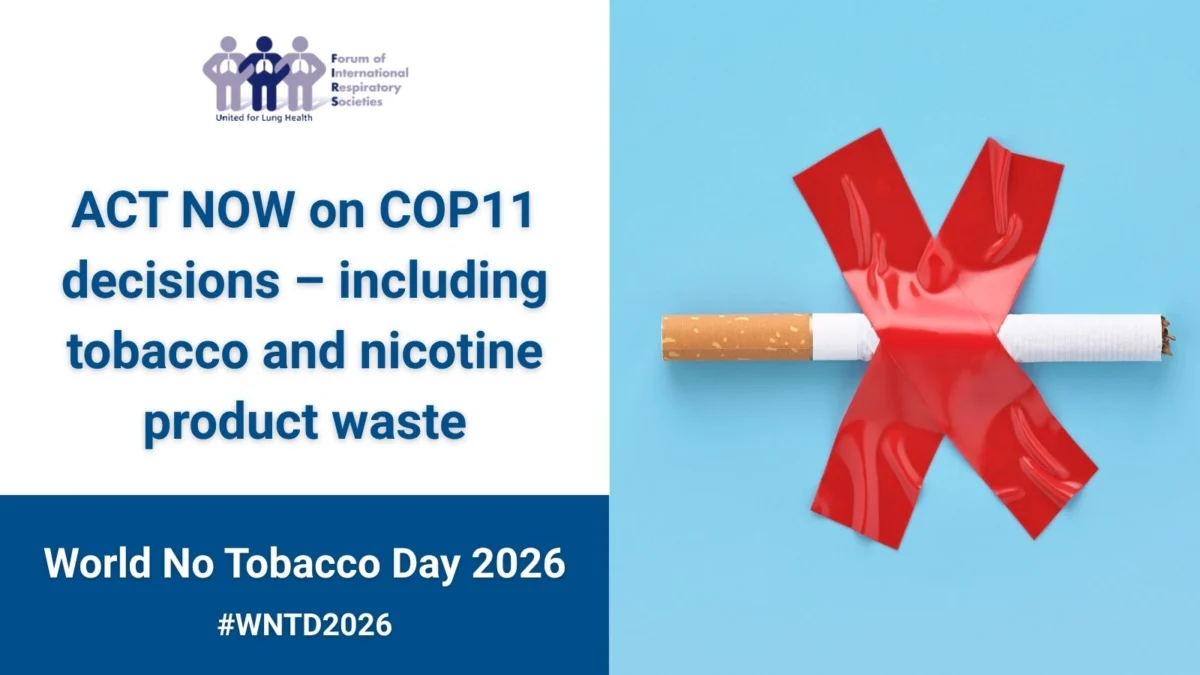
29 May, 2026 — As the global community prepares to mark World No Tobacco Day on 31 May, the Forum of International Respiratory Societies (FIRS)—a leading global authority representing the world’s foremost professional respiratory organizations—has issued a clarion call for immediate, aggressive legislative action. At the heart of their mandate is a demand that nations urgently implement the resolutions adopted at the 11th Conference of the Parties (COP11) to the WHO Framework Convention on Tobacco Control (FCTC).
While tobacco control has traditionally focused on the physiological damage caused by smoking, the discourse is shifting. Experts are now framing tobacco use not just as a medical crisis, but as a severe, dual-threat environmental catastrophe. Central to this advocacy is the push to categorize cigarette filters and single-use electronic nicotine delivery systems (ENDS) as environmentally hazardous products that require total prohibition.
The Core Mandate: Moving Beyond Health toward Environmental Stewardship
The European Respiratory Society (ERS), a founding member of FIRS, has been at the forefront of this shift. In a formal statement released following COP11, the organization underscored that the tobacco industry’s environmental footprint is an inseparable component of its public health impact.
The primary target of this advocacy is the cigarette filter. For decades, the public has been misled by the tobacco industry’s marketing, which positioned the filter as a "safety feature." In reality, these cellulose acetate filaments are one of the world’s most pervasive forms of plastic pollution. Unlike organic waste, these filters do not biodegrade; they fragment into microplastics, leaching toxic substances—including nicotine, heavy metals, and pesticide residues—into soil and water supplies.
"Beyond their direct health effects, tobacco and nicotine products also degrade the environment through waste, pollution, and emissions," says Dr. Filippos Filippidis, Chair of the ERS Tobacco Control Committee and Associate Professor in Public Health at Imperial College London. "This compounds the burden on lung health that our committees work to address. Phasing out and prohibiting these filters is the only way forward."
Chronology of the Crisis: From Industry Deception to Global Policy
To understand the urgency of the current moment, one must examine the timeline of how the "filter" became a global environmental enemy:
- 1950s–1960s: The "Filter Revolution." Faced with mounting evidence of smoking-related lung cancer, the tobacco industry introduced filtered cigarettes, marketing them as "safer" alternatives. This was a masterstroke of deceptive branding, providing a false sense of security that, in hindsight, likely increased tobacco uptake.
- 1990s–2010s: The recognition of cigarette butts as the single most littered item on the planet. Studies by ocean conservation groups consistently ranked cigarette filters as the number one item collected during international coastal cleanups.
- 2022: A seminal report, Tobacco’s Toxic Plastics, detailed the lifecycle of these products, revealing that the industry was aware of the environmental damage but continued to resist regulation.
- 2024–2025: The momentum toward COP11 began to build, with environmental health researchers providing empirical evidence that filters are not just trash—they are a source of chronic microplastic contamination.
- May 2026: The post-COP11 landscape. The WHO FCTC formally encourages member states to consider comprehensive regulatory options for tobacco components that increase environmental harm, signaling a decisive pivot in global tobacco control policy.
The Anatomy of the Filter Myth: Supporting Data
The scientific consensus is increasingly clear: cigarette filters serve no medical purpose and, conversely, may be exacerbating the health crisis they were designed to mitigate.
1. The "Harm Reduction" Fallacy
Research published in the Journal of the National Cancer Institute indicates that filters provide zero harm reduction. In fact, they may increase the risk of lung adenocarcinoma. By filtering out larger particles, the device allows for deeper inhalation, drawing carcinogenic smoke into the delicate peripheral lung tissue.
2. The Environmental Invisibility
Filters are composed of cellulose acetate, a plastic that is not biodegradable. They are designed to trap particles, meaning they act as a "toxic sponge." Once discarded, they release these captured toxins into the environment. Studies published in Science of the Total Environment have documented the devastating impact of these filters on marine life, which frequently ingest the debris, leading to the bioaccumulation of toxins in the food chain.
3. The Recycling Myth
Despite the tobacco industry’s attempts to initiate "filter recycling" programs, there is no evidence that these items can be safely or effectively recycled. The cost of collection and the toxic contamination of the filters make the process economically and environmentally unviable.
Official Responses and the "Greenwashing" Problem
A significant hurdle in the fight against tobacco waste is the industry’s adoption of "Extended Producer Responsibility" (EPR) programs. By appearing to take responsibility for cleanup, the industry engages in what public health experts call "greenwashing."
The ERS and FIRS are adamant: these cleanup programs are a distraction. They serve to sanitize the industry’s image while shifting the financial burden of waste management onto the public sector. By focusing on "recycling" rather than "elimination," the industry manages to keep their most harmful products on the shelves, effectively undermining comprehensive marketing bans.
"Efforts to recycle or clean up cigarette filters promote the greenwashing narratives of the tobacco industry," the ERS stated. "These efforts detract from the necessary focus on tobacco industry financial accountability and the ultimate goal: the end of tobacco consumption."
Implications: A New Era of Tobacco Control
The implications of a potential global ban on filters are profound. If governments follow the guidance of the WHO FCTC and the expert recommendations of the ERS, the tobacco landscape could change in three critical ways:
1. Reduced Uptake Among Youth
Filters were originally designed to improve the "palatability" of cigarettes, making the smoke feel smoother and less harsh to new smokers. Removing the filter would restore the natural, harsh, and bitter taste of raw tobacco. Research suggests that this loss of palatability is a proven deterrent for youth and first-time smokers, effectively acting as a barrier to entry.
2. A Shift in Financial Accountability
By moving from "cleanup" to "prohibition," the focus shifts back to the manufacturer. If a product cannot be sold legally because it causes irreparable environmental damage, the industry loses its primary argument for the necessity of the product. This creates a stronger legal basis for holding tobacco companies accountable for the life-cycle costs of their products.
3. Strengthening Cessation Efforts
The perception of a "safer" cigarette is a major barrier to smoking cessation. When smokers believe their brand of cigarettes is "light" or "filtered," they are less likely to perceive the immediate, visceral danger of their habit. By de-normalizing the filter, public health campaigns can re-educate the public on the inherent toxicity of every single cigarette, regardless of its appearance.
Conclusion: The Path to a Smoke-Free, Plastic-Free Future
As we observe World No Tobacco Day 2026, the message from the respiratory community is unified and unequivocal. The "filter" is a relic of 20th-century industry deception that has no place in a sustainable, health-conscious future.
The implementation of COP11 decisions is not merely a bureaucratic checkbox; it is a vital step toward protecting the planet and the human lung. As Dr. Filippidis aptly stated, the only way to resolve the environmental burden is through a phase-out.
Governments worldwide are now at a crossroads. They can continue to allow the industry to pollute under the guise of "responsible management," or they can take the bold, necessary steps to ban the filter—a move that would simultaneously reduce youth smoking uptake, hold the industry accountable, and begin the long process of healing our environments from decades of plastic-laden, toxic waste.
For more information on the ERS’s ongoing advocacy and to read the full policy statements regarding the COP11 outcomes, visit the ERS Tobacco Control resource page. The evidence is in: it is time to filter out the industry, not the smoke.