










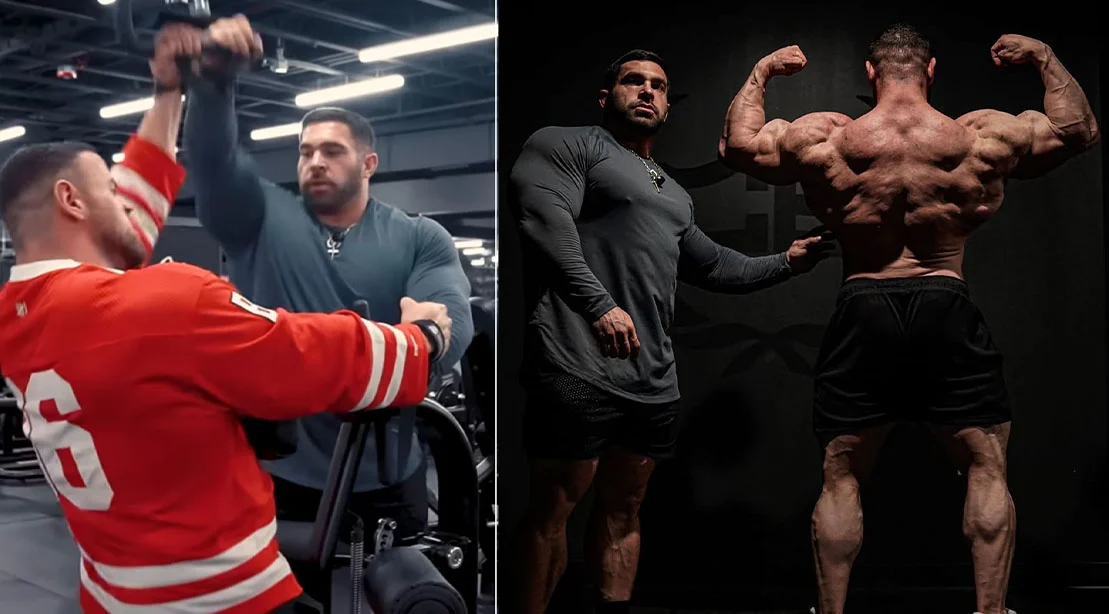
In the high-stakes world of professional bodybuilding, the distance between a top-ten contender and the reigning Mr. Olympia is often measured in more than just points on a scorecard; it is measured in wisdom, experience, and the ability to command one’s own physiology. Recently, 2025 Mr. Olympia Derek Lunsford demonstrated the true definition of a champion’s leadership, inviting rising star Josema “Beast” Munoz into his inner sanctum for a high-intensity, back-focused training session.
The session, hosted at the prestigious Champs Elysium Gym in St. Petersburg, Florida, served as more than just a workout. It was a transfer of knowledge from a man currently atop the sport’s most elite mountain to a young phenom looking to cement his own legacy. For Munoz, the Spanish Classic Physique sensation who jumped from a sixth-place finish in his 2024 Olympia debut to a formidable fourth in 2025, the session was a career-defining opportunity to observe the mechanics and mindset of the world’s best.
The Chronology of a Championship Session
The training session was characterized by a methodical, science-driven approach to hypertrophy. Lunsford, known for his incredible back thickness and detail, emphasized that the structure of a workout should be fluid, adapting to the athlete’s internal feedback rather than strictly adhering to a rigid set-and-rep scheme.
Phase 1: The Warm-Up and Foundation
Lunsford set the tone early by explaining his volume philosophy. He typically initiates his sessions with a higher set count—around five—to fully saturate the target musculature with blood and neurological stimulus. As the workout progresses and cumulative fatigue sets in, he reduces the volume to two or three sets, ensuring that every repetition performed is of the highest quality.
The session kicked off with the cable lat pulldown. Lunsford noted that this movement is the cornerstone of his back development, as it engages the entire posterior chain, including the rhomboids, traps, teres major, and the latissimus dorsi. By starting here, they effectively pre-exhausted the muscle groups, allowing for a more intense focus on mind-muscle connection during the subsequent compound lifts.
Phase 2: Unilateral Mechanics
Transitioning to the plate-loaded high row, the duo moved into unilateral territory. This machine is vital for correcting imbalances, a common hurdle for athletes moving up the ranks. Lunsford provided specific technical cues, stressing the importance of elbow positioning. He instructed Munoz to drive his elbows low and toward the hips, ensuring they aligned with the thighs at the apex of the contraction. "Make sure you stretch," Lunsford urged, highlighting that the eccentric—or lengthening—portion of the movement is just as vital as the concentric squeeze.
Phase 3: Stability and Core Engagement
The third movement involved the standing row machine. For those without access to specialized equipment, Lunsford suggested that a cable station variation works just as well. This exercise is not merely about pulling weight; it is a full-body stabilization test. Lunsford’s mantra of "chin up, chest up" served as a reminder that proper spinal alignment is the prerequisite for isolating the back muscles without involving the lower back unnecessarily.
Phase 4: The Final Pump
To conclude the session, they utilized the mid-cable row. The objective here shifted from raw strength to metabolic stress. Lunsford emphasized a deliberate, hard squeeze at the peak of the pull, intended to "open up" the muscle fibers and provide a final flush of blood to the lats, creating that deep, full look that is essential for stage presence.
Mentorship Beyond the Iron: Managing the Mind
Perhaps the most significant aspect of the session occurred between sets. Bodybuilding is a sport of extreme isolation, both physical and psychological. Lunsford, who has navigated the immense pressure of holding the Mr. Olympia title, shared candid reflections on the anxiety that accompanies the pursuit of perfection.
"You’re in the best position," Lunsford told the 25-year-old Munoz. "Just enjoy it and ride it till the wheels fall off, man."
This advice strikes at the heart of the "champion’s dilemma." The constant need to improve, the scrutiny of judges, and the weight of public expectation can easily lead to burnout. Lunsford’s philosophy is rooted in presence; he encourages younger athletes to recognize that the journey is as significant as the result. By normalizing the feeling of anxiety, Lunsford provided Munoz with a framework for mental longevity in a sport that often chews up and spits out those who cannot manage the psychological toll.
Supporting Data: The Rising Trajectory of Josema Munoz
To understand the weight of this mentorship, one must look at Munoz’s trajectory. Entering the 2024 Olympia, he was an unknown quantity to many, yet he walked away with a respectable sixth place. His leap to fourth in 2025 was not a matter of luck; it was a testament to his evolution in muscle density and stage maturity.
Training with Lunsford allows Munoz to see the "gap"—the difference between being a top-five contender and being the man who stands in the center of the stage. The collaboration underscores a growing trend in the IFBB Pro League: the mentorship of the next generation by the current guard, ensuring the sport’s standard of excellence continues to climb.
Official Responses and Future Implications
During their conversation, a major life update emerged that will shift the trajectory of the 2026 competitive season. Munoz revealed that he will be taking a hiatus from the Olympia stage in 2026 as he prepares to welcome a child with his partner. While this news might be disappointing to fans of the "Beast," it highlights the human side of professional bodybuilding.
However, the ambition remains high. Munoz shared that he is seriously evaluating a jump to the Open division by 2027. This move would be a massive undertaking, requiring significant tissue growth and a change in training protocols to accommodate the sheer size requirements of the Open class. Should Munoz make the transition, he may find himself lining up directly against his mentor, Lunsford.
The prospect of a friendly rivalry between the two—a bond forged in the iron of a St. Petersburg gym—is an exciting narrative for the future of the sport. It suggests a camaraderie that transcends the competitive hostility often associated with professional bodybuilding.
Conclusion: The Legacy of the Champion
The collaboration between Derek Lunsford and Josema Munoz serves as a microcosm for the evolution of bodybuilding. It is no longer just about who can lift the heaviest weight or who has the most dramatic posing routine; it is about the synthesis of biomechanics, mental health, and long-term planning.
Lunsford’s willingness to share his trade secrets, his training structure, and his personal struggles with a rising talent proves that his leadership extends beyond the trophy case. For Munoz, the knowledge gained during this session will serve as a foundational element in his preparation for the Open division.
As the sport looks toward the 2026 and 2027 seasons, the training session at Champs Elysium stands as a reminder of what the culture of bodybuilding should be: a brotherhood of athletes dedicated to the relentless pursuit of human potential, where the greatest success isn’t just winning, but lifting those who will one day challenge you.
For those looking to adopt Lunsford’s methods, the key remains consistent: prioritize the mind-muscle connection, be willing to adjust your volume based on real-time fatigue, and never lose sight of the "why" behind the work. As Lunsford put it, if your body feels good, go for it; if it doesn’t, change it up. In the gym, as in life, adaptability is the ultimate competitive advantage.