











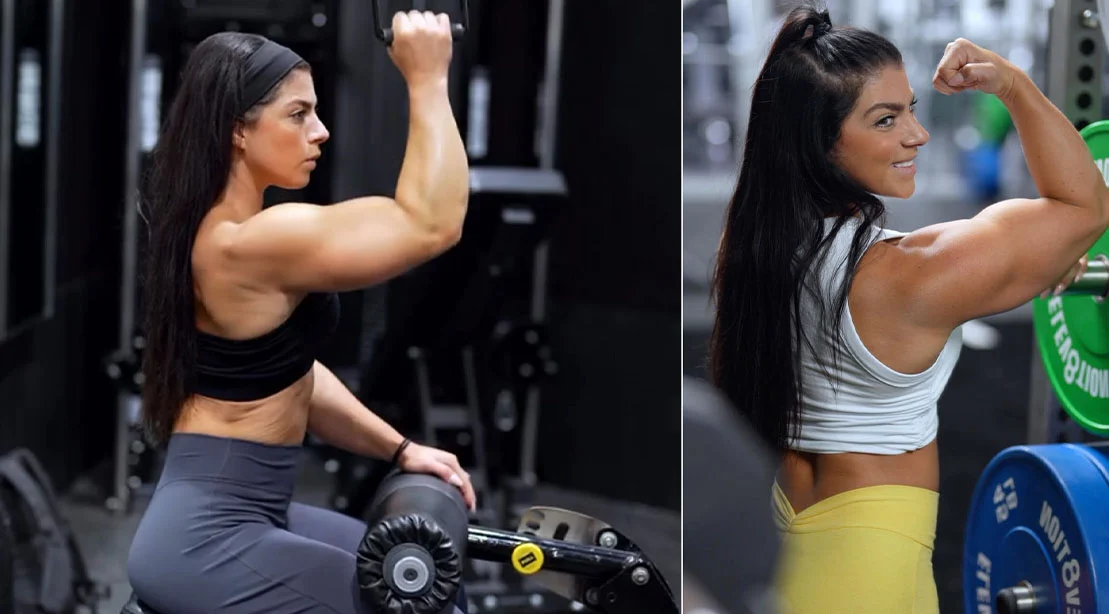
In the modern landscape of fitness, where social media influencers often prioritize heavy lifting over mechanical integrity, Swedish body transformation coach Ida Bergfoth has emerged as a voice of reason. With millions of followers looking to her for guidance, Bergfoth has shifted the conversation from how much weight one can move to how efficiently one can stimulate muscle growth.
Her latest approach to upper-body training is a masterclass in biomechanics. By emphasizing subtle adjustments to traditional movements, Bergfoth demonstrates that real-life results—those that manifest in defined lats, dense pectorals, and sculpted triceps—are born from precision rather than brute force. For athletes looking to take their physique to the next level, understanding these nuances is no longer optional; it is essential.
Main Facts: The Philosophy of Micro-Adjustments
At the core of Bergfoth’s methodology is the principle of "Targeted Tension." Many gym-goers perform standard movements with high volume but low efficacy, often inadvertently shifting the load onto stabilizing muscles or joints rather than the intended target muscle groups.
Bergfoth’s routine centers on four fundamental movements: the single-arm cable lat pulldown, the flat bench dumbbell press, the seated overhead triceps extension, and the incline dumbbell press. Her directive is clear: aim for three sets of 8 to 12 repetitions. This rep range is a gold standard for hypertrophy, ensuring that the muscle fibers reach a point of mechanical failure without overtaxing the central nervous system.
The primary takeaway from Bergfoth’s philosophy is the elimination of "leakage"—the process by which energy is lost through inefficient movement patterns. Whether it is tucking the elbows or adjusting the angle of a pull, every tweak Bergfoth recommends is designed to keep the tension strictly within the muscle tissue, effectively silencing the joints and secondary stabilizers.
Chronology of the Workout: A Step-by-Step Guide
To understand how these adjustments manifest in a real-world setting, one must look at the chronology of her training session. Each movement is carefully selected to fatigue the upper body systematically, starting from the largest muscle groups and moving toward isolation.
1. The Single-Arm Cable Lat Pulldown
Most gym-goers approach the lat pulldown by sitting bolt upright. Bergfoth argues that this posture forces the biceps and shoulders to take over the movement, stripping the lats of their primary stimulation. By leaning back slightly with the chest lifted, she aligns the cable trajectory directly with the latissimus dorsi. The cue here is critical: pull the elbow down toward the hip. This singular focus ensures the lats remain the prime movers throughout the entire range of motion.
2. The Flat Bench Dumbbell Press
The common mistake in chest training is the "flared elbow" syndrome, which frequently leads to rotator cuff impingement. Bergfoth mandates that elbows be tucked inward at a 45-degree angle. By doing so, she keeps the tension localized on the pectorals. This minor structural change drastically reduces the shear force on the shoulder joints, allowing for a safer, more sustainable training volume.
3. Seated Overhead Triceps Extensions
The triceps represent two-thirds of the arm’s mass, yet they are often trained with poor form that leads to elbow pain. By keeping her elbows tucked and facing forward rather than allowing them to flare out, Bergfoth isolates the long head of the triceps. This eliminates the compensatory movement of the shoulders and keeps the focus entirely on the extension of the arm, which is the primary function of the triceps.
4. The Incline Dumbbell Press
The final movement targets the clavicular head of the pectorals—the "upper chest" that defines a well-built physique. Because the incline angle changes the mechanics of the press, the muscles involved are under different leverage. Bergfoth cautions against bending the wrists backward, which can lead to fatigue in the forearm before the chest is sufficiently worked. Instead, she utilizes the cue: "Punch your knuckles to the ceiling," maintaining a neutral, solid wrist position throughout the press.
Supporting Data: Biomechanical Efficiency
Why do these specific adjustments yield better results? Scientific literature on muscle hypertrophy supports the concept of "Mind-Muscle Connection," which is essentially the conscious contraction of a target muscle during a lift. When an athlete uses Bergfoth’s cues, they are increasing the neural drive to the muscle fibers.
According to research in sports kinesiology, muscle recruitment is heavily dependent on the alignment of the muscle’s line of pull with the resistance vector. In the case of the single-arm lat pulldown, leaning back alters the vector so that the lats are lengthened and shortened under maximum load. Similarly, by keeping wrists straight during the incline press, the force is transferred directly from the dumbbell through the palm and into the chest, rather than dissipating through the wrist joint.
Furthermore, the 8-12 repetition range recommended by Bergfoth is supported by the "Time Under Tension" (TUT) principle. By slowing down the tempo and ensuring perfect form, the athlete increases the duration the muscle is under load, which is a primary driver of sarcoplasmic hypertrophy (the increase in fluid volume in the muscle cell).
Official Responses and Expert Consensus
Industry experts have praised Bergfoth’s approach for its emphasis on longevity. In an era where "ego lifting" is rampant, her focus on joint health is viewed as a responsible transition toward sustainable fitness.
Physical therapists and biomechanics coaches have long advocated for the "tucked elbow" position for pressing movements, noting that it aligns with the natural anatomical structure of the glenohumeral joint. Bergfoth’s specific inclusion of the "neutral wrist" cue in the incline press is also receiving positive attention, as it corrects a common habit that often leads to wrist tendonitis in intermediate lifters. By demystifying these movements, Bergfoth is effectively bridging the gap between clinical biomechanics and aesthetic bodybuilding.
Implications: The Future of Upper-Body Training
The implications of Bergfoth’s methodology are profound. If we move away from the "more is better" mentality and toward a "better is better" approach, we can expect a decrease in exercise-related injuries and an increase in the quality of physiques being developed in commercial gyms.
Long-Term Joint Health
By avoiding flared elbows and hyper-extended wrists, lifters can protect their joints. The shoulder, being a highly mobile but inherently unstable joint, is particularly susceptible to the damage caused by improper bench press form. Bergfoth’s routine serves as a preventative measure, ensuring that athletes can train consistently for years without the need for frequent "deloading" due to injury.
Enhanced Aesthetic Development
The specific targeting of the upper chest and the latissimus dorsi is what separates a novice physique from a professional-looking one. By isolating these muscles through precise alignment, Bergfoth’s followers are able to build a more symmetrical and aesthetically balanced upper body.
Accessibility for All Levels
One of the most impressive aspects of this routine is its accessibility. These adjustments do not require expensive equipment or complex machinery; they require only a pair of dumbbells and a cable machine. This democratizes high-level training, proving that professional results are accessible to anyone willing to refine their technique.
The Role of Digital Coaching
Finally, the popularity of Bergfoth’s advice highlights the changing nature of fitness education. Through Instagram and other digital platforms, coaches like Bergfoth are able to disseminate highly technical information to a global audience. This has created a new generation of "educated lifters" who are more interested in the why and how of their workouts than ever before.
In conclusion, Ida Bergfoth’s "Next Level Upper Body Workout" is more than just a list of exercises. It is a fundamental shift in how we view resistance training. By prioritizing the integrity of the movement, the alignment of the joints, and the focus of the muscle contraction, she has provided a blueprint for long-term growth. Whether you are a seasoned bodybuilder or a beginner looking to build your first set of gains, these four exercises and their associated cues represent the gold standard for efficient, effective, and safe upper-body development. As the fitness community continues to evolve, it is through the guidance of experts like Bergfoth that we learn the most valuable lesson of all: when you stop fighting the physics of your own body and start working with them, the results become inevitable.