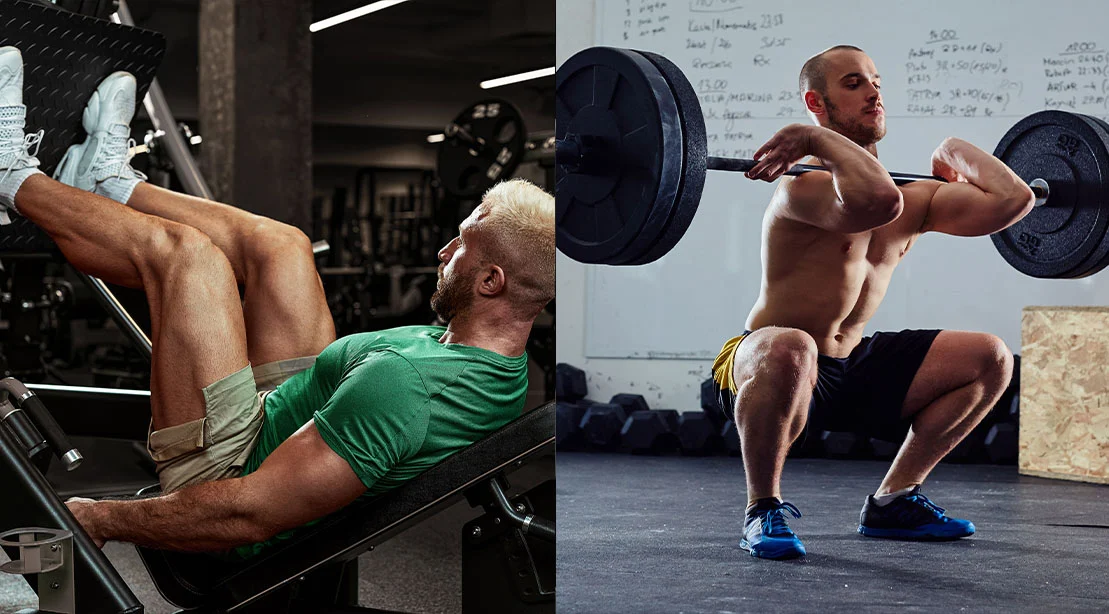
For decades, the barbell squat has worn the crown as the undisputed king of leg exercises. Walk into any hardcore gym, and you will inevitably hear the mantra: "If you want big legs, you have to squat." It is a dogma that has persisted through generations of bodybuilding lore, powerlifting competitions, and high school strength and conditioning programs.
But is it true? Does the barbell squat deserve its throne, or is it an exercise that, for many, serves as a one-way ticket to the orthopedist’s office? The reality is that the squat is not a universal panacea for leg development. For many beginners, it is arguably one of the most hazardous ways to initiate a hypertrophy program. The issue is not that squats are inherently "bad"; rather, the exercise demands a specific constellation of anatomical advantages, technical proficiency, and structural resilience that the average beginner simply does not possess.
The Anatomical Reality: Why Not Everyone Is Built to Squat
The fitness industry often clings to absolutes. Squats are king. Deadlifts are mandatory. The bench press defines your value. However, the reality of biomechanics is far less romantic.
The Genetics of the Kinetic Chain
Scientific research into human movement has repeatedly demonstrated that hip joint structure, femur length, pelvic geometry, and muscle origin/insertion points vary dramatically between individuals. These are not merely superficial differences; they are functional constraints.
Studies examining skeletal architecture have shown that someone with short femurs and a favorable acetabular orientation (the hip socket) can achieve a deep, upright squat with minimal spinal stress. Conversely, a lifter with long femurs and limited ankle dorsiflexion will be forced into an excessive forward lean to maintain their center of mass. In this scenario, the lifter is no longer performing a "squat"; they are performing a high-risk "good morning" hybrid. When the hips cannot travel deeper without the lumbar spine rounding, the lower back becomes the primary mover—or the primary casualty.
The Myth of "Perfect Form"
We are often told that if you struggle to squat, you just need to "fix your form." But how do you "fix" a femur length that is genetically predetermined? For many, the attempt to force an upright, deep squat is a direct conflict with their skeletal geometry. While mobility work can improve ankle and hip range, it cannot change the shape of your bones. Attempting to force a specific movement pattern on a body that lacks the necessary lever lengths is not discipline; it is an invitation to injury.
Chronology of a Training Philosophy: From "Hardcore" to "Efficient"
The evolution of modern gym culture has been a slow pivot from dogma toward biomechanical efficiency.
- The Golden Era (1960s–1980s): The "squat or go home" mentality dominated. Information was limited to magazines and local gym floor hearsay. If you couldn’t squat, you were viewed as lacking "grit."
- The Rise of Machine Engineering (1990s–2010s): The emergence of high-quality leverage machines, hack squat units, and leg presses allowed lifters to isolate muscles without the high-risk, high-skill requirements of the barbell.
- The Modern Era (2020–Present): With the democratization of sports science, the focus has shifted toward "Stimulus-to-Fatigue Ratio" (SFR). Elite coaches now prioritize movements that maximize muscle recruitment while minimizing systemic fatigue and injury risk.
For the average trainee, the chronology of their lifting career should reflect this shift. Starting with the most complex, high-risk movement (the barbell squat) is logically flawed. A more effective progression involves building the foundation of hypertrophy first, then moving toward complex compound movements once the kinetic chain is sufficiently strengthened.
Supporting Data: Squatting vs. Machine Training
The debate between free-weight squats and machine-based leg development often misses the nuance of "stability."
Stability and Neural Demand
When performing a barbell squat, the lifter must manage load, balance, coordination, and spinal stabilization simultaneously. This is a high neural demand. For a beginner, the brain is often so occupied with "not falling over" that the ability to actually stimulate the quadriceps is severely diminished.
In contrast, the leg press or the pendulum squat provides a fixed movement path. Because the back is supported, the lifter can direct 100% of their effort toward pushing weight with their legs. This creates a superior environment for hypertrophy. A study in the Journal of Strength and Conditioning Research suggests that machines allow for a more stable base, leading to greater muscle activation in the target area because the lifter is not struggling to maintain structural integrity.
The Lower Back Memory
Unlike the quadriceps, which recover relatively quickly, the lower back has a long memory. A "pop" in the lumbar spine during a heavy set of squats can result in months, or even years, of chronic pain. By removing the spinal loading component inherent in free-weight squats, the leg press allows a beginner to train at a higher intensity safely.
Official Perspectives: What the Experts Say
Physical therapists and orthopedic surgeons often express frustration with the "squat-at-all-costs" culture. The general consensus among medical professionals is that "movement competency" must precede "load intensity."
Dr. Stuart McGill, a world-renowned expert in spine biomechanics, has long advocated for protecting the lumbar spine during training. His research suggests that repetitive loading of the spine under high-intensity stress—particularly when technical breakdown is imminent—is a leading cause of disc herniation. The consensus is clear: if an exercise cannot be performed with perfect, pain-free form, it is not an exercise—it is a liability.
Many strength coaches have now pivoted to a "machines-first" approach for their general population clients. The rationale is simple: the goal is to build muscle, not to train for a weightlifting meet. If the machine builds the muscle without the risk, it is the superior tool.
Implications: Building a Sustainable Future
So, where does this leave the beginner? Does the barbell squat have any place in the gym?
The "Earned" Progression
The barbell squat is a tool, not a religion. It should be "earned" through a process of:
- Strength Base: Building foundational strength through machines (leg press, hack squat, belt squat).
- Motor Learning: Introducing the movement with a Smith machine to practice depth and bar path without the instability of a free-floating barbell.
- Assessment: Testing mobility and spinal alignment without load.
Redefining Success
If your goal is to build thick, powerful legs, you don’t need a barbell on your back. You need progressive overload. Whether you achieve that overload through a barbell squat, a pendulum squat, or a leg press is secondary to the fact that you are stimulating the muscle safely.
If you are a beginner, stop looking at the squat rack as a test of your character. It is simply a piece of equipment. If your body is screaming that it doesn’t like the movement, listen to it. The most successful lifters are not the ones who squat the heaviest on Day 1; they are the ones who are still training pain-free twenty years later.
Final Takeaway
Modern gym equipment has revolutionized the way we train. With pendulum squats, belt-loaded machines, and advanced leverage systems, we can now replicate the intensity of the squat while sparing the lower back from unnecessary wear and tear.
The question should never be, "Should I squat?" The question is, "What is the most effective way for my body to reach failure safely?" If the answer to that question is the leg press, then you have found your path to world-class legs. Don’t let the "squat police" dictate your longevity. Train smart, train hard, and leave the ego at the door. Your joints will thank you in the decades to come.