






Ayurveda, an ancient system of medicine originating in the Indian subcontinent, offers more than just health guidelines; it provides a comprehensive metaphysical map of the universe. To understand the Ayurvedic lens on life, one must navigate the foundational concept of the Pancha Maha Bhuta—the five great elements. While modern science views matter through the periodic table, Ayurveda classifies existence based on the state of matter and the energetic qualities that govern the transition from consciousness into physical form.
Main Facts: The Pancha Maha Bhuta and the Nature of Reality
At the core of Ayurvedic philosophy lies the understanding that all organic and inorganic matter is composed of five elemental states: ether, air, fire, water, and earth. These are not merely chemical building blocks but representative stages of manifestation.
- Ether (Akasha): The most subtle element, representing the field in which matter appears and the potential from which it stems. It is the space that allows for existence.
- Air (Vayu): The principle of movement. When ether is set into motion, it manifests as air.
- Fire (Tejas): The principle of transformation. Movement creates friction, and friction generates heat, which provides the energy necessary for change.
- Water (Jala): The principle of cohesion. The cooling effect of fire’s radiance leads to the condensation of matter into a liquid state.
- Earth (Prithvi): The principle of stability. The final, most "gross" manifestation where matter crystallizes into solid, tangible form.
These elements function in a hierarchical evolutionary sequence. Ether is the least dense and most expansive, while Earth is the most dense and static. This elemental framework allows practitioners to classify substances—from the food we eat to the air we breathe—based on their predominant elemental qualities.
Chronology: The Journey of Consciousness into Matter
The evolution of the universe, according to the Sankhya philosophy—the philosophical precursor to Ayurveda—mirrors a journey from the unmanifested singularity into the manifested world of multiplicity.
The Primordial Singularity
Before the dawn of creation, there existed an eternal, dimensionless point. This singularity, incomprehensible to limited human perception, contained the potential for all existence. Much like the "Big Bang" theory in modern physics, Sankhya posits that this singularity multiplied itself into the cosmos. In the Ayurvedic view, this was not a random event but a "divine play" (Lila), where the singularity desired to perceive itself.
The Role of Vibration
The transition from silence to sound is the first step in creation. This is often equated to the "Logos" or the "Word" mentioned in various theological traditions. The primordial vibration, often identified as Om, serves as the fabric of space-time. This vibration condenses pure consciousness through three primary qualities, or Gunas:
- Sattva: Transparency, lightness, and beingness.
- Rajas: Passion, movement, and the active drive to connect.
- Tamas: Inertia, density, and the objective, material world.
From these, the Ahamkara (ego) emerges, creating a sense of individual identity. This biological necessity allows for the diversity of life forms, as the observer begins to differentiate themselves from the observed.
Supporting Data: The Science of Qualities and Sensory Perception
Ayurveda operates on the natural law that "like increases like" and "opposites balance." Healing is not viewed through the suppression of symptoms, but through the rebalancing of elemental qualities.
The Qualitative Framework
Substances are classified by their Gunas (qualities), which dictate their action within the body. For instance, a cucumber is predominantly composed of water and earth elements, yielding qualities that are cold, liquid, heavy, and unctuous.
- Clinical Application: An individual suffering from a "burning" sensation (excess fire/heat) during the summer would benefit from the cooling qualities of a cucumber. Conversely, someone suffering from a cold, congested condition (excess water/earth) in winter would find these same qualities detrimental.
The Five Tanmatras (Subtle Elements)
Our interaction with the physical world is facilitated by the Tanmatras, which are the objects of our five cognitive senses. These subtle elements represent the bridge between consciousness and matter:
- Ether is experienced through Sound (Hearing).
- Air is experienced through Touch (Tactile perception).
- Fire is experienced through Vision (Radiance).
- Water is experienced through Taste (Liquefaction).
- Earth is experienced through Smell (Olfaction).
Each element encompasses the Tanmatras of the elements preceding it. Thus, earth—the final manifestation—contains the potential for all five sensory perceptions, making it the most complete expression of consciousness in matter.
Official Perspectives and Ayurvedic Methodology
In Ayurvedic medical practice, the classification of substances goes beyond basic elemental theory. Physicians assess:
- Rasa (Taste): Six tastes (sweet, sour, salty, pungent, bitter, and astringent) represent specific elemental combinations.
- Virya (Energetic Potency): Whether a substance has a heating or cooling effect.
- Vipaka (Post-Digestive Effect): The long-term impact on the body after metabolism.
- Prabhava (Special Effect): Unique properties that defy conventional logic.
This structured approach allows Ayurveda to address the individual’s unique constitution (Prakriti). Because "substance" is defined as the inseparable conjugation of quality and action, the ingestion of any material substance acts as a direct intervention in the body’s elemental balance.
Implications: The Quest for True Health (Swasthya)
The ultimate goal of the Ayurvedic system is not merely the absence of disease, but Swasthya—a term that translates to "being situated in one’s self."
The Mirror of Reality
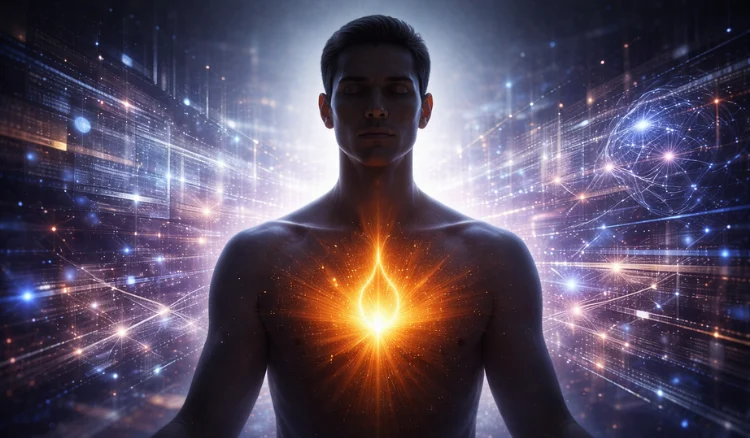
Each human being is considered an individual "mirror" of the supreme reality. When the mind is fully active yet emptied of content—a state of profound silence—the individual can "melt" into the singularity. This is the Ayurvedic equivalent of liberation or enlightenment.
Modern Parallels
There is a striking convergence between this ancient worldview and contemporary scientific inquiry. Both suggest that the fundamental substratum of existence is a unified, often invisible field. While modern physics uses mathematics to describe the "singularity" and the expansion of space-time, Ayurveda uses the language of vibration and consciousness.
Conclusion: A Philosophy of Gratitude
The study of the Pancha Maha Bhuta encourages a shift in perspective: we are not separate from the environment, but a sophisticated, localized expression of the same elements that form the stars and the soil. By acknowledging the interplay of these elements, practitioners of Ayurveda aim to harmonize the individual with the cosmic rhythm. As we consume food, interact with our surroundings, and navigate our internal thoughts, we are participating in the constant, divine play of consciousness manifesting as matter. Cultivating gratitude for this "Great Mother"—the elemental foundation that sustains, creates, and ultimately redeems human existence—remains the hallmark of the Ayurvedic way of life.