











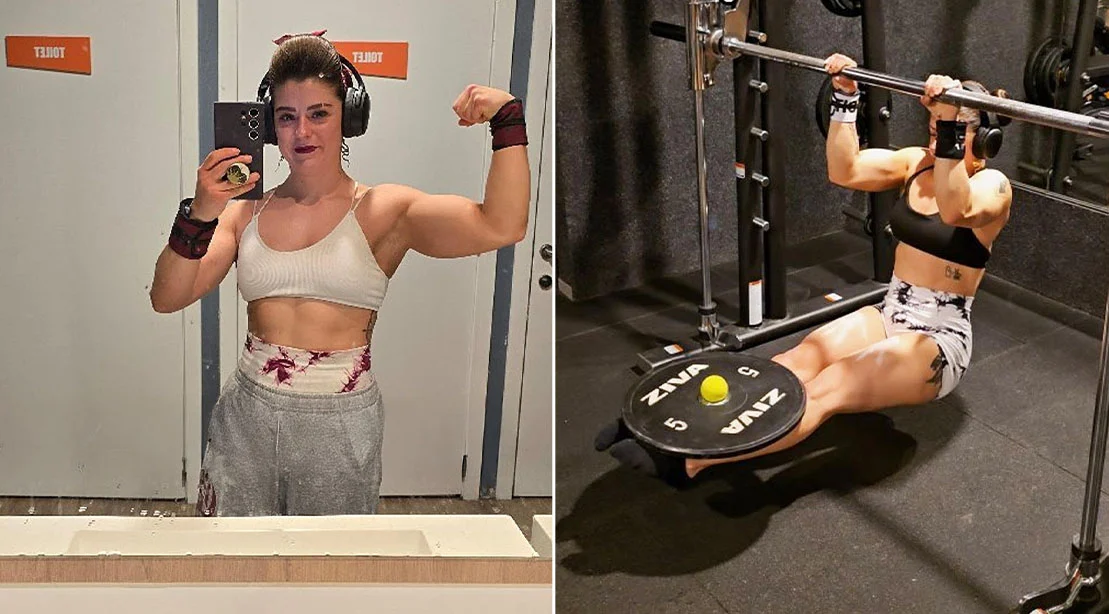
In the ever-evolving landscape of social media fitness, where trends often prioritize aesthetics over utility, professional pole dancer and calisthenics athlete Laura Verberne has carved out a niche that demands both grace and absolute physical dominance. Her latest endeavor—a variation of the "Ball in a Maze" game integrated into a standard hanging leg raise—has sent shockwaves through the fitness community, setting a new benchmark for what is possible in core stabilization and neuromuscular control.
What started as a lighthearted attempt to tackle a viral trend has quickly transformed into a serious discussion about the limits of human core strength. Dubbed by Verberne herself as the "Diabolical Hanging Leg Raise Challenge," this movement is far more than a stunt; it is a complex, multi-joint exercise that tests the synergy between the upper body, the hip flexors, and the deepest layers of the abdominal wall.
Main Facts: The Anatomy of a Viral Feat
The challenge, which Verberne documented on her Instagram profile (@x.hellnokitty.x), requires a unique setup that transforms a basic gym movement into a test of extreme precision.
To perform the movement, an athlete must:
- Secure the Setup: Place a weight plate—typically a standard Olympic plate with a central aperture—flat across the shins while in a hanging position.
- The Balancing Act: Carefully position a tennis ball on the surface of the plate.
- The Execution: While hanging from a pull-up bar, the athlete must perform a perfect hanging leg raise, keeping the legs extended and rigid.
- The Objective: Using subtle, controlled movements of the hips and legs, the athlete must guide the ball so that it settles directly into the center hole of the weight plate.
The "diabolical" nature of this exercise stems from the fact that any deviation in form, a slight tremble in the grip, or a lapse in core tension causes the ball to roll off the plate. It is a exercise of extreme refinement, forcing the muscles to work not just for power, but for delicate, millimeter-perfect stability.
Chronology: From Inspiration to Internet Phenomenon
The trajectory of this challenge began when Verberne, an athlete with over 100,000 followers, encountered the concept through the digital sphere. Crediting fellow fitness influencer Emanuela (@coach_emanuela_dubai) for the initial spark, Verberne decided to put her own calisthenics expertise to the test.
Phase 1: The Conceptualization
Verberne recognized that while hanging leg raises are a staple of core training, they often become mechanical. By adding a dynamic, unstable load (the tennis ball), she introduced a feedback loop that required constant muscular adjustment.
Phase 2: The Training Struggle
As she noted in her candid social media posts, the journey to success was far from linear. "This was unnecessarily difficult and took me a LOT of tries," Verberne admitted. Her posts included "bloopers"—unfiltered clips of the ball rolling away, the plate shifting, and the fatigue setting in. This transparency was crucial; it moved the challenge from a "perfect influencer post" to a relatable, human struggle that resonated with her audience.
Phase 3: The Breakthrough
Once Verberne successfully maneuvered the ball into the center of the plate, the video went viral. The combination of her evident skill, the absurdity of the task, and the high level of concentration visible on her face created an immediate engagement spike, drawing in both casual gym-goers and elite athletes who were intrigued by the biomechanical difficulty.
Supporting Data: Why It Works
While it may appear to be a gimmick, the "Diabolical Hanging Leg Raise" is grounded in sound principles of functional training.
1. Neuromuscular Recruitment
Standard leg raises target the rectus abdominis and the hip flexors. However, by introducing an unstable object, the body is forced to recruit deep stabilizers, including the transverse abdominis and the internal/external obliques. These muscles are tasked with preventing "swinging" or "twisting" during the raise—the very motions that would cause the ball to roll off.
2. Grip and Upper Body Integration
The exercise is not merely an ab workout. The act of hanging requires sustained isometric contraction of the forearms and hand grip. Furthermore, the lats and serratus anterior are recruited to stabilize the shoulder girdle, preventing the body from oscillating. This makes it a "total-body" core exercise.
3. Proprioceptive Demand
The athlete must develop a heightened sense of proprioception—the awareness of the body’s position in space. By "steering" with the quads and hip flexors, the athlete is essentially learning to control their lower extremities with a level of precision usually reserved for elite dancers or gymnasts.
Official Responses: The Community Reacts
The reaction to Verberne’s challenge has been a blend of awe, intimidation, and competitive curiosity. Fitness forums and Instagram comments have become a hub for debate regarding the difficulty of the maneuver.
One prominent commenter noted, "The lightest plate I own is 10 pounds. Oh no," highlighting the sheer physical demand of balancing an additional, shifting weight during a high-intensity hanging movement.
Another user remarked, "My core is trained just looking at it," pointing to the psychological exhaustion that comes with attempting to maintain such high levels of concentration during physical exertion.
The sentiment among fitness professionals is largely one of respect. While many warn against "ego lifting" or trying advanced calisthenics without a solid base, the consensus is that Verberne’s challenge represents the pinnacle of "play-based" training, where the goal is to make fitness both challenging and cognitively engaging.
Implications: The Future of Core Training
The popularity of the "Diabolical Hanging Leg Raise" suggests a shifting trend in the fitness industry. For years, the market has been dominated by static movements—planks, sit-ups, and crunches. However, athletes like Laura Verberne are pushing the narrative toward dynamic instability.
The Rise of "Functional Play"
Modern fitness enthusiasts are increasingly looking for ways to gamify their workouts. When a movement is framed as a "challenge" or a "game," it increases adherence and enjoyment. This is the core philosophy behind the rise of obstacle course racing, hybrid training like HYROX, and now, viral challenges that test coordination alongside strength.
A Warning for the Unprepared
Despite its popularity, experts caution that this movement is not for the novice. The strain placed on the shoulders and lower back during a hanging leg raise is significant. Without proper scapular retraction and a solid foundational core, attempting to balance a weight plate on the shins could lead to injury. The "bloopers" Verberne shared serve as a vital warning: this is an advanced movement that requires significant prerequisite strength.
The Role of Influencers in Fitness Literacy
Verberne’s approach—documenting the failures as much as the success—is a masterclass in responsible content creation. By showing that she, a professional, failed multiple times before succeeding, she demystifies the process of skill acquisition. She validates the idea that mastery is a process, not an overnight occurrence.
Conclusion
Laura Verberne’s "Diabolical Hanging Leg Raise" is more than just a viral moment on the internet. It is a testament to the fact that when we strip away the machinery of a modern gym and rely on simple gravity, balance, and intentional movement, we find the most effective ways to challenge our bodies.
As we look toward the future of training, we are likely to see more of these "integrated" movements—exercises that require the brain to work as hard as the muscles. Whether or not you choose to attempt this particular challenge, the underlying message is clear: fitness is a canvas for creativity. If you can dream up a way to make it more difficult, more precise, or more engaging, you have the potential to change the way people think about their own physical potential.
For now, Verberne continues to inspire, proving that with enough dedication—and perhaps a very steady hand—the most "diabolical" challenges are the ones that yield the most impressive results.