











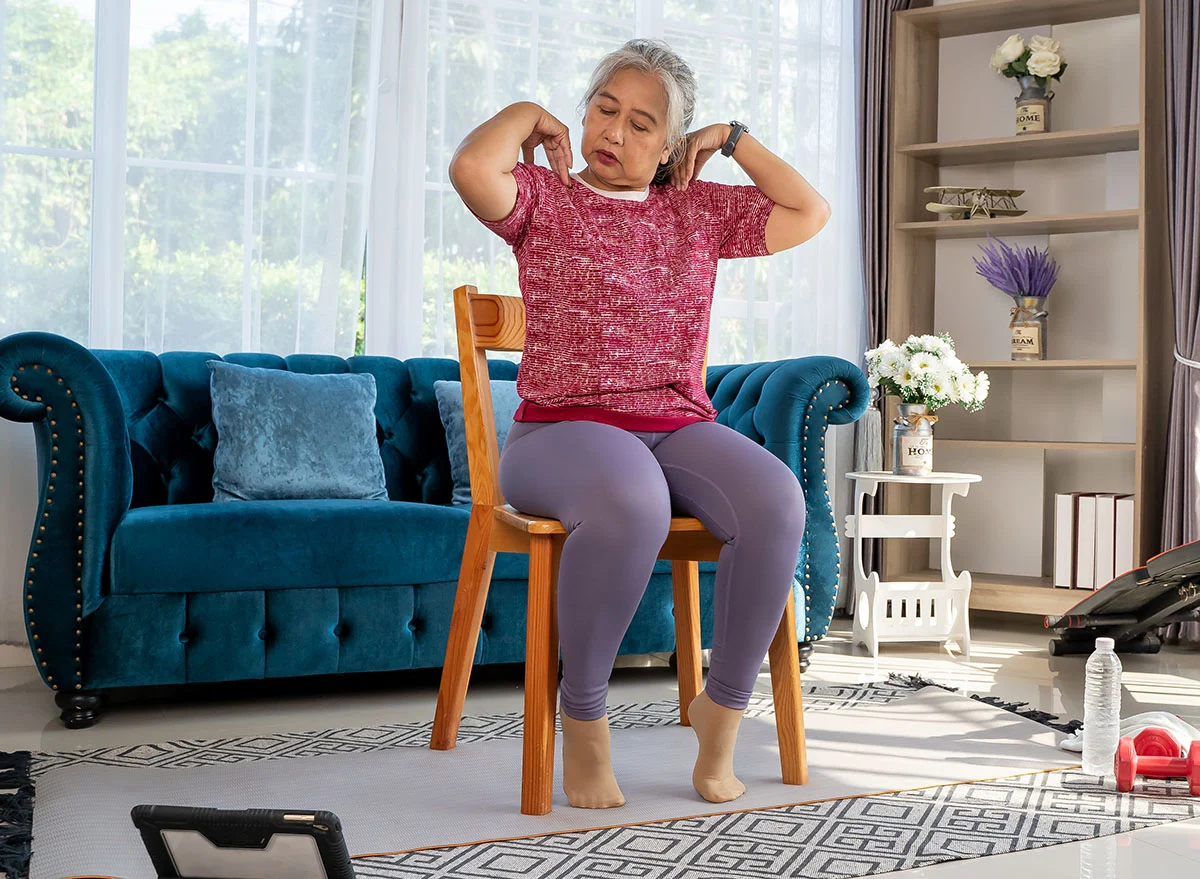
As we cross the threshold into our mid-50s, the body begins to send subtle signals that its requirements for maintenance are changing. Often, these aren’t the dramatic, headline-grabbing injuries that land someone in the emergency room. Instead, they are the quiet, persistent reminders of declining mobility: the slight hesitation when reaching for a coffee mug on a high shelf, the awkward struggle to pull on a jacket, or the discomfort of fastening a seat belt.
These everyday tasks are deceptively complex, relying on a sophisticated, synchronized dance between the shoulder joint, the shoulder blade (scapula), the upper back, and the rotator cuff. When one of these components loses strength or flexibility, the entire system compensates, leading to stiffness, tension, and a diminished quality of life. Fortunately, restoring shoulder function does not require heavy gym equipment or grueling floor routines. By utilizing the stability of a chair, individuals over 55 can target these specific muscle groups with precision and safety.
The Anatomy of Everyday Movement
To understand why these exercises are transformative, one must first appreciate the shoulder’s role as the most mobile joint in the human body. Unlike the hip, which is a deep, stable socket, the shoulder is a shallow ball-and-socket joint that relies heavily on soft tissues—muscles, tendons, and ligaments—for its stability.
After age 55, the natural aging process can lead to a decrease in synovial fluid (which lubricates the joints) and a gradual loss of muscle mass, known as sarcopenia. When the rotator cuff muscles weaken, they struggle to keep the "ball" centered in the socket during movement. This leads to friction, irritation, and the sensation of "tightness." Strengthening these muscles—specifically through pulling, external rotation, and controlled overhead patterns—is the gold standard for maintaining independence.
Chronology of a Shoulder-Focused Routine
A systematic approach is essential for long-term joint health. The following five exercises are designed to be performed in a seated position, which removes the need to worry about balance, allowing the user to focus entirely on muscular engagement and form.
1. Seated Band Pull-Aparts
This movement is the foundation of postural correction. It targets the rear deltoids, rhomboids, and middle trapezius—the "anti-slouch" muscles.
- The Technique: Holding a light resistance band with both hands, extend your arms forward at shoulder height. Pull the band apart by squeezing your shoulder blades together.
- The Benefit: By training these muscles, you counteract the forward-rounded posture often caused by years of computer work or driving.
- Protocol: Perform 3 sets of 12–15 repetitions, resting for 45 seconds between sets.
2. Seated Arm Circles
Arm circles are a dynamic warm-up that promotes blood flow and synovial fluid circulation within the glenohumeral joint.
- The Technique: Sit tall, extend your arms to the sides, and create small, controlled circles. Gradually increase the diameter of the circles.
- The Benefit: This primes the rotator cuff for more intense movements and encourages the shoulder blades to glide smoothly against the ribcage.
- Protocol: Perform 2 to 3 sets of 30 seconds in each direction.
3. Seated Band Face Pulls
If you have access to a secure anchor point, this is arguably the most important exercise for overhead reach.
- The Technique: Attach a band to a fixed object. Pull the band toward your face, focusing on driving your elbows back and rotating your hands so your thumbs point behind you.
- The Benefit: This targets the external rotators, which are essential for lifting objects overhead without pinching the shoulder joint.
- Protocol: 3 sets of 10–12 repetitions.
4. Seated I, Y, Ts
This exercise trains the shoulder through three specific planes of motion.

- The Technique: In the seated position, raise your arms to form an "I" (straight up), a "Y" (at a 45-degree angle), and a "T" (straight out to the sides).
- The Benefit: This builds strength in the lower traps and serratus anterior, which are critical for stabilizing the shoulder blade during reaching tasks.
- Protocol: 2 to 3 sets of 5–8 repetitions for each letter.
5. Seated Band External Rotations
This is a targeted isolation move for the rotator cuff.
- The Technique: Keep your elbows pinned to your ribs, forearms parallel to the floor, and pull the band apart while keeping your elbows glued to your sides.
- The Benefit: It isolates the infraspinatus and teres minor—muscles that are often neglected but vital for joint stability.
- Protocol: 3 sets of 10–15 repetitions.
Supporting Data: Why "Chair" Exercise Works
Research in geriatric kinesiology has consistently shown that "closed-kinetic chain" or stabilized exercises are safer for individuals with existing joint sensitivity. By sitting, you eliminate the "wobble factor"—the involuntary engagement of the core and legs to maintain balance—allowing the central nervous system to direct all neurological input to the shoulder girdle.
According to data from the Journal of Aging and Physical Activity, consistent resistance training in older adults not only improves joint range of motion but also significantly reduces the risk of "impingement syndrome," a common condition where the rotator cuff tendons become compressed. By performing these movements 3–4 times per week, the muscles adapt to the load, resulting in thicker, more resilient tendon attachments and improved scapular tracking.
Professional Insights: The Trainer’s Perspective
Experts in the field of senior fitness emphasize that "quality over quantity" is the rule of thumb. "The goal is not to exhaust the muscle to failure, but to teach the shoulder how to move correctly through a full, pain-free range," notes one leading physical therapist.
Professional trainers often advise their clients to avoid the "shrug reflex." Many adults, when attempting to lift their arms, will instinctively hike their shoulders toward their ears to compensate for weak upper back muscles. This is counterproductive and can lead to neck pain. The "form tip" for every exercise in this list is to keep the shoulders depressed (away from the ears) to ensure the load is being handled by the correct muscle groups.
The Broader Implications for Longevity
The implications of maintaining shoulder health extend far beyond the gym. In the context of "Activities of Daily Living" (ADLs), the ability to reach overhead is a primary indicator of long-term independence. When we lose the ability to reach the top shelf of a pantry, we rely on others or resort to unsafe climbing on stools. When we lose the ability to rotate our arms behind our backs, we lose the ability to perform basic self-care, such as washing our backs or dressing independently.
By dedicating just 15 minutes, three times a week, to these chair-based exercises, you are doing more than just "working out." You are investing in your autonomy. As you build strength around the shoulder, you will find that the movements you once dreaded—fastening a seat belt, reaching for a coat, or lifting a grocery bag—become fluid and automatic once again.
Implementation Checklist:
- Consistency: Aim for 3–4 sessions per week.
- Progression: Start with no resistance (body weight only) for the first two weeks.
- Listen to the Body: A mild "muscle burn" is expected; sharp, shooting joint pain is a sign to stop and check your form.
- Breathwork: Exhale on the effort (the pull) and inhale on the release.
In conclusion, the aging shoulder is not a lost cause. It is simply a system that requires a different approach to maintenance. By utilizing the chair as a tool for stability and focusing on the muscles that support the joint, you can ensure that your mobility remains a constant companion throughout your later years. Movement is medicine, and in this case, the pharmacy is simply a sturdy chair and a resistance band.