









Main Facts: A Crisis Across Borders
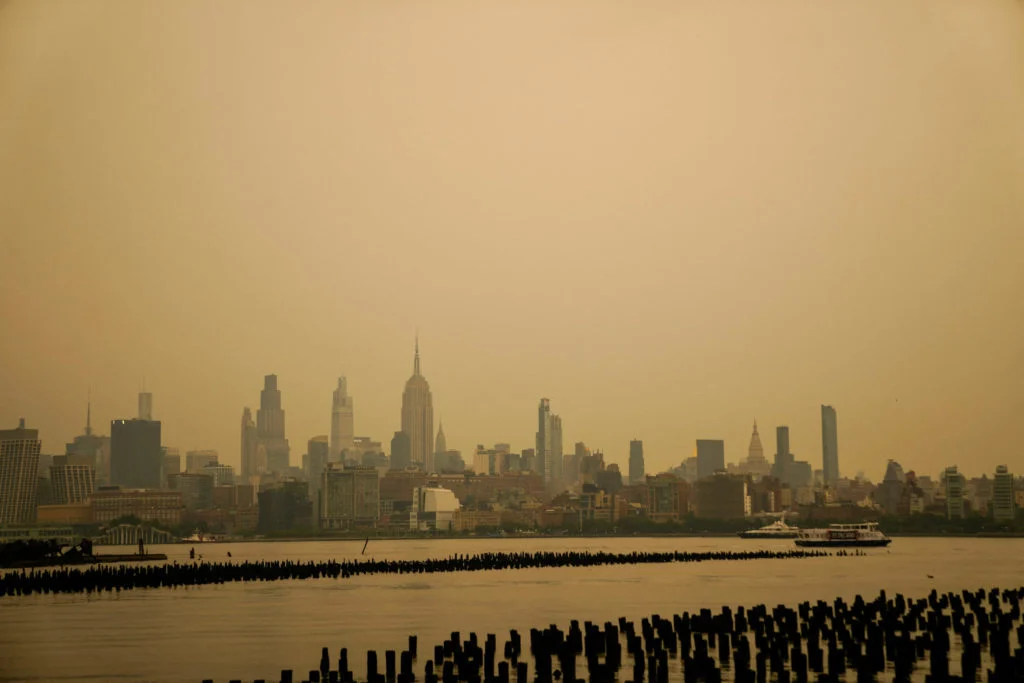
A massive, suffocating blanket of wildfire smoke has descended upon North America, creating a public health crisis that spans from the Canadian wilderness to the Mid-Atlantic coast of the United States. Current projections indicate that over 115 million people are currently within the path of hazardous air quality, triggering a cascade of state-level health advisories across at least 17 states.
What was once a localized concern for those living near forest lines has transformed into a continental emergency. Major metropolitan hubs—including Detroit, Chicago, and Minneapolis—have recorded some of the poorest air quality indices (AQI) on the planet. The atmospheric phenomenon, fueled by a complex interplay of high-pressure heat domes and record-breaking temperatures, has turned skies an eerie, apocalyptic orange, grounded flights, closed public recreational facilities, and forced the mass evacuation of residents in northern Minnesota. As environmental toxicologists warn of the systemic health risks posed by fine particulate matter, the event serves as a stark reminder of the escalating volatility of our climate.
Chronology: The Evolution of the Smoke Plume
The current crisis did not emerge in a vacuum; it is the result of an active fire season that began with unseasonable intensity in the Canadian Boreal forests and the Northern United States.
Early Ignition and Expansion
The catalyst for this disaster was a series of lightning strikes across Ontario and Minnesota, occurring against a backdrop of historic drought and heat. Throughout the early stages of the summer, these fires grew with alarming speed. By the time emergency crews reached the front lines near Armstrong, Ontario, the flames were already reaching intensities that overwhelmed standard containment efforts.
The Atmospheric "Heat Dome" Effect
As the fires raged, a massive high-pressure system—a "heat dome"—settled over Western and Central North America. This meteorological event acted as a dual-threat mechanism:
- The Catalyst: It pushed temperatures above 100 degrees Fahrenheit, drying out vegetation and creating "tinderbox" conditions that allowed fires to grow rapidly.
- The Delivery System: The high-pressure ridge injected smoke particles high into the atmosphere. As the air in the ridge began to sink, it compressed, warmed, and forced the smoke downward, effectively "trapping" it against the surface as it moved across the Great Lakes and into the Eastern United States.
Current Status
As of this week, the smoke has entrenched itself across the Midwest, the Northeast, and the Mid-Atlantic. While meteorologists suggest a reprieve by Saturday, the structural nature of these fires means that the threat is far from extinguished. Experts warn that unless there is significant precipitation or an early winter snowfall, these fires may continue to smolder well into the autumn months.
Supporting Data: Understanding the "Invisible" Threat
The danger of the current air quality crisis lies in the physical properties of the smoke itself. While the visual haziness—the "Armageddon-like" appearance—is unsettling, it is the microscopic particles that pose the greatest threat to human health.
Particulate Matter (PM2.5)
Environmental scientists emphasize that these fires are releasing high concentrations of PM2.5—particulate matter 2.5 micrometers or smaller. Because these particles are so fine, they bypass the body’s natural filtration systems, entering the lungs and eventually the bloodstream.
Toxicological Implications
Dr. Luke Montrose, an environmental toxicologist at Colorado State University, notes that "there is no such thing as good smoke." Current research is moving beyond the obvious respiratory effects, such as coughing, wheezing, and phlegm production. Emerging studies suggest that chronic exposure to wildfire smoke may have broader systemic impacts, including:
- Neurological effects: Potential links to brain fog and cognitive decline.
- Mental health: Heightened anxiety and stress responses associated with long-term atmospheric degradation.
- Reproductive health: Initial research suggests potential risks to fetal development and reproductive systems.
Vulnerable Populations
The health risk is not distributed equally. While healthy individuals may feel the effects of a "bad air day," the impact on children, the elderly, and those with pre-existing conditions—such as asthma or chronic obstructive pulmonary disease (COPD)—is often acute. Medical experts are urging these groups to remain indoors, utilize high-efficiency particulate air (HEPA) filtration, and rely on N95 respirators if forced to venture outside.
Official Responses and Public Adaptation
The scale of this event has forced a rapid mobilization of government and civic resources. In Minnesota, the evacuation of the Boundary Waters Canoe Area represents one of the more extreme measures taken to protect public safety as fire lines encroached on populated areas.
The Disruption of Daily Life
Public infrastructure has been significantly impacted. In cities across the affected regions, officials have made the difficult decision to close public pools and beaches, as the air quality levels rendered outdoor physical exertion dangerous. Aviation authorities have implemented ground stops and delays, as visibility in some regions dropped to levels deemed unsafe for flight operations.
Public Health Guidelines
Public health departments across 17 states have issued widespread advisories. The guidance remains consistent:
- Monitor local AQI levels through government portals.
- Minimize outdoor exposure during peak smoke hours.
- Ensure home air conditioning systems are recirculating indoor air rather than pulling from the outside.
- Utilize air purifiers in bedrooms and living spaces.
Implications: A New Climate Reality
The most profound implication of this smoke event is the link to anthropogenic climate change. Experts like Mike Flannigan, a professor of wildland fire at Thompson Rivers University, are categorical in their assessment of the situation.
The Climate Connection
The current crisis is not a "freak accident" but a predictable outcome of a warming world. "In Canada and the United States, we’re getting warmer because of human-caused climate change," Flannigan states. "The increases in area burned and fire severity are largely—not solely—due to human-caused climate change. I can’t be any clearer than that."
The "fire weather" of the 21st century is characterized by longer, hotter, and drier seasons. The high-pressure systems that once moved through regions with moderate impact are now strengthening into persistent heat domes, creating the perfect conditions for catastrophic fire growth.
The Future of "Fire Season"
The term "fire season" is becoming increasingly obsolete as the risk period expands from a few summer months to nearly half the year. The implications for policy-makers are severe:
- Urban Planning: Cities must begin designing "clean air shelters" and upgrading public buildings to handle high-particulate events.
- Infrastructure Resilience: The power grid and transportation sectors must adapt to extreme weather that renders current systems vulnerable.
- Environmental Policy: The debate over wildfire management—ranging from controlled burns to forest thinning—must now contend with a climate that makes every acre of timber a potential fuel source for the next regional catastrophe.
As the smoke eventually clears from the skies over Toronto, Chicago, and the Mid-Atlantic, the lingering question for citizens and officials alike is not if this will happen again, but how prepared we are for the next inevitable wave. The orange-tinted horizon is no longer a distant threat—it is the new, uncomfortable reality of a changing planet.