








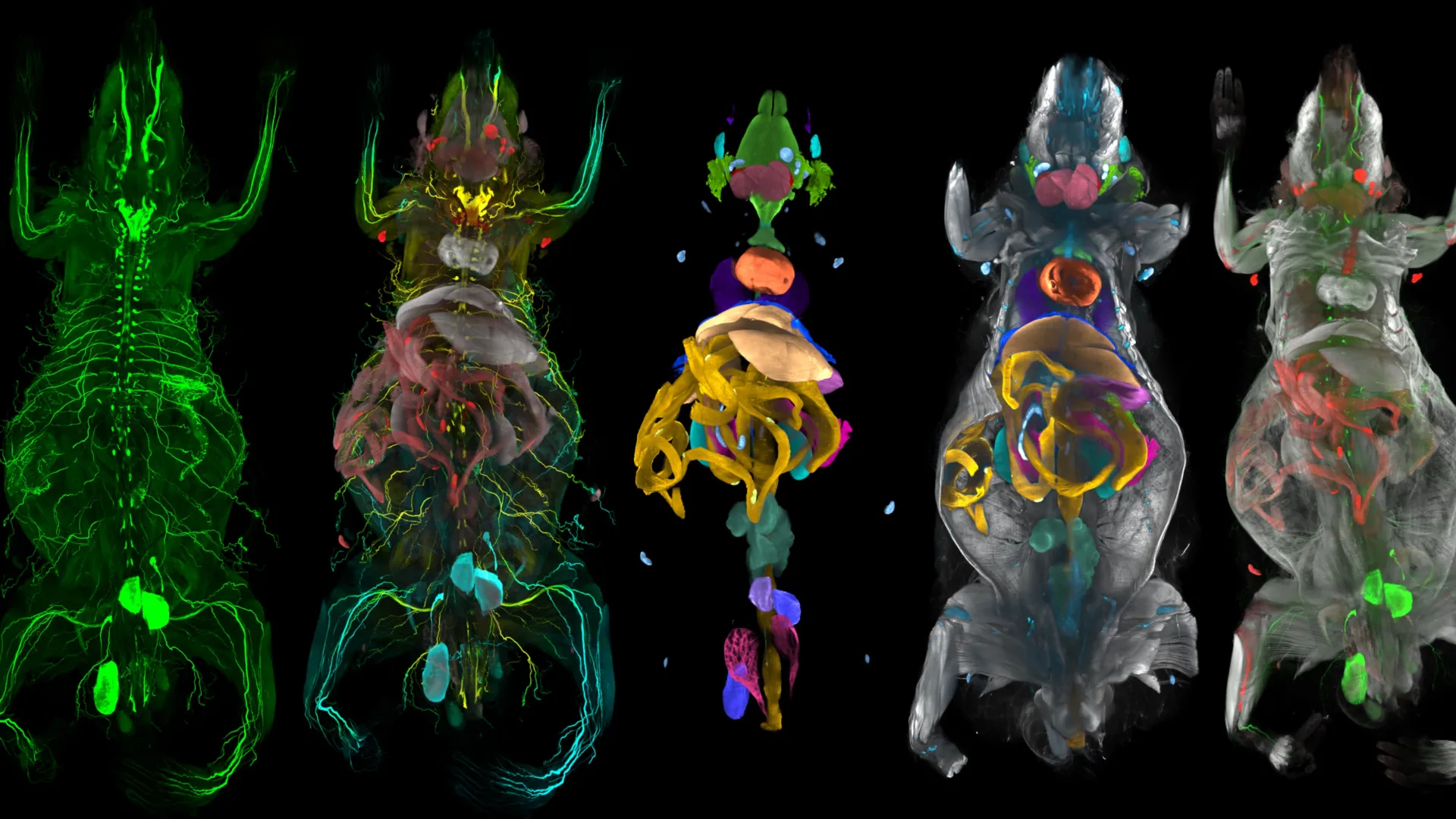
In a landmark study published in the journal Nature, an international research consortium has unveiled a groundbreaking technological platform that promises to transform how we study complex systemic diseases. Known as "MouseMapper," this AI-driven framework allows scientists to visualize and analyze cellular-level changes across an entire mouse body, effectively mapping the systemic "footprint" of disease in unprecedented detail.
Developed by researchers at Helmholtz Munich, Ludwig Maximilians University (LMU) Munich, and their global partners, MouseMapper is not merely a tool for observation; it is a diagnostic leap forward. By integrating deep learning with advanced tissue-clearing techniques, the team has already made a startling discovery: obesity is linked to previously unknown nerve damage in the face, a finding that may hold significant implications for human health.
The Technological Breakthrough: Seeing the Whole Organism
For decades, biological research has been constrained by the limitations of traditional histology. Scientists typically excise small samples of tissue—a slice of liver, a section of brain, or a sample of fat—and examine them under a microscope. While this has provided the foundation for modern medicine, it is inherently reductionist. By studying organs in isolation, researchers often miss the "big picture" of how a disease like obesity communicates its destructive signals across multiple body systems simultaneously.
The Methodology: Making Mice Transparent
To overcome these limitations, the research team, led by Professor Ali Ertürk, Director of the Institute for Biological Intelligence (iBIO) at Helmholtz Munich, employed a two-pronged strategy:
- Tissue Clearing: Using advanced chemical protocols, researchers rendered mouse bodies optically transparent. By tagging nerves and immune cells with fluorescent markers, the scientists could observe the internal architecture of the organism without the need for physical dissection, preserving the spatial relationships between organs.
- Whole-Body Imaging: These "transparent mice" were then subjected to high-resolution light-sheet microscopy, generating massive, three-dimensional datasets containing tens of millions of individual cellular structures.
The AI Engine: MouseMapper
The raw data generated by this process is far too voluminous for human analysis. This is where MouseMapper enters the picture. Built on foundation-model-based deep learning algorithms, MouseMapper functions as an automated, intelligent cartographer. It identifies and segments 31 distinct organs and tissue types, simultaneously tracking immune-cell clusters and nerve networks across the entire body.
"MouseMapper is built on a foundation model, which means it generalizes far beyond the data it was originally trained on," explains Ying Chen, co-first author of the study. Unlike rigid AI models that require specific training for every new task, MouseMapper’s architecture allows it to adapt to various biological contexts, making it a robust platform for future medical research.
Chronology of Discovery: From Diet to Neuropathy
The research team’s journey toward this breakthrough followed a rigorous experimental timeline, designed to simulate human metabolic conditions while capturing the systemic effects of obesity.
Phase 1: Metabolic Induction
Researchers placed a cohort of mice on a high-fat diet, successfully inducing a state of obesity and metabolic syndrome that closely mirrors the pathology observed in human patients. This established the "disease model" necessary to test the efficacy of the MouseMapper system.
Phase 2: Whole-Body Mapping
Once the mice reached the target physiological state, they were processed through the tissue-clearing and imaging pipeline. MouseMapper was then deployed to scan the entire anatomy, searching for patterns of inflammation and tissue degradation that would otherwise be invisible to standard diagnostic tools.
Phase 3: The Trigeminal Discovery
The most significant finding occurred when the AI identified localized, widespread damage to the trigeminal nerve. This nerve, which provides sensory input to the face and controls motor functions like chewing, showed a marked reduction in nerve branches and endings in the obese cohort. Behavioral testing corroborated the data: the obese mice exhibited a diminished response to sensory stimulation, confirming that the structural damage translated to functional neurological impairment.
Phase 4: Human Validation
Recognizing the potential translational impact of their findings, the team conducted a spatial proteomics analysis on human trigeminal tissue. They discovered that the same molecular signatures associated with inflammation and nerve remodeling in the mice were also present in human subjects with obesity. This crucial step validated that the mouse model is not just a laboratory curiosity but a representative mirror of human biology.
Supporting Data: Why Systemic Perspective Matters
The importance of the MouseMapper study lies in its ability to quantify the "interconnectedness" of the body. Obesity is a systemic condition, yet it is often treated as a series of isolated problems: insulin resistance in the liver, hypertension in the cardiovascular system, or inflammation in adipose tissue.
The study data suggests that these are not isolated events. By mapping the body as a whole, the researchers were able to identify:
- Inflammatory Hotspots: Precise localization of immune-cell activity in muscle, liver, and fat, providing a map of where systemic inflammation originates and propagates.
- Nerve Remodeling: Evidence that metabolic distress can induce structural changes in peripheral nerves that extend far beyond the visceral organs.
- Molecular Signatures: Conserved patterns of gene and protein expression that suggest the nervous system is a primary, albeit overlooked, casualty of metabolic dysfunction.
Dr. Doris Kaltenecker, senior scientist at the Institute for Diabetes and Cancer (IDC) at Helmholtz Munich and a first author of the study, emphasizes the necessity of this approach: "We revealed previously unknown structural and molecular changes in the trigeminal ganglion and its facial branches, and the same molecular signature was conserved in human tissue. This kind of finding simply cannot emerge from studying one organ at a time."
Official Perspectives and the Vision of a "Digital Twin"
The implications of this research extend far beyond the study of obesity. By providing a framework that treats the body as a single, integrated network, the team has opened the door to a new era of "systems-level" pathology.
A New Tool for Complex Diseases
The researchers anticipate that MouseMapper will be instrumental in studying diseases that involve multi-organ failure or systemic decline, such as:
- Neurodegenerative Diseases: Identifying how early-stage protein misfolding in one region might affect distant nerve clusters.
- Cancer Metastasis: Tracking how immune cells and tumor cells interact across different organs during the spread of malignancy.
- Autoimmune Disorders: Mapping the systemic distribution of autoimmune attacks, which often manifest in diverse and seemingly unrelated tissues.
The Long-Term Vision: Digital Twins
Professor Ali Ertürk has set an ambitious horizon for the project. The ultimate goal is not just to scan mice, but to build "digital twins"—comprehensive, high-fidelity virtual models of the mouse body.
"Our goal is to create a comprehensive framework for understanding how diseases affect the body as an interconnected system," says Ertürk. "Our long-term vision is to build truly realistic digital twins of mice in health and disease: cell-level atlases that we can query, perturb, and screen in silico computationally."
This vision suggests a future where researchers can run millions of virtual simulations to test new drug candidates before a single physical experiment is conducted. Such an approach would not only accelerate the discovery of life-saving treatments but also significantly reduce the number of animal experiments required in preclinical trials, adhering to the principles of the 3Rs (Replacement, Reduction, and Refinement).
Implications: A Paradigm Shift in Medical Research
The publication of this study marks a turning point in the field of systems biology. By moving away from the "siloed" approach of organ-specific study, the scientific community is beginning to grasp the sheer complexity of how diseases navigate the human body.
Public Access and Global Collaboration
In a move that mirrors the open-science ethos of the modern era, the researchers have made their whole-body datasets publicly available. This allows laboratories across the globe to interrogate the data for their own research questions, effectively turning the study into a living resource that will continue to yield insights for years to come.
The Future of Preventive Medicine
The discovery regarding the trigeminal nerve is particularly provocative. If obesity causes nerve damage in the face, what other subtle neurological changes are being overlooked in early-stage metabolic disease? MouseMapper offers a path to identifying the "earliest changes" that occur before a condition becomes clinically apparent.
If researchers can pinpoint the exact moment or location where a disease begins to take hold, they can design targeted interventions to prevent the cascade of damage that follows. For a condition like obesity, which affects millions and underpins a vast array of chronic diseases, this is more than a technical achievement—it is a beacon of hope for future preventative medicine.
Funding Acknowledgements:
This research was supported by the European Research Council (Consolidator Grant CALVARIA to A. Ertürk; grant 949017 to M. Rohm), the German Research Foundation (DFG) under Germany’s Excellence Strategy (SyNergy, ID 390857198, EXC 2145), DFG SFB 1052 (A9) and TR 296 (P03), the Collaborative Research Centre CRC 1744, the German Federal Ministry of Education and Research (NATON collaboration, 01KX2121, and HIVacToGC), the Vascular Dementia Research Foundation, the Nomis Heart Atlas Project Grant (Nomis Foundation), the Else-Kröner-Fresenius-Stiftung, the Edith-Haberland-Wagner Stiftung, the Helmut Horten Foundation, the EFSD and Novo Nordisk A/S Programme for Diabetes Research in Europe (to D. Kaltenecker), and the China Scholarship Council (to Y. Chen).