










Katie Thomas has spent her entire life operating under a singular, uncompromising philosophy: her limits are not defined by her biology, but by her own ambition. An adaptive HYROX champion, a Paralympic hopeful, and a viral social media powerhouse, Thomas is currently rewriting the playbook for what is possible for athletes with limb differences.
While the public may have been introduced to her through a humorous, viral traffic stop—where she playfully offered a police officer “the hand of God”—Thomas is leveraging that newfound global attention for a much deeper purpose. She isn’t chasing fame; she is chasing faster splits, refined technique, and a future where the next generation of adaptive athletes never has to question their place in the fitness community.
The Foundation: A Childhood Without "No"
Born with a limb difference affecting her right arm, Thomas’s early life was defined not by what she lacked, but by what she could master. Her parents, refusing to treat her condition as a disability, fostered an environment of radical independence.
“My dad very much believed in me and never told me no,” Thomas recalls. “If I wanted to do gymnastics, I was in gymnastics. If I wanted to play baseball, I played baseball. He never let anyone tell me I couldn’t do something, and that changed the entire trajectory of my life.”
This upbringing instilled a problem-solving mindset that has become the hallmark of her athletic career. Whether she is modifying a complex strength movement to accommodate her anatomy or balancing the high-intensity demands of professional fitness, Thomas’s default reaction to any obstacle is the same: How can I make this work?
Chronology of an Athlete: From Fields to Fitness Floors
Thomas’s journey into the elite sphere of adaptive sports was not a sudden pivot, but the culmination of a lifelong commitment to movement.
- Formative Years: As a child and teenager, Thomas was a constant competitor. She cycled through soccer, rodeos, and equestrian sports, learning early on how to adapt her physical mechanics to achieve parity with her peers.
- Academic and Professional Growth: Recognizing her passion for the human body, she earned a degree in exercise science and became a certified personal trainer. This academic background proved vital, providing her with the physiological knowledge required to safely and effectively engineer her own adaptive training protocols.
- The CrossFit Exploration: Like many modern functional fitness athletes, Thomas explored the world of CrossFit. While she valued the community, the sport’s heavy reliance on technical, symmetrical Olympic lifting often posed structural limitations that did not play to her specific strengths.
- The HYROX Breakthrough: The arrival of HYROX—a global fitness race blending 1km runs with functional stations—offered a new paradigm. With its emphasis on raw work capacity, endurance, and functional movement, the sport felt tailor-made for Thomas.
The Numbers Game: Performance and Potential
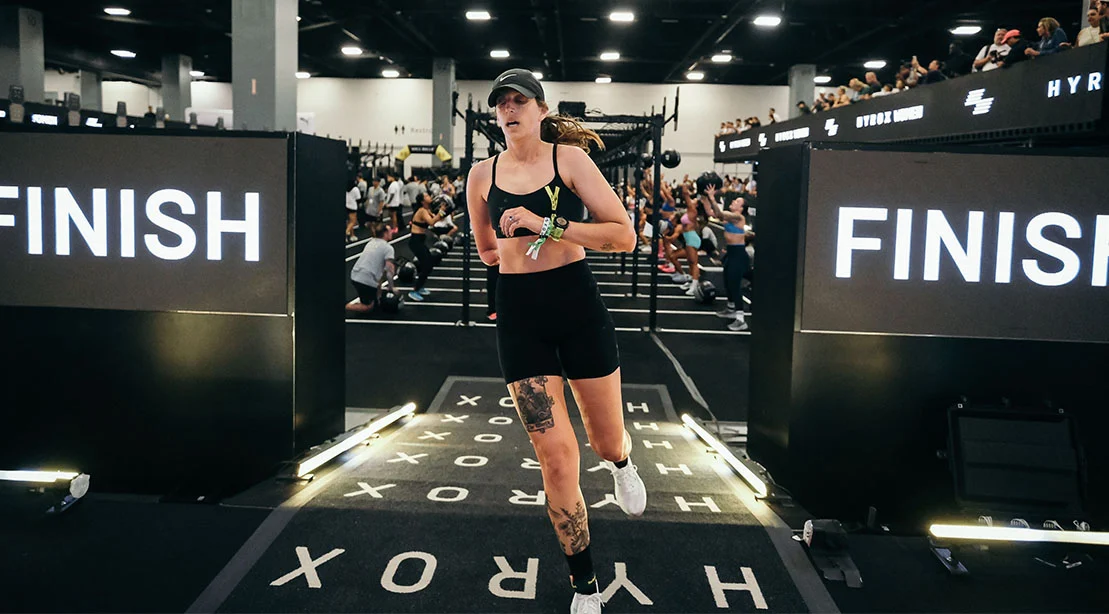
The transition to competitive HYROX was seamless. In her debut race in Miami, Thomas secured first place in the adaptive upper-limb division. However, it was the post-race data analysis that truly signaled her potential.
Upon reviewing the global rankings, Thomas discovered she was sitting in second place in the United States and 16th in the world within her division. This data was the validation she needed. It transformed her perspective from casual competitor to elite athlete.
Performance Metrics: The Path to Worlds
Thomas is currently in a hyper-focused training block, specifically targeting her "aerobic engine." In HYROX, where eight kilometers of running are interspersed between physical challenges, running economy is the deciding factor between a podium finish and a mid-pack result.
"If I can improve my running, I can shave four to six minutes off my time," Thomas notes. "At the elite level, that is the difference between being a participant and being a world-class contender."
Her current training regimen is a sophisticated blend of:
- High-Intensity Interval Training (HIIT): To improve VO2 max and recovery between stations.
- Functional Adaptation: Using resistance bands and unilateral strength implements to replicate the stimulus of traditional lifts (like the sled push or pull) without the risk of overcompensating with her stronger side.
- Flexibility Work: A new, critical focus necessitated by her recent invitation to the U.S. Paralympic sitting volleyball national team training camp.
The Science of Adaptation: An Expert Perspective
Thomas’s approach to training is rooted in the "Exercise Science" approach. She rejects the notion that she must perform a movement exactly as it is prescribed in a textbook. Instead, she analyzes the intent of the exercise.
“If something like a snatch or a clean and jerk comes up, I know that’s just not my movement,” she explains. “Instead of trying to force it, I’ll figure out another exercise that’s targeting those same muscle groups or developing that same explosive movement.”
This constant experimentation—swapping barbells for dumbbells or finding novel resistance band configurations—is the "puzzle" that keeps her engaged. More importantly, she documents these experiments on social media. She isn’t just showing off her fitness; she is building a library of resources for other adaptive athletes, effectively creating a "shortcut" for those who previously felt excluded from the gym environment.
Official Stance: The Role of Gyms and Coaches
Thomas is a vocal advocate for systemic change in the fitness industry. When asked what gym owners can do to foster inclusivity, her answer is strikingly simple: Visibility.
She argues that expensive, specialized equipment is secondary to the presence of adaptive athletes on the floor. When a newcomer with a limb difference walks into a gym and sees someone like Thomas training, the barrier of intimidation instantly dissolves.
“You can add equipment or make other changes,” she says, “but visibility is going to be the biggest thing. Kids want to see themselves. They want to know they belong. If seeing me makes someone feel more comfortable walking into a gym or signing up for a race, then that’s everything.”
The Cultural Impact: Beyond the Viral Moment
The "Hand to God" viral video brought millions of eyes to Thomas’s social media, but she has masterfully pivoted that attention toward her advocacy. Her inbox is now flooded with messages from parents of children with limb differences or congenital conditions.
One story, in particular, illustrates the depth of her impact. A mother of a young girl with Down syndrome who had recently undergone an amputation reached out, overwhelmed by grief and uncertainty about her daughter’s future. Upon seeing Thomas’s training videos, the mother realized that her daughter’s life would not be a series of "cannots," but a life of potential.
“She realized her daughter was going to be able to do whatever she wanted to do,” Thomas says. “And nobody was going to be able to tell her no.”
Implications: A New Era for Adaptive Athletics
The trajectory of Katie Thomas’s career carries significant implications for the future of sports. Her success is forcing governing bodies, race organizers, and athletic brands to reconsider how they categorize and support adaptive athletes.
- Broadened Sponsorship Opportunities: Brands that once ignored adaptive athletes are now seeing the immense commercial and cultural value of representation.
- Standardization of Adaptive Categories: As participation grows, the need for more defined, fair, and accessible competition structures in sports like HYROX is becoming a priority.
- The Normalization of "Different": By treating her training as a scientific pursuit rather than a struggle, Thomas is normalizing the idea that physical adaptation is just another form of athletic training.
The Road to the World Championships
Looking toward the future, Thomas’s focus is clear: qualify for the HYROX World Championships. She is not interested in being a "feel-good" story; she is interested in being a world-class competitor.
Her schedule is packed with training sessions, Paralympic volleyball camps, and, most importantly, the ongoing process of refining her body for peak performance. Even when things go wrong—like a recent incident where a carpet fold nearly ruined a sled push—she views it as an opportunity to sharpen her competitive instincts.
“It wasn’t the race I expected, but that’s competition,” she says. “You learn from it, adjust, and come back better next time.”
For Katie Thomas, the "finish line" is not a physical place. It is a societal goal. She is working toward a future where the next generation of children with limb differences will look at a gym, a stadium, or a starting line and never wonder if they belong. They will know they do.
In her own words, she is just a regular girl—but her work is anything but regular. By dismantling the stigma around disability through the simple, brutal, and beautiful act of training, Katie Thomas is proving that the only limits that truly matter are the ones we place on ourselves.