











For decades, the triceps extension has been a cornerstone of upper-body aesthetics and functional strength. Whether performed with a heavy barbell, a set of dumbbells, or the modern cable machine, the objective remains the same: to isolate the triceps brachii—the muscle group responsible for two-thirds of arm volume. However, the traditional vertical overhead extension, while biomechanically effective at hitting all three heads of the triceps, has long been a source of contention for athletes dealing with spinal strain, postural instability, or joint discomfort.
Fitness transformation coach and industry expert Travis Smith has recently introduced a paradigm shift in how we approach this movement. By transitioning from a vertical to a horizontal plane, Smith argues that lifters can achieve superior hypertrophy while simultaneously safeguarding the spine and minimizing elbow distress. This article explores the mechanics, implications, and professional methodology behind the "Lying Triceps Cable Crossover," a technique that is rapidly gaining traction in the high-performance fitness community.
The Biomechanics of the Triceps Brachii
To understand why Smith’s variation is significant, one must first appreciate the anatomy of the triceps. The triceps brachii is composed of three distinct heads: the lateral, the medial, and the long head. The long head is unique because it crosses both the elbow and the shoulder joint. This means that for maximum engagement, the arm must be positioned in a way that stretches the long head, typically by bringing the elbow overhead.
Traditionally, the overhead extension has been the gold standard for this. However, the overhead position introduces a "vertical load" challenge. As a lifter increases the weight to reach progressive overload—a requirement for muscle growth—the stabilizing muscles of the core and lower back must engage to prevent the torso from swaying or arching. For many, this leads to lower back fatigue long before the triceps reach failure, effectively capping the growth potential of the target muscle.
Chronology of the Shift: From Vertical Loading to Horizontal Stability
The evolution of triceps training has been a slow transition toward greater stability. Early bodybuilding methods favored the heavy barbell "Skull Crusher," which, while effective, often caused significant strain on the olecranon (elbow) joint. As cable machines became more sophisticated, fitness professionals began experimenting with pulley heights and body positioning.
Travis Smith’s approach represents the maturation of this experimentation. By integrating the bench into the cable station, Smith has effectively eliminated the "stability tax."
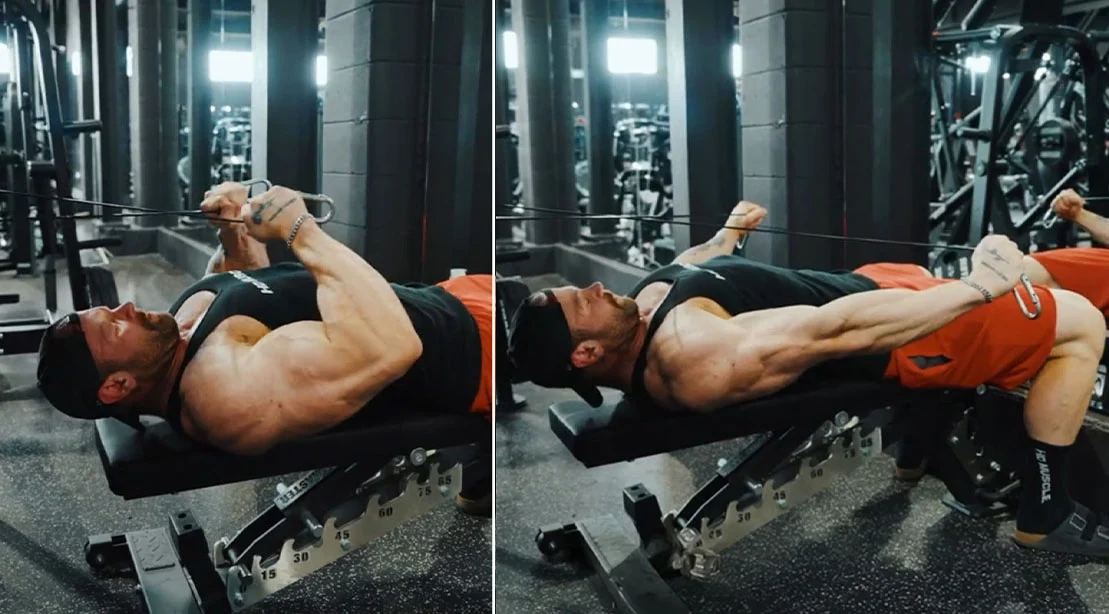
- The Setup: Smith positions a flat weight bench directly in front of a cable crossover station.
- The Positioning: By lying supine (on the back), the torso is physically pinned to the bench. This removes the lumbar spine from the equation entirely, as the bench acts as a rigid support.
- The Execution: Using individual carabiner clips on the cables, Smith crosses the cables over his body. This crossing pattern ensures that the line of resistance is optimized for the triceps’ range of motion, maintaining tension throughout the entire movement.
Supporting Data: Why Stability Drives Hypertrophy
The central thesis of Smith’s philosophy is that stability is an "underrated variable for muscle growth." In exercise physiology, this is known as the "stability-force output ratio."
When the body is forced to stabilize a weight, it recruits secondary motor units to maintain balance. If you are standing and performing an overhead extension, your core, glutes, and spinal erectors are firing just to keep you upright. By lying on a bench, you effectively "turn off" these unnecessary stabilizers. The nervous system, sensing a secure environment, can then direct a higher percentage of motor unit recruitment toward the primary mover: the triceps.
Furthermore, the cable constant tension (CCT) principle applies here. Unlike free weights, which provide a "dead zone" of tension at the bottom or top of a movement, cables provide a continuous drag. When combined with the horizontal bench setup, the triceps are under a constant mechanical load that does not fluctuate based on gravity, leading to superior metabolic stress—a primary driver of hypertrophy.
Official Commentary: Insights from Travis Smith
In his recent demonstration, Smith emphasized that the horizontal approach is not merely a "safety modification" for injured athletes, but a superior tool for everyone from beginners to seasoned bodybuilders.
"Lying on the bench locks your torso and shoulders in place," Smith explained. "So, you can focus on producing as much force as possible with the triceps. The less energy spent stabilizing movement, the more you can put into the target muscle."
Perhaps the most compelling argument Smith offers concerns the elbows. Many lifters abandon overhead work because of the "grinding" sensation in the elbow joint—a common precursor to tendonitis. Smith notes that because the lying cable crossover allows for a more controlled, fluid range of motion, it bypasses the harsh lockout that often plagues traditional skull crushers. It is, according to Smith, the ultimate variation for long-term joint health.
Implications for Training Programs
For the average gym-goer, the implications of this technique are profound. Implementing the Lying Triceps Cable Crossover into a routine does not require specialized equipment, only a bench and a cable machine.
Implementation Protocol
To maximize the benefits of this exercise, Smith recommends a specific volume and intensity range:
- Frequency: 2 to 3 sets per workout, typically placed toward the end of an arm or "push" day.
- Repetition Range: 8 to 12 repetitions. This range is scientifically supported to fall within the optimal "hypertrophy window," balancing mechanical tension and metabolic stress.
- Technique Cues: Focus on the "negative" or the lowering portion of the lift. Smith advises that the fists do not need to go past the shoulders, but the athlete should focus on finding a deep, controlled stretch at the point of extension.
This approach acknowledges that muscle growth is not just about the weight on the stack; it is about the quality of the contraction. By removing the back and shoulder stabilizers from the movement, the lifter can push closer to absolute failure without the risk of compensatory movement patterns.
Addressing the Skeptics: Is Vertical Training Dead?
While Smith’s horizontal variation is highly effective, it does not mean that traditional standing overhead extensions are obsolete. They still offer benefits for functional strength and core stabilization. However, for those seeking to isolate the triceps for maximum cosmetic and strength gains, the horizontal variation offers a clear advantage in safety and focus.
The industry is moving toward a more nuanced understanding of "joint-friendly hypertrophy." We are seeing a decline in the "no pain, no gain" mentality and an increase in intelligent, biomechanically sound programming. Smith’s method is a reflection of this modern standard.
Conclusion: The Path Forward for Arm Development
The Lying Triceps Cable Crossover stands as a testament to the fact that you do not need to move heavy weight dangerously to see progress. By manipulating the environment—in this case, by lying down—one can create an ideal stimulus for muscle growth.
For those who have struggled with lower back pain during heavy arm sessions or those who find their progress has plateaued, this horizontal shift may be the missing piece of the puzzle. It allows the athlete to move away from the distractions of stabilization and toward the absolute, pure isolation of the triceps brachii.
As Travis Smith continues to demonstrate, the most effective fitness solutions are often those that simplify the movement while maximizing the intensity. If you are looking to revitalize your arm training, take the load off your spine and get horizontal. Your triceps, and your back, will thank you.
For those interested in following Travis Smith’s continued fitness journey and learning more about his transformation techniques, he can be followed on Instagram at travyjsmith. His feed serves as a repository for ongoing demonstrations of biomechanically sound training methods designed for both longevity and muscle growth.