











By International Affairs Desk
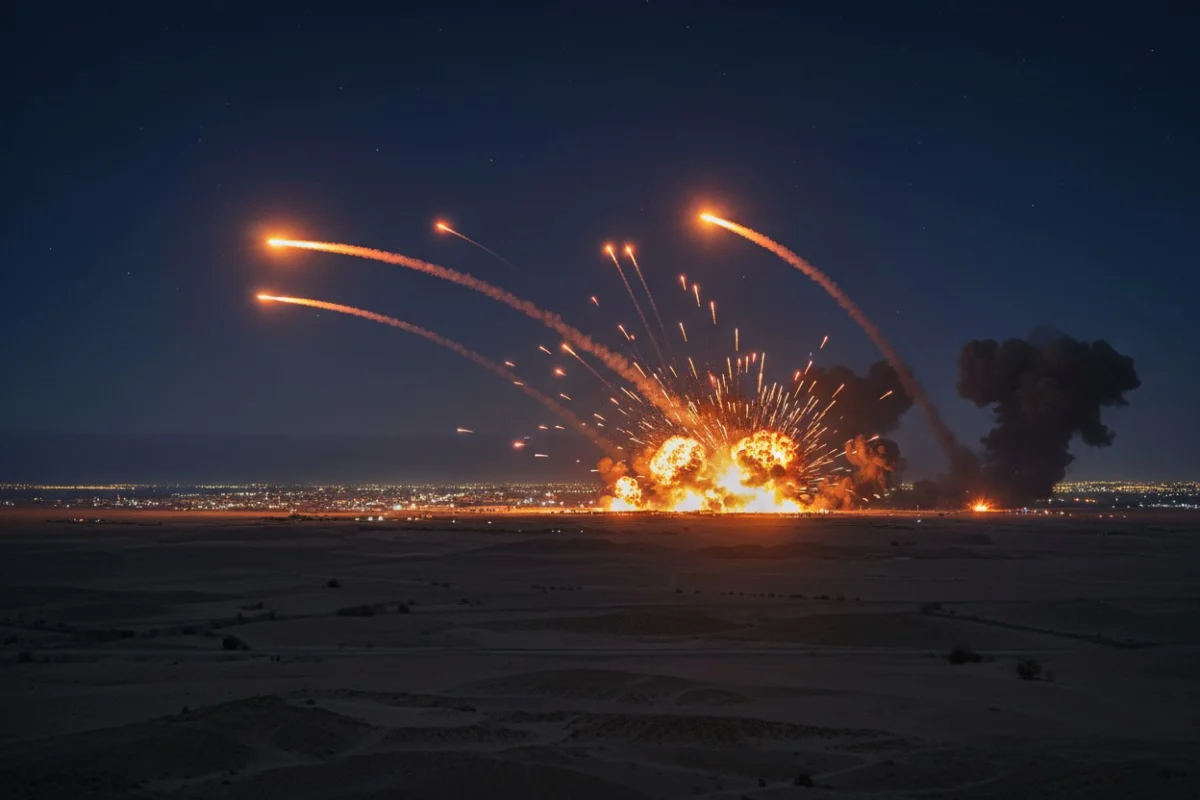
The Middle East teetered on the brink of a broader regional war this Wednesday as Iranian forces launched a coordinated barrage of ballistic missiles and loitering drones against U.S. military installations across Jordan, Kuwait, and Bahrain. The escalation, which marks a significant departure from previous tit-for-tat exchanges, saw the Iranian Islamic Revolutionary Guard Corps (IRGC) directly target American assets, including logistics hubs and radar installations, in a bid to challenge U.S. air superiority in the region.
The strikes, which occurred at midday, prompted immediate defensive reactions from both Jordanian authorities and the Israeli military, as the violence spilled over into neighboring territories. This development follows a harrowing 11-day campaign of U.S.-led aerial sorties deep into Iranian territory, suggesting that the fragile diplomatic framework that governed the region earlier this year has completely disintegrated.
The Aqaba Assault: A Coordinated Strike
The primary focus of Wednesday’s operation was the Jordanian port city of Aqaba. Situated on the Red Sea, the city has long served as a vital logistical artery for U.S. troop movements and supply chains. According to Jordanian state media, the attack involved a multi-pronged approach, utilizing ballistic missiles and "Arash" loitering drones.
Jordanian air defenses were pushed to their limits, successfully intercepting four incoming missiles. However, two additional projectiles struck unpopulated areas, causing significant alarm. The impact was felt as far away as the Israeli city of Eilat, where residents reported hearing loud explosions. The Israeli Defense Forces (IDF) activated Iron Dome interceptors to neutralize potential debris, though officials confirmed that no sirens were triggered, as the threat was deemed to be concentrated on U.S. facilities within the Jordanian perimeter.
The U.S. Embassy in Amman had anticipated the volatility. Days prior, they issued an "extraordinary security alert," explicitly warning American citizens to avoid the Aqaba International Airport and the city’s seaport, citing "specific and credible intelligence" regarding an impending attack. This warning proved prescient, as the IRGC later confirmed that U.S. aircraft and radar systems stationed at the airport were the primary objectives of the strike.
Chronology of Escalation: From Ceasefire to Chaos
The current instability is the byproduct of a rapidly deteriorating security environment that began in late February.
- Late February: The initial outbreak of regional hostilities began, leading to a series of skirmishes between Iranian proxies and U.S.-led coalition forces.
- June: A fragile 60-day ceasefire was established, offering a brief respite from the violence. However, the agreement failed to address underlying tensions regarding maritime security in the Strait of Hormuz.
- Early July: Hostilities resumed with renewed vigor. On July 9, Iran launched ten ballistic missiles at Jordan’s Azraq air base.
- July 18: A strike on the Muwaffaq Salti Air Base in Jordan resulted in the tragic deaths of two U.S. service members.
- July 22: The current series of strikes intensified, with the IRGC claiming to have hit storage facilities and accommodation blocks at Muwaffaq Salti.
- Present Day: The U.S. has concluded its 11th consecutive night of retaliatory strikes within Iran, targeting military operations centers, maritime capabilities, and drone storage infrastructure.
The collapse of the June ceasefire has effectively shredded any remaining diplomatic avenues for de-escalation, leading Iranian President Masoud Pezeshkian to declare that the nation is now engaged in a "full-scale war."
The "Blind, Deplete, and Overwhelm" Strategy
Military analysts are closely monitoring the evolving tactics of the IRGC. The Iranian military’s recent performance suggests the implementation of a doctrine explicitly described as "blind, deplete, and overwhelm."
This strategy involves using high-speed, maneuvering missiles designed to saturate and exhaust U.S. air defense batteries. By launching simultaneous volleys of loitering drones and ballistic missiles, Iran seeks to render American systems like the Patriot and THAAD obsolete through sheer volume. Former intelligence officials have noted that the missiles utilized in Wednesday’s attack exhibited advanced terminal-phase maneuvering, making them increasingly difficult for traditional interception systems to track and engage.
The IRGC’s communication following the strike highlighted a concerning element of local intelligence: they claimed that their precision was bolstered by "accurate information" provided by local residents. This suggests an active intelligence-gathering network operating near U.S. bases, complicating the security posture for American commanders who must now contend with both external missile threats and potential internal reconnaissance.
U.S. Central Command’s Response
While the IRGC launched their assault on Aqaba, U.S. Central Command (CENTCOM) was in the midst of its own intensive bombing campaign. For 11 consecutive nights, American forces have struck targets inside Iran, focusing on the country’s maritime infrastructure and logistics hubs.
CENTCOM reports indicate that these strikes are intended to degrade Iran’s ability to project power in the Strait of Hormuz, a critical chokepoint for global energy supplies. The scope of these operations has expanded significantly, with reports of explosions in Tabriz, Sirik, Bushehr, and the outskirts of Tehran. Iranian state media has acknowledged the activation of air defenses across these regions, though they maintain that no direct hits were recorded on major facilities within the capital.
The intensity of the U.S. response suggests that the Pentagon is no longer merely reacting to individual provocations but is engaged in a strategic effort to dismantle the infrastructure that enables Iran’s regional missile program.
Implications: The Nuclear Threshold
The most alarming dimension of this conflict is the explicit threat issued by Iran’s Khatam al-Anbiya Central Command. In a formal statement, the Iranian military declared that any U.S. strike on Iran’s nuclear or power infrastructure would be treated as an expansion of the war, rendering all U.S. interests and those of its allies "legitimate targets."
This rhetoric follows threats made by former U.S. President Donald Trump to "hit very heavily" Iran’s Pickaxe Mountain nuclear site. Such threats have forced a shift in the Iranian defensive posture; the leadership in Tehran appears to be signaling that the red line is no longer just the protection of military personnel, but the preservation of the state’s nuclear and energy capabilities.
The implications are dire. Should either side choose to strike these critical infrastructure nodes, the conflict would likely transition from a regional skirmish into a full-scale systemic collapse. Diplomatic efforts, led largely by Pakistani mediators, have thus far failed to gain traction, with both sides entrenched in a cycle of retaliation that shows no signs of abating.
Data Analysis: The Cost of the Conflict
Satellite imagery and Pentagon briefings paint a grim picture of the conflict’s toll. Since the fighting resumed in late February, at least 228 structures or pieces of military equipment have been destroyed or damaged at U.S. sites in the Middle East. These include:
- Hangars and Barracks: Specifically at Muwaffaq Salti and Azraq.
- Logistics Infrastructure: Damaged or destroyed in Kuwait and Bahrain.
- Personnel Casualties: The Pentagon has confirmed that nearly 100 U.S. service members have sustained injuries ranging from shrapnel wounds to traumatic brain injuries caused by the pressure waves of nearby missile impacts.
The persistent targeting of Bahrain’s Sheikh Isa Air Base, where Iranian Arash drones have successfully struck warehouses, underscores the geographical expansion of the conflict. The IRGC is clearly demonstrating that no U.S. position in the Persian Gulf or the Levant is out of reach.
As the smoke clears over Aqaba, the international community faces a sobering reality. The mechanisms of deterrence that once kept the U.S.-Iran rivalry in the shadows have failed. With both sides now operating under a "war footing," the potential for a miscalculation—either at a military base or in the halls of political power—could turn this already bloody conflict into a defining catastrophe of the 21st century.