









Katie Thomas has spent her entire life operating under a singular, non-negotiable premise: limits are not inherent—they are merely design challenges waiting to be solved. As an adaptive HYROX champion, a Paralympic hopeful, and a burgeoning digital force, Thomas has shifted the narrative surrounding limb difference from one of "overcoming" to one of absolute, high-octane performance. She isn’t chasing inspiration; she is chasing faster splits, higher power outputs, and a permanent seat at the table of elite athletics.
The Foundation of Independence
Born with a congenital limb difference affecting her right arm, Thomas’s early life was devoid of the "pity paradigm" that often stifles children with disabilities. Her parents operated on a philosophy of radical inclusion and problem-solving. Whether it was baseball, soccer, competitive rodeo, or gymnastics, the answer to "Can I do this?" was never "No." It was, "Let’s figure out how."
"My dad very much believed in me and never told me no," Thomas recalls. "If I wanted to do gymnastics, I was in gymnastics. If I wanted to play baseball, I played baseball. He never let anyone tell me I couldn’t do something, and that changed the entire trajectory of my life."
This childhood training ground—where independence was a daily necessity—provided the bedrock for her career in exercise science. By the time she reached adulthood, Thomas possessed not just the physical grit of a multi-sport athlete, but the analytical mind of a trainer who understands biomechanics, movement patterns, and the art of the pivot.
Chronology: From Recreational Athlete to Global Contender
Thomas’s journey into the competitive fitness world was organic. Her athletic identity was forged on soccer pitches and in the dust of the rodeo arena. However, it was the transition to functional fitness that brought her competitive drive to the surface.
- The Formative Years: A background in soccer and sprint triathlons established her aerobic engine early on.
- The CrossFit Era: Thomas explored CrossFit, finding community but struggling with the sport’s rigid adherence to heavy, two-handed Olympic lifting—a discipline that didn’t always align with her anatomy.
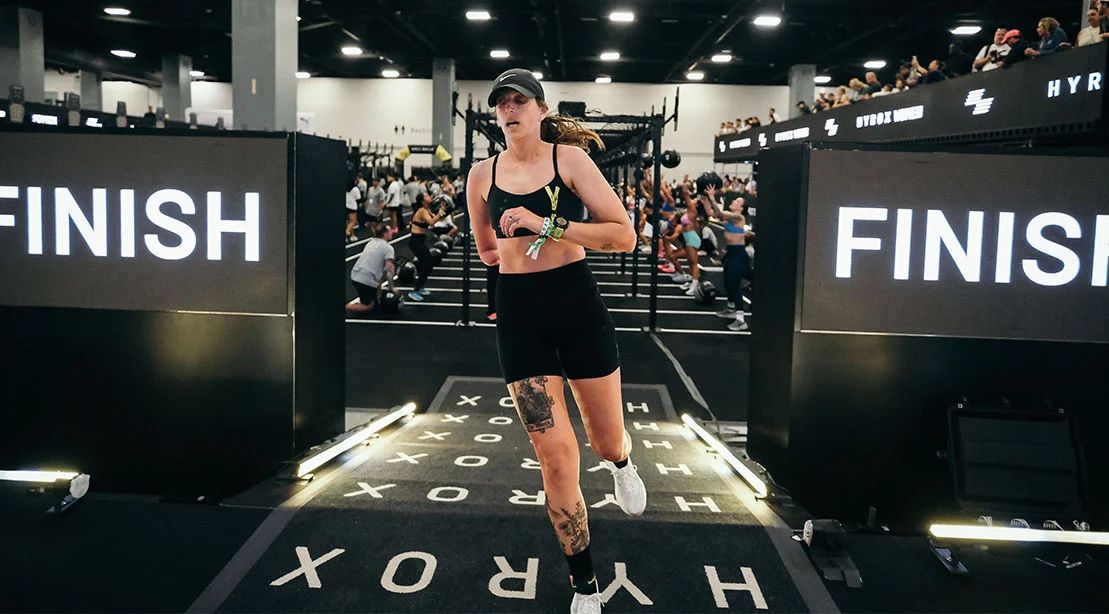
- The HYROX Discovery: The emergence of HYROX—a global fitness racing phenomenon—changed everything. By blending endurance running with functional stations like sled pushes, rowing, and lunges, the sport prioritized work capacity over technical lifting. It was, for Thomas, the perfect puzzle.
- The Miami Breakthrough: Entering her first HYROX race in Miami, she didn’t just participate; she dominated the adaptive upper-limb division.
- The "Hand of God" Moment: A viral traffic stop in which she jokingly told a police officer she was offering him "the hand of God" catapulted her from a local competitor to a digital sensation, moving her Instagram following from 60 to over half a million overnight.
- The Paralympic Horizon: Most recently, Thomas has been invited to train with the U.S. Paralympic sitting volleyball team, marking a new chapter in her pursuit of elite international representation.
Supporting Data: Why HYROX is the Ultimate Test
HYROX is frequently described as the "World Series of Fitness," and for a good reason. It requires a rare combination of cardiovascular endurance and muscular stamina. For an adaptive athlete like Thomas, the sport’s accessibility is a game-changer.
When Thomas first looked at the race requirements—the 8km of running interspersed with eight functional stations—she didn’t see barriers. She saw a series of tasks that could be modified without losing the spirit of the test. Her first-place finish in Miami was not a fluke; it was a testament to her athletic preparation. When she later analyzed her performance against the global rankings, she discovered she was sitting 16th in the world in her division. This data point shifted her perspective from "I can do this" to "I can win this."
Her current training regimen is a masterclass in efficiency. She is currently focused on her "aerobic engine," specifically targeting her run times. "If I can improve my running, I can shave four to six minutes off my time," she notes. In a sport where seconds separate the podium, that potential improvement is the difference between a regional win and a World Championship title.
The Science of Adaptation: An Analytical Approach
Thomas approaches her workouts with the clinical precision of a professional kinesiologist. She doesn’t view her arm as a liability; she views it as a variable in an equation.
"If something like a snatch or a clean and jerk comes up, I know that’s just not my movement," she explains. "Instead of trying to force it, I’ll figure out another exercise that’s targeting those same muscle groups or developing that same explosive movement."
This experimental mindset has led to her creating a library of "shortcuts" that she shares on social media. By utilizing resistance bands, creative dumbbell placements, and modified grip angles, she is essentially crowdsourcing solutions for other adaptive athletes. Her content serves a dual purpose: it documents her own progress and provides a "how-to" guide for a community that has historically been underserved by mainstream fitness programming.
Official Perspectives: The Role of Visibility
When asked about what the fitness industry can do to better support athletes like her, Thomas’s answer is remarkably simple: Visibility.
"Have an adaptive athlete working out in your gym," she says. "You can add equipment or make other changes, but visibility is going to be the biggest thing."
This echoes a broader sentiment in sports sociology. Representation acts as a psychological permission slip. When a child with a limb difference walks into a gym and sees someone like Katie Thomas training, the "can I?" becomes "how do I?" The intimidation factor dissolves, and the culture of the gym begins to shift.
Thomas acknowledges the importance of this, especially after receiving messages from parents of children with physical differences. One particularly moving story involves a mother whose daughter underwent an arm amputation. "She told me she’d been crying and worrying about what her daughter’s life was going to look like," Thomas recalls. "Then she said that after seeing my videos, she realized her daughter was going to be able to do whatever she wanted to do, and nobody was going to be able to tell her no."
The Implications: Changing the Future of Sport
The implications of Thomas’s rise are twofold. First, there is the competitive aspect. By consistently qualifying for and performing at high-level events like the HYROX World Championships, she is forcing the sports industry to refine its adaptive divisions. She is proving that "adaptive" does not mean "lesser"; it means a different set of tactical requirements.
Second, there is the cultural impact. Thomas is actively dismantling the "inspirational" trope. She is not a hero because she is disabled; she is a high-performing athlete who happens to have a limb difference. She has moved past the stage where she worries if the cheers from the crowd are for her performance or her disability.
"I used to struggle with that," she admits. "You wonder, ‘Would they be cheering if I had two arms?’ But now, when I hear those cheers, I think about the athlete who may be racing their first event. I think about the child standing behind the barricades watching someone who looks like them compete without hesitation. So I don’t want people to stop."
Conclusion: The Finish Line Keeps Moving
Katie Thomas is currently deep in preparation for the upcoming HYROX World Championships. Her days are split between running intervals, refining her strength movements, and the high-intensity agility drills required for her Paralympic volleyball training.
She knows that viral fame is a transient commodity. She is under no illusions that the "Hand of God" moment will sustain her career. Instead, she is using that platform to build something lasting. Her goal is to create a future where the next generation of athletes with limb differences don’t have to wonder if they belong in a gym, on a track, or on a podium.
For Thomas, the finish line is never the end. It is simply the starting point for the next, more difficult, more rewarding goal. She isn’t just training for a race; she is training for a shift in the global consciousness of what a human body is capable of achieving. She is proving, one rep at a time, that adaptation is not an act of surrender—it is the ultimate act of defiance.